

The Great Barrier Reef
34
of larvae among reefs and the aggre gated plankton is
often an attractant for nekton.
N EDDIES
Eddies vary greatly in spatial scale from small scale features that are tens to hundreds of metres wide to those
that are tens of kilometres wide. Eddies form on the
down current side of reefs and will influence the trajectory of particles. Eddies are three-dimensional structures with a shape like a doughnut (Figs 4.5, 4.6A).
Particles are subducted at convergence zones around
the edge of the eddy. Rotation of the eddy facilitates
upwelling up through the core and sea level is lowest
in the core of the eddy. These eddies are common
around reefs. It takes an hour or two for them to generate after a change of the tide and particles may only do
a few orbits of the doughnut before the eddy moves off
with a change of the tide and dissipates. Some reefs
that are in the Coral Sea have topographically stable
eddies for periods of much greater than a day because
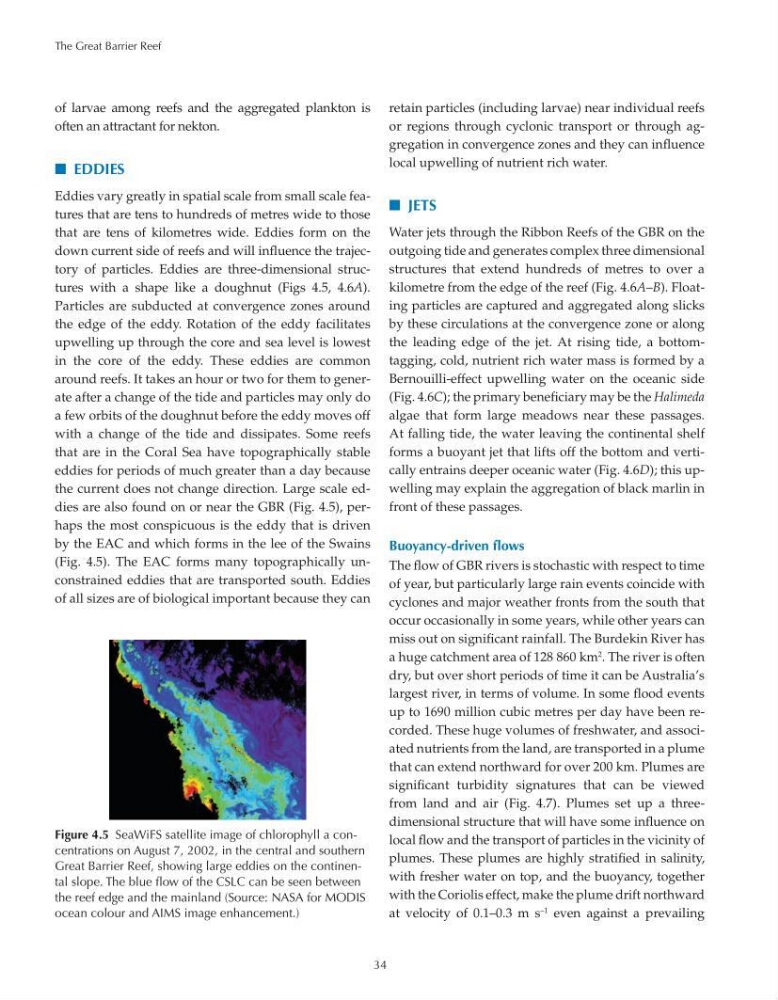
the current does not change direction. Large scale eddies are also found on or near the GBR (Fig. 4.5), perhaps the most conspicuous is the eddy that is driven
by the EAC and which forms in the lee of the Swains
(Fig. 4.5). The EAC forms many topographically unconstrained eddies that are transported south. Eddies
of all sizes are of biological important because they can
retain particles (including larvae) near individual reefs
or regions through cyclonic transport or through aggregation in convergence zones and they can influence
local upwelling of nutrient rich water.
N JETS
Water jets through the Ribbon Reefs of the GBR on the
outgoing tide and generates complex three dimensional
structures that extend hundreds of metres to over a
kilometre from the edge of the reef (Fig. 4.6A–B). Floating particles are captured and aggregated along slicks
by these circulations at the convergence zone or along
the leading edge of the jet. At rising tide, a bottomtagging, cold, nutrient rich water mass is formed by a
Bernouilli-effect upwelling water on the oceanic side
(Fig. 4.6C); the primary beneficiary may be the Halimeda
algae that form large meadows near these passages.
At falling tide, the water leaving the continental shelf
forms a buoyant jet that lifts off the bottom and vertically entrains deeper oceanic water (Fig. 4.6D); this upwelling may explain the aggregation of black marlin in
front of these passages.
Buoyancy-driven flows
The flow of GBR rivers is stochastic with respect to time
of year, but particularly large rain events coincide with
cyclones and major weather fronts from the south that
occur occasionally in some years, while other years can
miss out on significant rainfall. The Burdekin River has
a huge catchment area of 128 860 km
2 . The river is often
dry, but over short periods of time it can be Australia’s
largest river, in terms of volume. In some flood events
up to 1690 million cubic metres per day have been recorded. These huge volumes of freshwater, and associated nutrients from the land, are transported in a plume
that can extend northward for over 200 km. Plumes are
significant turbidity signatures that can be viewed
from land and air (Fig. 4.7). Plumes set up a threedimensional structure that will have some influence on
local flow and the transport of particles in the vicinity of
plumes. These plumes are highly stratified in salinity,
with fresher water on top, and the buoyancy, together
with the Coriolis effect, make the plume drift northward
at velocity of 0.1–0.3 m s
–1 even against a prevailing
Figure 4.5 SeaWiFS satellite image of chlorophyll a concentrations on August 7, 2002, in the central and southern
Great Barrier Reef, showing large eddies on the continental slope. The blue flow of the CSLC can be seen between
the reef edge and the mainland (Source: NASA for MODIS
ocean colour and AIMS image enhancement.)
34
of larvae among reefs and the aggre gated plankton is
often an attractant for nekton.
N EDDIES
Eddies vary greatly in spatial scale from small scale features that are tens to hundreds of metres wide to those
that are tens of kilometres wide. Eddies form on the
down current side of reefs and will influence the trajectory of particles. Eddies are three-dimensional structures with a shape like a doughnut (Figs 4.5, 4.6A).
Particles are subducted at convergence zones around
the edge of the eddy. Rotation of the eddy facilitates
upwelling up through the core and sea level is lowest
in the core of the eddy. These eddies are common
around reefs. It takes an hour or two for them to generate after a change of the tide and particles may only do
a few orbits of the doughnut before the eddy moves off
with a change of the tide and dissipates. Some reefs
that are in the Coral Sea have topographically stable
eddies for periods of much greater than a day because
the current does not change direction. Large scale eddies are also found on or near the GBR (Fig. 4.5), perhaps the most conspicuous is the eddy that is driven
by the EAC and which forms in the lee of the Swains
(Fig. 4.5). The EAC forms many topographically unconstrained eddies that are transported south. Eddies
of all sizes are of biological important because they can
retain particles (including larvae) near individual reefs
or regions through cyclonic transport or through aggregation in convergence zones and they can influence
local upwelling of nutrient rich water.
N JETS
Water jets through the Ribbon Reefs of the GBR on the
outgoing tide and generates complex three dimensional
structures that extend hundreds of metres to over a
kilometre from the edge of the reef (Fig. 4.6A–B). Floating particles are captured and aggregated along slicks
by these circulations at the convergence zone or along
the leading edge of the jet. At rising tide, a bottomtagging, cold, nutrient rich water mass is formed by a
Bernouilli-effect upwelling water on the oceanic side
(Fig. 4.6C); the primary beneficiary may be the Halimeda
algae that form large meadows near these passages.
At falling tide, the water leaving the continental shelf
forms a buoyant jet that lifts off the bottom and vertically entrains deeper oceanic water (Fig. 4.6D); this upwelling may explain the aggregation of black marlin in
front of these passages.
Buoyancy-driven flows
The flow of GBR rivers is stochastic with respect to time
of year, but particularly large rain events coincide with
cyclones and major weather fronts from the south that
occur occasionally in some years, while other years can
miss out on significant rainfall. The Burdekin River has
a huge catchment area of 128 860 km
2 . The river is often
dry, but over short periods of time it can be Australia’s
largest river, in terms of volume. In some flood events
up to 1690 million cubic metres per day have been recorded. These huge volumes of freshwater, and associated nutrients from the land, are transported in a plume
that can extend northward for over 200 km. Plumes are
significant turbidity signatures that can be viewed
from land and air (Fig. 4.7). Plumes set up a threedimensional structure that will have some influence on
local flow and the transport of particles in the vicinity of
plumes. These plumes are highly stratified in salinity,
with fresher water on top, and the buoyancy, together
with the Coriolis effect, make the plume drift northward
at velocity of 0.1–0.3 m s
–1 even against a prevailing
Figure 4.5 SeaWiFS satellite image of chlorophyll a concentrations on August 7, 2002, in the central and southern
Great Barrier Reef, showing large eddies on the continental slope. The blue flow of the CSLC can be seen between
the reef edge and the mainland (Source: NASA for MODIS
ocean colour and AIMS image enhancement.)