

4 – Oceanography
31
flowing East Australian Current (EAC) south of the bifurcation point and the northward flowing Coral Sea
Coastal Current (CSCC) north of the bifurcation point.
The bifurcation point fluctuates between Townsville
and Lizard Island. The EAC does enter the reef mosaic
of the GBR and generates a coastal GBR lagoon flow
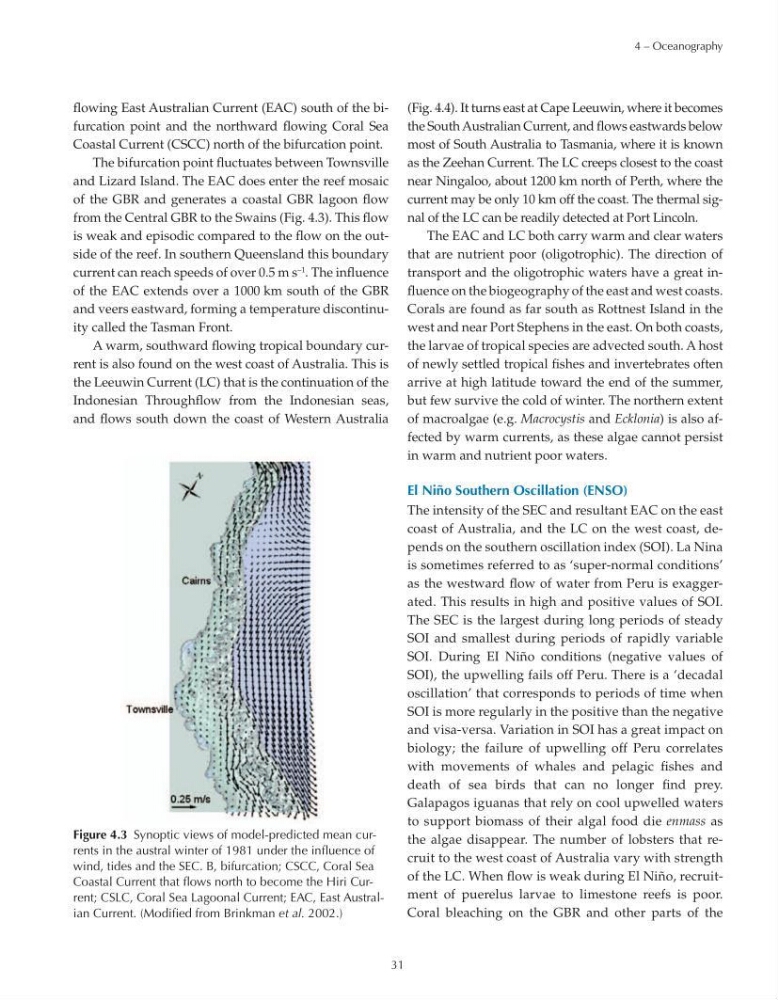
from the Central GBR to the Swains (Fig. 4.3). This flow
is weak and episodic compared to the flow on the outside of the reef. In southern Queensland this boundary
current can reach speeds of over 0.5 m s
–1 . The influence
of the EAC extends over a 1000 km south of the GBR
and veers eastward, forming a temperature discontinuity called the Tasman Front.
A warm, southward flowing tropical boundary current is also found on the west coast of Australia. This is
the Leeuwin Current (LC) that is the continuation of the
Indonesian Throughflow from the Indonesian seas,
and flows south down the coast of Western Australia
(Fig. 4.4). It turns east at Cape Leeuwin, where it becomes
the South Australian Current, and flows eastwards below
most of South Australia to Tasmania, where it is known
as the Zeehan Current. The LC creeps closest to the coast
near Ningaloo, about 1200 km north of Perth, where the
current may be only 10 km off the coast. The thermal signal of the LC can be readily detected at Port Lincoln.
The EAC and LC both carry warm and clear waters
that are nutrient poor (oligotrophic). The direction of
transport and the oligotrophic waters have a great influence on the biogeography of the east and west coasts.
Corals are found as far south as Rottnest Island in the
west and near Port Stephens in the east. On both coasts,
the larvae of tropical species are advected south. A host
of newly settled tropical fishes and invertebrates often
arrive at high latitude toward the end of the summer,
but few survive the cold of winter. The northern extent
of macroalgae (e.g. Macrocystis and Ecklonia) is also affected by warm currents, as these algae cannot persist
in warm and nutrient poor waters.
El Niño Southern Oscillation (ENSO)
The intensity of the SEC and resultant EAC on the east
coast of Australia, and the LC on the west coast, depends on the southern oscillation index (SOI). La Nina
is sometimes referred to as ‘super-normal conditions’
as the westward flow of water from Peru is exaggerated. This results in high and positive values of SOI.
The SEC is the largest during long periods of steady
SOI and smallest during periods of rapidly variable
SOI. During EI Niño conditions (negative values of
SOI), the upwelling fails off Peru. There is a ‘ decadal
oscillation’ that corresponds to periods of time when
SOI is more regularly in the positive than the negative
and visa-versa. Variation in SOI has a great impact on
biology; the failure of upwelling off Peru correlates
with movements of whales and pelagic fishes and
death of sea birds that can no longer find prey.
Galapagos iguanas that rely on cool upwelled waters
to support biomass of their algal food die enmass as
the algae disappear. The number of lobsters that recruit to the west coast of Australia vary with strength
of the LC. When flow is weak during El Niño, recruitment of puerelus larvae to limestone reefs is poor.
Coral bleaching on the GBR and other parts of the
Figure 4.3 Synoptic views of model-predicted mean currents in the austral winter of 1981 under the influence of
wind, tides and the SEC. B, bifurcation; CSCC, Coral Sea
Coastal Current that flows north to become the Hiri Current; CSLC, Coral Sea Lagoonal Current; EAC, East Australian Current. (Modified from Brinkman et al. 2002.)
31
flowing East Australian Current (EAC) south of the bifurcation point and the northward flowing Coral Sea
Coastal Current (CSCC) north of the bifurcation point.
The bifurcation point fluctuates between Townsville
and Lizard Island. The EAC does enter the reef mosaic
of the GBR and generates a coastal GBR lagoon flow
from the Central GBR to the Swains (Fig. 4.3). This flow
is weak and episodic compared to the flow on the outside of the reef. In southern Queensland this boundary
current can reach speeds of over 0.5 m s
–1 . The influence
of the EAC extends over a 1000 km south of the GBR
and veers eastward, forming a temperature discontinuity called the Tasman Front.
A warm, southward flowing tropical boundary current is also found on the west coast of Australia. This is
the Leeuwin Current (LC) that is the continuation of the
Indonesian Throughflow from the Indonesian seas,
and flows south down the coast of Western Australia
(Fig. 4.4). It turns east at Cape Leeuwin, where it becomes
the South Australian Current, and flows eastwards below
most of South Australia to Tasmania, where it is known
as the Zeehan Current. The LC creeps closest to the coast
near Ningaloo, about 1200 km north of Perth, where the
current may be only 10 km off the coast. The thermal signal of the LC can be readily detected at Port Lincoln.
The EAC and LC both carry warm and clear waters
that are nutrient poor (oligotrophic). The direction of
transport and the oligotrophic waters have a great influence on the biogeography of the east and west coasts.
Corals are found as far south as Rottnest Island in the
west and near Port Stephens in the east. On both coasts,
the larvae of tropical species are advected south. A host
of newly settled tropical fishes and invertebrates often
arrive at high latitude toward the end of the summer,
but few survive the cold of winter. The northern extent
of macroalgae (e.g. Macrocystis and Ecklonia) is also affected by warm currents, as these algae cannot persist
in warm and nutrient poor waters.
El Niño Southern Oscillation (ENSO)
The intensity of the SEC and resultant EAC on the east
coast of Australia, and the LC on the west coast, depends on the southern oscillation index (SOI). La Nina
is sometimes referred to as ‘super-normal conditions’
as the westward flow of water from Peru is exaggerated. This results in high and positive values of SOI.
The SEC is the largest during long periods of steady
SOI and smallest during periods of rapidly variable
SOI. During EI Niño conditions (negative values of
SOI), the upwelling fails off Peru. There is a ‘ decadal
oscillation’ that corresponds to periods of time when
SOI is more regularly in the positive than the negative
and visa-versa. Variation in SOI has a great impact on
biology; the failure of upwelling off Peru correlates
with movements of whales and pelagic fishes and
death of sea birds that can no longer find prey.
Galapagos iguanas that rely on cool upwelled waters
to support biomass of their algal food die enmass as
the algae disappear. The number of lobsters that recruit to the west coast of Australia vary with strength
of the LC. When flow is weak during El Niño, recruitment of puerelus larvae to limestone reefs is poor.
Coral bleaching on the GBR and other parts of the
Figure 4.3 Synoptic views of model-predicted mean currents in the austral winter of 1981 under the influence of
wind, tides and the SEC. B, bifurcation; CSCC, Coral Sea
Coastal Current that flows north to become the Hiri Current; CSLC, Coral Sea Lagoonal Current; EAC, East Australian Current. (Modified from Brinkman et al. 2002.)