

28
4. Oceanography
M. J. Kingsford & E. Wolanski
phases through to their settlement on reefs or other
habitats. Some plankton will only spawn while aggregated. Many jellyfish and larvaceans, for example, primarily spawn when concentrated in convergence
zones so that the chances of fertilisation are greatest.
Currents can move plankton to favourable or unfavourable environments and therefore influence the
connectivity of populations. This is particularly important for larval forms that must settle on coral
reefs; unfavourable currents may expatriate them from
N REEFS AND OCEANOGRAPHY
The coral reefs that form the GBR are scattered over the
continental shelf, which is shallow and fringed by the
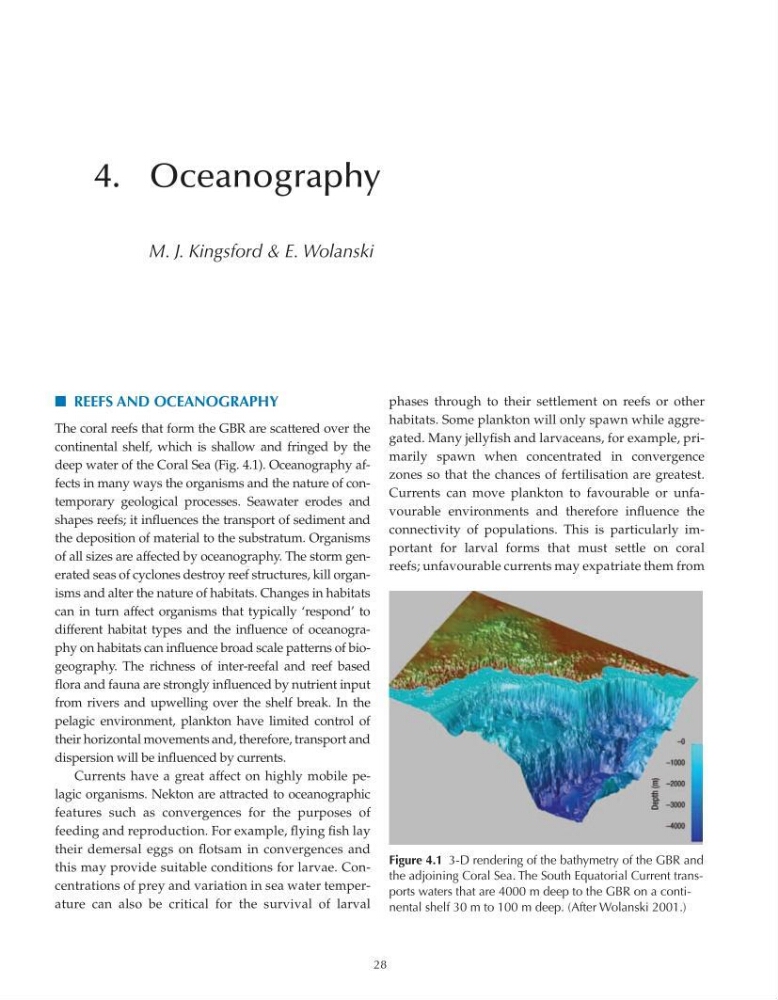
deep water of the Coral Sea (Fig. 4.1). Oceanography affects in many ways the organisms and the nature of contemporary geological processes. Seawater erodes and
shapes reefs; it influences the transport of sediment and
the deposition of material to the substratum. Organisms
of all sizes are affected by oceanography. The storm generated seas of cyclones destroy reef structures, kill organisms and alter the nature of habitats. Changes in habitats
can in turn affect organisms that typically ‘respond’ to
different habitat types and the influence of oceanography on habitats can influence broad scale patterns of biogeography. The richness of inter-reefal and reef based
flora and fauna are strongly influenced by nutrient input
from rivers and upwelling over the shelf break. In the
pelagic environment, plankton have limited control of
their horizontal movements and, therefore, transport and
dispersion will be influenced by currents.
Currents have a great affect on highly mobile pelagic organisms. Nekton are attracted to oceanographic
features such as convergences for the purposes of
feeding and reproduction. For example, flying fish lay
their demersal eggs on flotsam in convergences and
this may provide suitable conditions for larvae. Concentrations of prey and variation in sea water temperature can also be critical for the survival of larval
Figure 4.1 3-D rendering of the bathymetry of the GBR and
the adjoining Coral Sea. The South Equatorial Current transports waters that are 4000 m deep to the GBR on a continental shelf 30 m to 100 m deep. (After Wolanski 2001.)
4. Oceanography
M. J. Kingsford & E. Wolanski
phases through to their settlement on reefs or other
habitats. Some plankton will only spawn while aggregated. Many jellyfish and larvaceans, for example, primarily spawn when concentrated in convergence
zones so that the chances of fertilisation are greatest.
Currents can move plankton to favourable or unfavourable environments and therefore influence the
connectivity of populations. This is particularly important for larval forms that must settle on coral
reefs; unfavourable currents may expatriate them from
N REEFS AND OCEANOGRAPHY
The coral reefs that form the GBR are scattered over the
continental shelf, which is shallow and fringed by the
deep water of the Coral Sea (Fig. 4.1). Oceanography affects in many ways the organisms and the nature of contemporary geological processes. Seawater erodes and
shapes reefs; it influences the transport of sediment and
the deposition of material to the substratum. Organisms
of all sizes are affected by oceanography. The storm generated seas of cyclones destroy reef structures, kill organisms and alter the nature of habitats. Changes in habitats
can in turn affect organisms that typically ‘respond’ to
different habitat types and the influence of oceanography on habitats can influence broad scale patterns of biogeography. The richness of inter-reefal and reef based
flora and fauna are strongly influenced by nutrient input
from rivers and upwelling over the shelf break. In the
pelagic environment, plankton have limited control of
their horizontal movements and, therefore, transport and
dispersion will be influenced by currents.
Currents have a great affect on highly mobile pelagic organisms. Nekton are attracted to oceanographic
features such as convergences for the purposes of
feeding and reproduction. For example, flying fish lay
their demersal eggs on flotsam in convergences and
this may provide suitable conditions for larvae. Concentrations of prey and variation in sea water temperature can also be critical for the survival of larval
Figure 4.1 3-D rendering of the bathymetry of the GBR and
the adjoining Coral Sea. The South Equatorial Current transports waters that are 4000 m deep to the GBR on a continental shelf 30 m to 100 m deep. (After Wolanski 2001.)