

The Great Barrier Reef
26
sequences of drowned coral reefs occur at significant
water depths in Hawaii and the Gulf of Papua. Although
the scale of resolution is much less for these drowned
reefs, the overall picture is one of community similarity
through large intervals of geological time. When sea
level falls and a new reef grows, there is a high degree of
predictability in the coral composition of the reefs.
N EPILOGUE
Global environmental change has had a profound influence over the development of tropical coral reefs
since time immemorial, and their effects are no less
profound for the GBR. Coral growth culminating in
today’s GBR has been shaped by the natural variations
in sea level, temperature, CO 2 and other climate variables that control light levels, rainfall, turbidity and
ocean acidification. It is no wonder then that the ecology of coral and coral reef communities must be seen
as dynamic and fluid in their response to Pleistocene
sea level and climatic fluctuations.
During the last interglacial to interglacial cycle the
GBR has experienced large scale platform reef accretion
during two short intervals near the peak of each transgression. However, for more extensive periods the GBR
has been doing ‘something else’, including intervals of
(B)
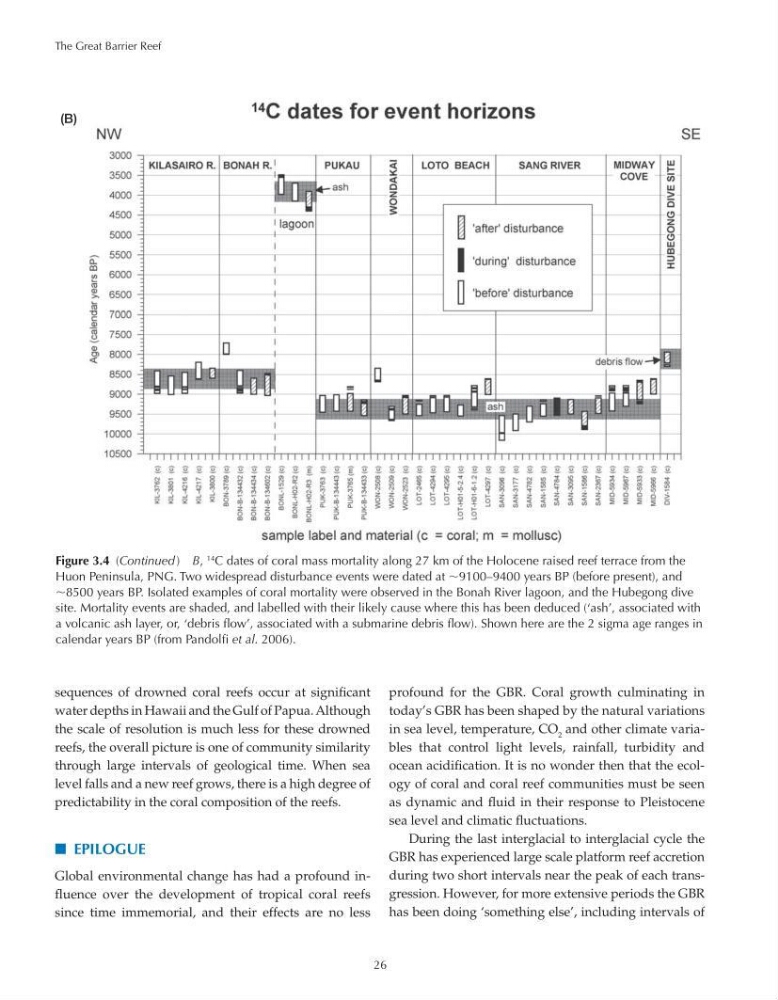
Figure 3.4 (Continued ) B,
14 C dates of coral mass mortality along 27 km of the Holocene raised reef terrace from the
Huon Peninsula, PNG. Two widespread disturbance events were dated at 9100–9400 years BP (before present), and
8500 years BP. Isolated examples of coral mortality were observed in the Bonah River lagoon, and the Hubegong dive
site. Mortality events are shaded, and labelled with their likely cause where this has been deduced (‘ash’, associated with
a volcanic ash layer, or, ‘debris flow’, associated with a submarine debris flow). Shown here are the 2 sigma age ranges in
calendar years BP (from Pandolfi et al. 2006).
26
sequences of drowned coral reefs occur at significant
water depths in Hawaii and the Gulf of Papua. Although
the scale of resolution is much less for these drowned
reefs, the overall picture is one of community similarity
through large intervals of geological time. When sea
level falls and a new reef grows, there is a high degree of
predictability in the coral composition of the reefs.
N EPILOGUE
Global environmental change has had a profound influence over the development of tropical coral reefs
since time immemorial, and their effects are no less
profound for the GBR. Coral growth culminating in
today’s GBR has been shaped by the natural variations
in sea level, temperature, CO 2 and other climate variables that control light levels, rainfall, turbidity and
ocean acidification. It is no wonder then that the ecology of coral and coral reef communities must be seen
as dynamic and fluid in their response to Pleistocene
sea level and climatic fluctuations.
During the last interglacial to interglacial cycle the
GBR has experienced large scale platform reef accretion
during two short intervals near the peak of each transgression. However, for more extensive periods the GBR
has been doing ‘something else’, including intervals of
(B)
Figure 3.4 (Continued ) B,
14 C dates of coral mass mortality along 27 km of the Holocene raised reef terrace from the
Huon Peninsula, PNG. Two widespread disturbance events were dated at 9100–9400 years BP (before present), and
8500 years BP. Isolated examples of coral mortality were observed in the Bonah River lagoon, and the Hubegong dive
site. Mortality events are shaded, and labelled with their likely cause where this has been deduced (‘ash’, associated with
a volcanic ash layer, or, ‘debris flow’, associated with a submarine debris flow). Shown here are the 2 sigma age ranges in
calendar years BP (from Pandolfi et al. 2006).