

The Great Barrier Reef
268
(A)
(B)
(C)
(D)
(E)
(F)
(G)
(H)
(I)
(J)
(K)
(L)
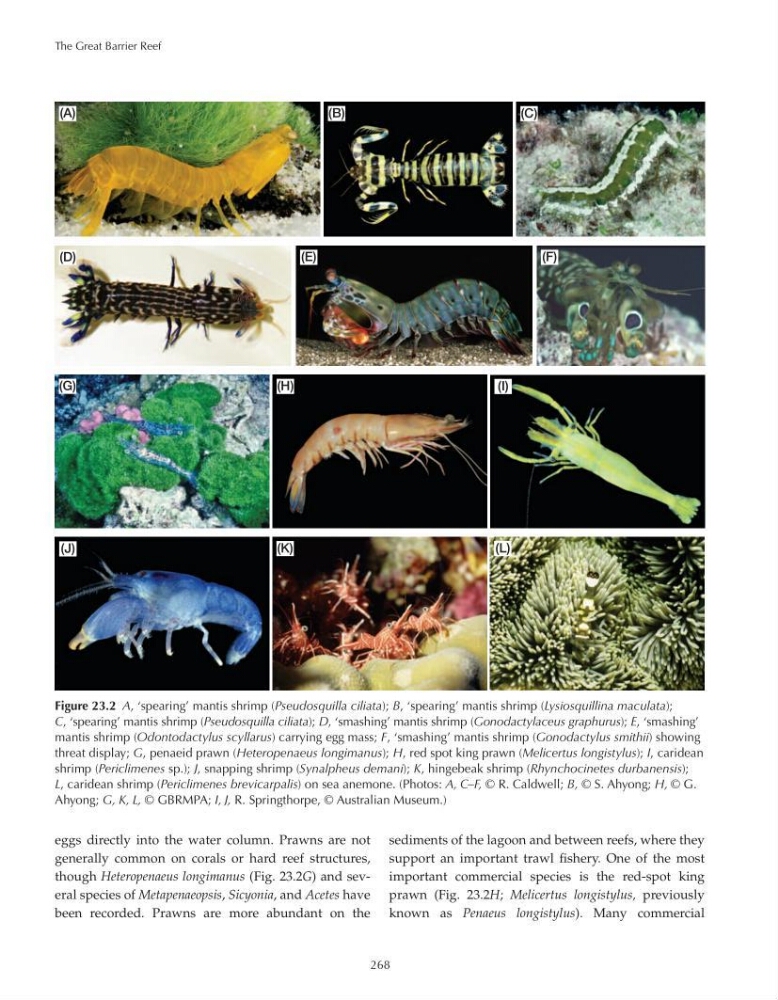
Figure 23.2 A, ‘spearing’ mantis shrimp (Pseudosquilla ciliata); B, ‘spearing’ mantis shrimp (Lysiosquillina maculata);
C, ‘spearing’ mantis shrimp (Pseudosquilla ciliata); D, ‘smashing’ mantis shrimp (Gonodactylaceus graphurus); E, ‘smashing’
mantis shrimp (Odontodactylus scyllarus) carrying egg mass; F, ‘smashing’ mantis shrimp (Gonodactylus smithii) showing
threat display; G, penaeid prawn (Heteropenaeus longimanus); H, red spot king prawn (Melicertus longistylus); I, caridean
shrimp (Periclimenes sp.); J, snapping shrimp (Synalpheus demani); K, hingebeak shrimp (Rhynchocinetes durbanensis);
L, caridean shrimp (Periclimenes brevicarpalis) on sea anemone. (Photos: A, C–F, © R. Caldwell; B, © S. Ahyong; H, © G.
Ahyong; G, K, L, © GBRMPA; I, J, R. Springthorpe, © Australian Museum.)
eggs directly into the water column. Prawns are not
generally common on corals or hard reef structures,
though Heteropenaeus longimanus (Fig. 23.2G) and several species of Metapenaeopsis, Sicyonia, and Acetes have
been recorded. Prawns are more abundant on the
sediments of the lagoon and between reefs, where they
support an important trawl fishery. One of the most
important commercial species is the red-spot king
prawn (Fig. 23.2H; Melicertus longistylus, previously
known as Penaeus longistylus). Many commercial
268
(A)
(B)
(C)
(D)
(E)
(F)
(G)
(H)
(I)
(J)
(K)
(L)
Figure 23.2 A, ‘spearing’ mantis shrimp (Pseudosquilla ciliata); B, ‘spearing’ mantis shrimp (Lysiosquillina maculata);
C, ‘spearing’ mantis shrimp (Pseudosquilla ciliata); D, ‘smashing’ mantis shrimp (Gonodactylaceus graphurus); E, ‘smashing’
mantis shrimp (Odontodactylus scyllarus) carrying egg mass; F, ‘smashing’ mantis shrimp (Gonodactylus smithii) showing
threat display; G, penaeid prawn (Heteropenaeus longimanus); H, red spot king prawn (Melicertus longistylus); I, caridean
shrimp (Periclimenes sp.); J, snapping shrimp (Synalpheus demani); K, hingebeak shrimp (Rhynchocinetes durbanensis);
L, caridean shrimp (Periclimenes brevicarpalis) on sea anemone. (Photos: A, C–F, © R. Caldwell; B, © S. Ahyong; H, © G.
Ahyong; G, K, L, © GBRMPA; I, J, R. Springthorpe, © Australian Museum.)
eggs directly into the water column. Prawns are not
generally common on corals or hard reef structures,
though Heteropenaeus longimanus (Fig. 23.2G) and several species of Metapenaeopsis, Sicyonia, and Acetes have
been recorded. Prawns are more abundant on the
sediments of the lagoon and between reefs, where they
support an important trawl fishery. One of the most
important commercial species is the red-spot king
prawn (Fig. 23.2H; Melicertus longistylus, previously
known as Penaeus longistylus). Many commercial