

The Great Barrier Reef
244
they are hollow, but this tubular nature is not to be confused with the soft, cross-chambered central core of the
holaxonians. Internodes can be coloured, and although
they may be quite smooth, they are often ornamented
with prickles and ridges. The nodes that alternate with
the internodes consist of pure gorgonin. Colonies can be
whip-like, but are usually profusely branched, bushy or
fan-like, but rarely net-like. Polyps can be retractile or
non-retractile. If non-retractile, they are commonly covered with broad scales, narrow rods or needles. If retractile, the polyps either have no sclerites or are armed
with spindles in a collaret and points arrangement.
(A)
(B)
(C)
0.1 mm
Subsurface
Surface
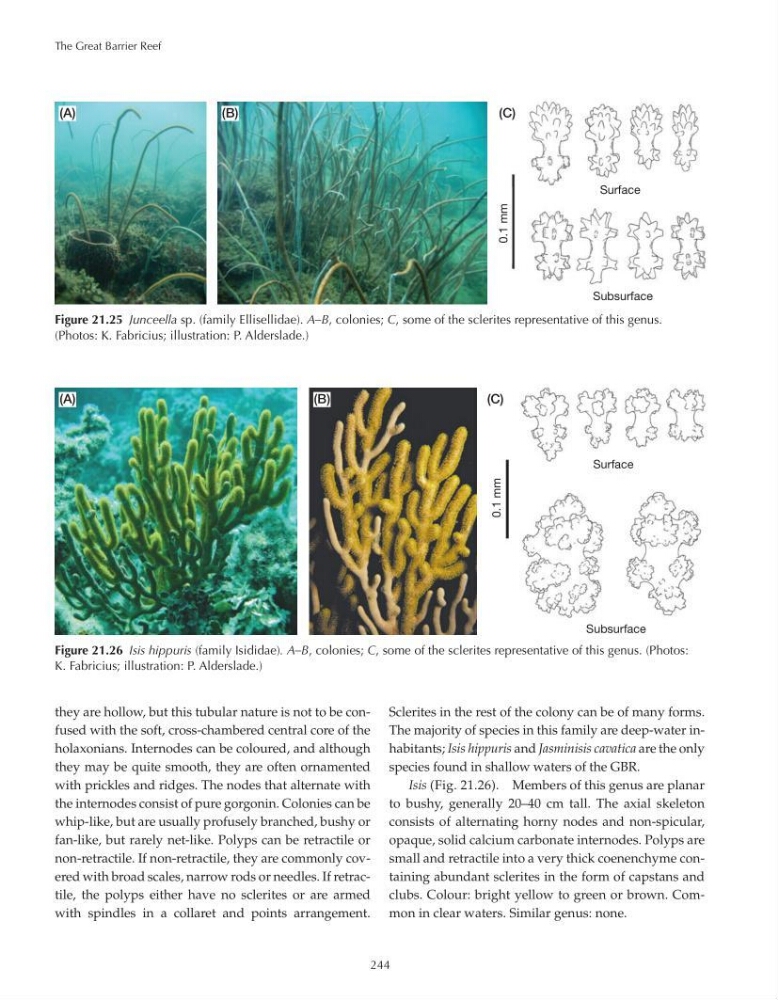
Figure 21.25 Junceella sp. (family Ellisellidae). A–B, colonies; C, some of the sclerites representative of this genus.
( Photos: K. Fabricius; illustration: P. Alderslade.)
Sclerites in the rest of the colony can be of many forms.
The majority of species in this family are deep-water inhabitants; Isis hippuris and Jasminisis cavatica are the only
species found in shallow waters of the GBR.
Isis (Fig. 21.26). Members of this genus are planar
to bushy, generally 20–40 cm tall. The axial skeleton
consists of alternating horny nodes and non-spicular,
opaque, solid calcium carbonate internodes. Polyps are
small and retractile into a very thick coenenchyme containing abundant sclerites in the form of capstans and
clubs. Colour: bright yellow to green or brown. Common in clear waters. Similar genus: none.
(A)
(B)
(C)
0.1 mm
Subsurface
Surface
Figure 21.26 Isis hippuris (family Isididae). A–B, colonies; C, some of the sclerites representative of this genus. (Photos:
K. Fabricius; illustration: P. Alderslade.)
244
they are hollow, but this tubular nature is not to be confused with the soft, cross-chambered central core of the
holaxonians. Internodes can be coloured, and although
they may be quite smooth, they are often ornamented
with prickles and ridges. The nodes that alternate with
the internodes consist of pure gorgonin. Colonies can be
whip-like, but are usually profusely branched, bushy or
fan-like, but rarely net-like. Polyps can be retractile or
non-retractile. If non-retractile, they are commonly covered with broad scales, narrow rods or needles. If retractile, the polyps either have no sclerites or are armed
with spindles in a collaret and points arrangement.
(A)
(B)
(C)
0.1 mm
Subsurface
Surface
Figure 21.25 Junceella sp. (family Ellisellidae). A–B, colonies; C, some of the sclerites representative of this genus.
( Photos: K. Fabricius; illustration: P. Alderslade.)
Sclerites in the rest of the colony can be of many forms.
The majority of species in this family are deep-water inhabitants; Isis hippuris and Jasminisis cavatica are the only
species found in shallow waters of the GBR.
Isis (Fig. 21.26). Members of this genus are planar
to bushy, generally 20–40 cm tall. The axial skeleton
consists of alternating horny nodes and non-spicular,
opaque, solid calcium carbonate internodes. Polyps are
small and retractile into a very thick coenenchyme containing abundant sclerites in the form of capstans and
clubs. Colour: bright yellow to green or brown. Common in clear waters. Similar genus: none.
(A)
(B)
(C)
0.1 mm
Subsurface
Surface
Figure 21.26 Isis hippuris (family Isididae). A–B, colonies; C, some of the sclerites representative of this genus. (Photos:
K. Fabricius; illustration: P. Alderslade.)