

The Great Barrier Reef
240
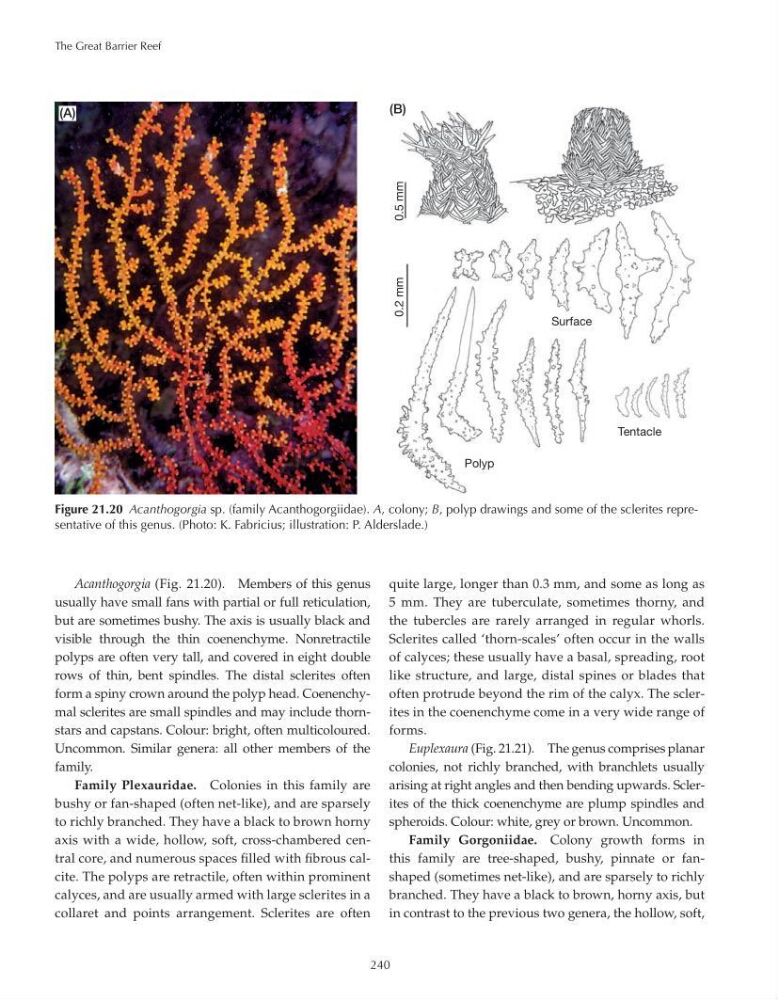
Acanthogorgia (Fig. 21.20). Members of this genus
usually have small fans with partial or full reticulation,
but are sometimes bushy. The axis is usually black and
visible through the thin coenenchyme. Nonretractile
polyps are often very tall, and covered in eight double
rows of thin, bent spindles. The distal sclerites often
form a spiny crown around the polyp head. Coenenchymal sclerites are small spindles and may include thornstars and capstans. Colour: bright, often multicoloured.
Uncommon. Similar genera: all other members of the
family.
Family Plexauridae. Colonies in this family are
bushy or fan-shaped (often net-like), and are sparsely
to richly branched. They have a black to brown horny
axis with a wide, hollow, soft, cross-chambered central core, and numerous spaces filled with fibrous calcite. The polyps are retractile, often within prominent
calyces, and are usually armed with large sclerites in a
collaret and points arrangement. Sclerites are often
quite large, longer than 0.3 mm, and some as long as
5 mm. They are tuberculate, sometimes thorny, and
the tubercles are rarely arranged in regular whorls.
Sclerites called ‘thorn-scales’ often occur in the walls
of calyces; these usually have a basal, spreading, root
like structure, and large, distal spines or blades that
often protrude beyond the rim of the calyx. The sclerites in the coenenchyme come in a very wide range of
forms.
Euplexaura (Fig. 21.21). The genus comprises planar
colonies, not richly branched, with branchlets usually
arising at right angles and then bending upwards. Sclerites of the thick coenenchyme are plump spindles and
spheroids. Colour: white, grey or brown. Uncommon.
Family Gorgoniidae. Colony growth forms in
this family are tree-shaped, bushy, pinnate or fanshaped (sometimes net-like), and are sparsely to richly
branched. They have a black to brown, horny axis, but
in contrast to the previous two genera, the hollow, soft,
Figure 21.20 Acanthogorgia sp. (family Acanthogorgiidae). A, colony; B, polyp drawings and some of the sclerites representative of this genus. (Photo: K. Fabricius; illustration: P. Alderslade.)
(A)
(B)
Surface
Tentacle
Polyp
0.2 mm
0.5 mm
240
Acanthogorgia (Fig. 21.20). Members of this genus
usually have small fans with partial or full reticulation,
but are sometimes bushy. The axis is usually black and
visible through the thin coenenchyme. Nonretractile
polyps are often very tall, and covered in eight double
rows of thin, bent spindles. The distal sclerites often
form a spiny crown around the polyp head. Coenenchymal sclerites are small spindles and may include thornstars and capstans. Colour: bright, often multicoloured.
Uncommon. Similar genera: all other members of the
family.
Family Plexauridae. Colonies in this family are
bushy or fan-shaped (often net-like), and are sparsely
to richly branched. They have a black to brown horny
axis with a wide, hollow, soft, cross-chambered central core, and numerous spaces filled with fibrous calcite. The polyps are retractile, often within prominent
calyces, and are usually armed with large sclerites in a
collaret and points arrangement. Sclerites are often
quite large, longer than 0.3 mm, and some as long as
5 mm. They are tuberculate, sometimes thorny, and
the tubercles are rarely arranged in regular whorls.
Sclerites called ‘thorn-scales’ often occur in the walls
of calyces; these usually have a basal, spreading, root
like structure, and large, distal spines or blades that
often protrude beyond the rim of the calyx. The sclerites in the coenenchyme come in a very wide range of
forms.
Euplexaura (Fig. 21.21). The genus comprises planar
colonies, not richly branched, with branchlets usually
arising at right angles and then bending upwards. Sclerites of the thick coenenchyme are plump spindles and
spheroids. Colour: white, grey or brown. Uncommon.
Family Gorgoniidae. Colony growth forms in
this family are tree-shaped, bushy, pinnate or fanshaped (sometimes net-like), and are sparsely to richly
branched. They have a black to brown, horny axis, but
in contrast to the previous two genera, the hollow, soft,
Figure 21.20 Acanthogorgia sp. (family Acanthogorgiidae). A, colony; B, polyp drawings and some of the sclerites representative of this genus. (Photo: K. Fabricius; illustration: P. Alderslade.)
(A)
(B)
Surface
Tentacle
Polyp
0.2 mm
0.5 mm