

The Great Barrier Reef
10
Marine Park. Most are small (average 1 km
2 ) and in
total they cover only 350 km
2 . In addition there may
be up to 100 small inshore reefs and shoals, only a
few of which have been mapped because of the turbidity of the waters in which they are found. Fringing
reefs attached to the mainland occur in the Whitsunday area and north of Cairns, probably the best known
being those of Cape Tribulation. However, the majority are attached to the high continental islands of the
inner shelf and their location puts them within the
zero isobase of hydro-isostatic uplift. Some of the
oldest reef flat dates on the GBR are found on these
reefs (6000 yrs BP) and inner flats are frequently
composed of raised microatolls indicative of a 1.5 m
higher sea level. Similar to the outer reefs, the fringing reefs had commenced Holocene growth by
9000 yrs BP and accumulated much of their structure
by 5500 yrs BP.
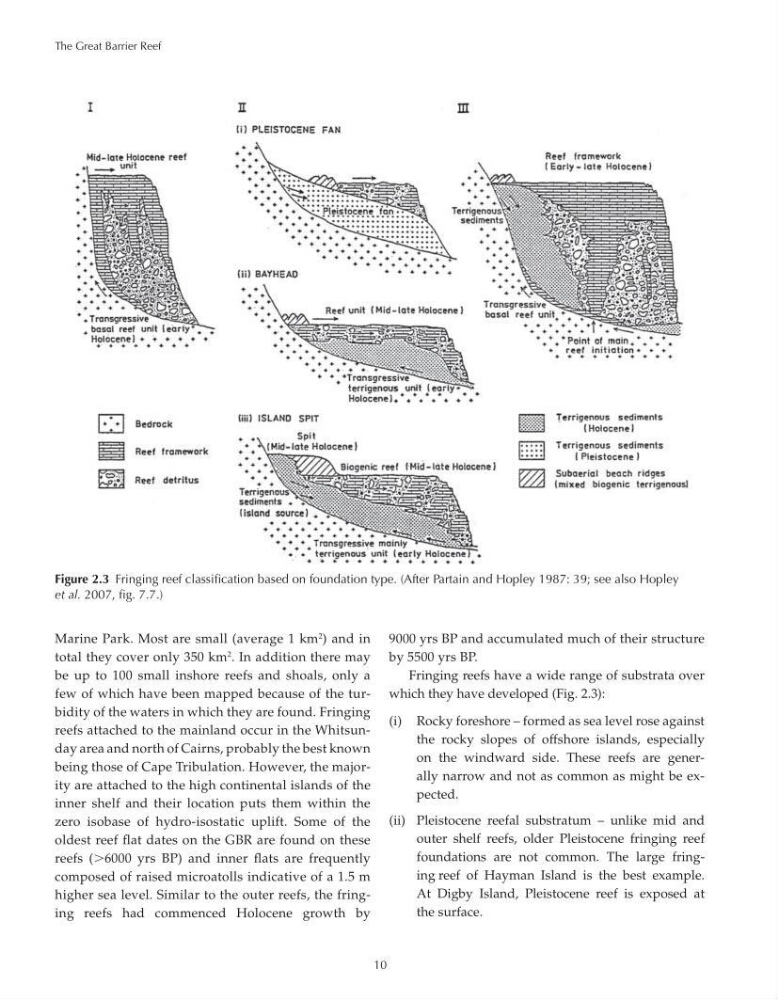
Fringing reefs have a wide range of substrata over
which they have developed (Fig. 2.3):
(i) Rocky foreshore – formed as sea level rose against
the rocky slopes of offshore islands, especially
on the windward side. These reefs are generally narrow and not as common as might be expected.
(ii) Pleistocene reefal substratum – unlike mid and
outer shelf reefs, older Pleistocene fringing reef
foundations are not common. The large fringing reef of Hayman Island is the best example.
At Digby Island, Pleistocene reef is exposed at
the surface.
Figure 2.3 Fringing reef classification based on foundation type. (After Partain and Hopley 1987: 39; see also Hopley
et al. 2007, fig. 7.7.)
10
Marine Park. Most are small (average 1 km
2 ) and in
total they cover only 350 km
2 . In addition there may
be up to 100 small inshore reefs and shoals, only a
few of which have been mapped because of the turbidity of the waters in which they are found. Fringing
reefs attached to the mainland occur in the Whitsunday area and north of Cairns, probably the best known
being those of Cape Tribulation. However, the majority are attached to the high continental islands of the
inner shelf and their location puts them within the
zero isobase of hydro-isostatic uplift. Some of the
oldest reef flat dates on the GBR are found on these
reefs (6000 yrs BP) and inner flats are frequently
composed of raised microatolls indicative of a 1.5 m
higher sea level. Similar to the outer reefs, the fringing reefs had commenced Holocene growth by
9000 yrs BP and accumulated much of their structure
by 5500 yrs BP.
Fringing reefs have a wide range of substrata over
which they have developed (Fig. 2.3):
(i) Rocky foreshore – formed as sea level rose against
the rocky slopes of offshore islands, especially
on the windward side. These reefs are generally narrow and not as common as might be expected.
(ii) Pleistocene reefal substratum – unlike mid and
outer shelf reefs, older Pleistocene fringing reef
foundations are not common. The large fringing reef of Hayman Island is the best example.
At Digby Island, Pleistocene reef is exposed at
the surface.
Figure 2.3 Fringing reef classification based on foundation type. (After Partain and Hopley 1987: 39; see also Hopley
et al. 2007, fig. 7.7.)