

222
21. Octocorals
P. Alderslade and K. Fabricius
N TAXONOMIC OVERVIEW
Octocorals are sessile animals with a mobile larval
phase that are only found in marine systems. Octocorallia are a subclass within the Class Anthozoa. The distinguishing characteristic of this subclass is that their
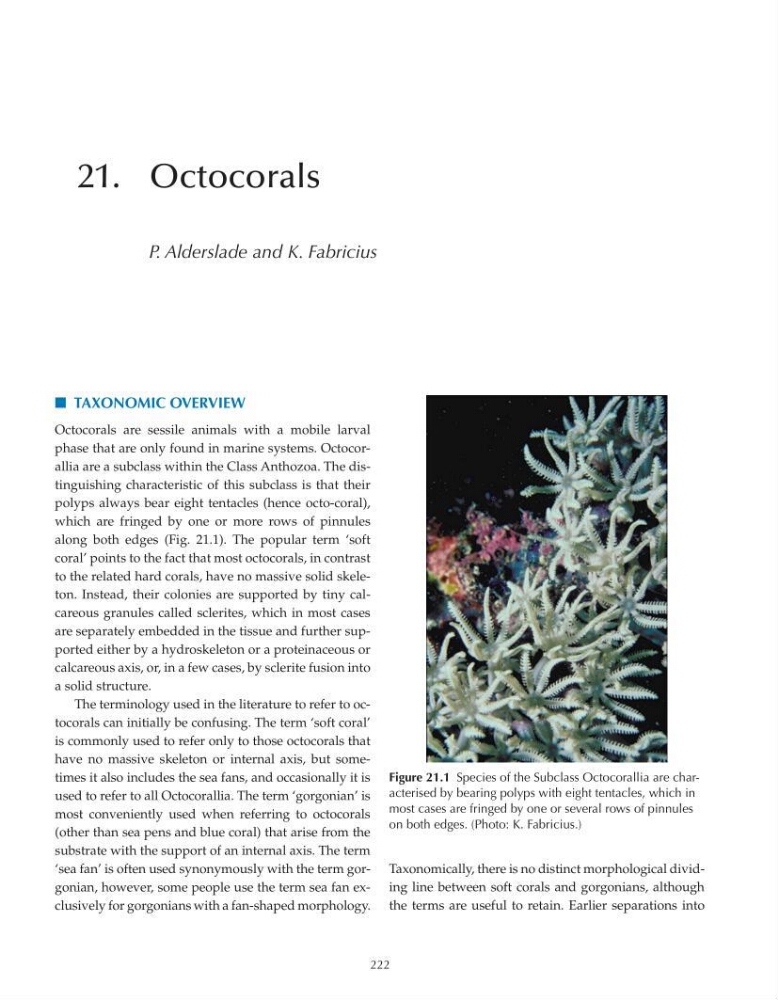
polyps always bear eight tentacles (hence octo-coral),
which are fringed by one or more rows of pinnules
along both edges (Fig. 21.1). The popular term ‘soft
coral’ points to the fact that most octocorals, in contrast
to the related hard corals, have no massive solid skeleton. Instead, their colonies are supported by tiny calcareous granules called sclerites, which in most cases
are separately embedded in the tissue and further supported either by a hydroskeleton or a proteinaceous or
calcareous axis, or, in a few cases, by sclerite fusion into
a solid structure.
The terminology used in the literature to refer to octocorals can initially be confusing. The term ‘soft coral’
is commonly used to refer only to those octocorals that
have no massive skeleton or internal axis, but sometimes it also includes the sea fans, and occasionally it is
used to refer to all Octocorallia. The term ‘gorgonian’ is
most conveniently used when referring to octocorals
(other than sea pens and blue coral) that arise from the
substrate with the support of an internal axis. The term
‘sea fan’ is often used synonymously with the term gorgonian, however, some people use the term sea fan exclusively for gorgonians with a fan-shaped morphology.
Taxonomically, there is no distinct morphological dividing line between soft corals and gorgonians, although
the terms are useful to retain. Earlier separa tions into
Figure 21.1 Species of the Subclass Octocorallia are characterised by bearing polyps with eight tentacles, which in
most cases are fringed by one or several rows of pinnules
on both edges. (Photo: K. Fabricius.)
21. Octocorals
P. Alderslade and K. Fabricius
N TAXONOMIC OVERVIEW
Octocorals are sessile animals with a mobile larval
phase that are only found in marine systems. Octocorallia are a subclass within the Class Anthozoa. The distinguishing characteristic of this subclass is that their
polyps always bear eight tentacles (hence octo-coral),
which are fringed by one or more rows of pinnules
along both edges (Fig. 21.1). The popular term ‘soft
coral’ points to the fact that most octocorals, in contrast
to the related hard corals, have no massive solid skeleton. Instead, their colonies are supported by tiny calcareous granules called sclerites, which in most cases
are separately embedded in the tissue and further supported either by a hydroskeleton or a proteinaceous or
calcareous axis, or, in a few cases, by sclerite fusion into
a solid structure.
The terminology used in the literature to refer to octocorals can initially be confusing. The term ‘soft coral’
is commonly used to refer only to those octocorals that
have no massive skeleton or internal axis, but sometimes it also includes the sea fans, and occasionally it is
used to refer to all Octocorallia. The term ‘gorgonian’ is
most conveniently used when referring to octocorals
(other than sea pens and blue coral) that arise from the
substrate with the support of an internal axis. The term
‘sea fan’ is often used synonymously with the term gorgonian, however, some people use the term sea fan exclusively for gorgonians with a fan-shaped morphology.
Taxonomically, there is no distinct morphological dividing line between soft corals and gorgonians, although
the terms are useful to retain. Earlier separa tions into
Figure 21.1 Species of the Subclass Octocorallia are characterised by bearing polyps with eight tentacles, which in
most cases are fringed by one or several rows of pinnules
on both edges. (Photo: K. Fabricius.)