

2 – Geomorphology of Coral Reefs with Special Reference to the Great Barrier Reef
7
Light may become a factor in determining the morphology in nearshore turbid environments. In turbid
waters the whole ecomorphological zonation may be
vertically compressed and colonial morphology that
encourages sediment shedding dominates.
N THE GREAT BARRIER REEF
The GBR (Fig. 2.2) is the largest marine province in the
world and has great geomorphological diversity, lacking
only open ocean atolls. From 9°15S the GBR extends
southwards off the coast of Queensland to Lady Elliott
Island at 24°07S, a latitudinal spread of 14°52. The outer
perimeter of the reef province is about 2300 km. The
outer reefs vary greatly in distance from the mainland
coast, approaching within 23 km at 14°S to a maximum
of 260 km at 21°S. On the wider shelf, reefs are established on the outer third with a wide area of reefless sea
floor at depths of between 20 m and 40 m but with a very
gentle slope. In the north, reefs occupy a much greater
proportion of the shelf but a narrow reefless ‘shipping
channel’ can still be recognised. The outer edge of the
GBR lies on the shoulder of the continental shelf in water
depths of up to 100 m, beyond which the sea floor falls
away almost vertically in the north, more gently in
the central and southernmost GBR (Bunker-Capricorn
Group) and in a step-like fashion off the southern-central
GBR in the vicinity of the Pompey Reefs.
Dimensions of the GBR are often related to those of
the Great Barrier Reef Marine Park (345 500 km
2 ) and
the GBR World Heritage Area (348 000 km
2 ) both of
which end at 10°45S and thus do not include the reefs
of Torres Strait. Within the GBRMP the area of continental shelf is approximately 224 000 km
2
, the area of
reefs and shoals of 20 055 km
2 making up about 9% of
the total area. Although it is sometimes difficult to
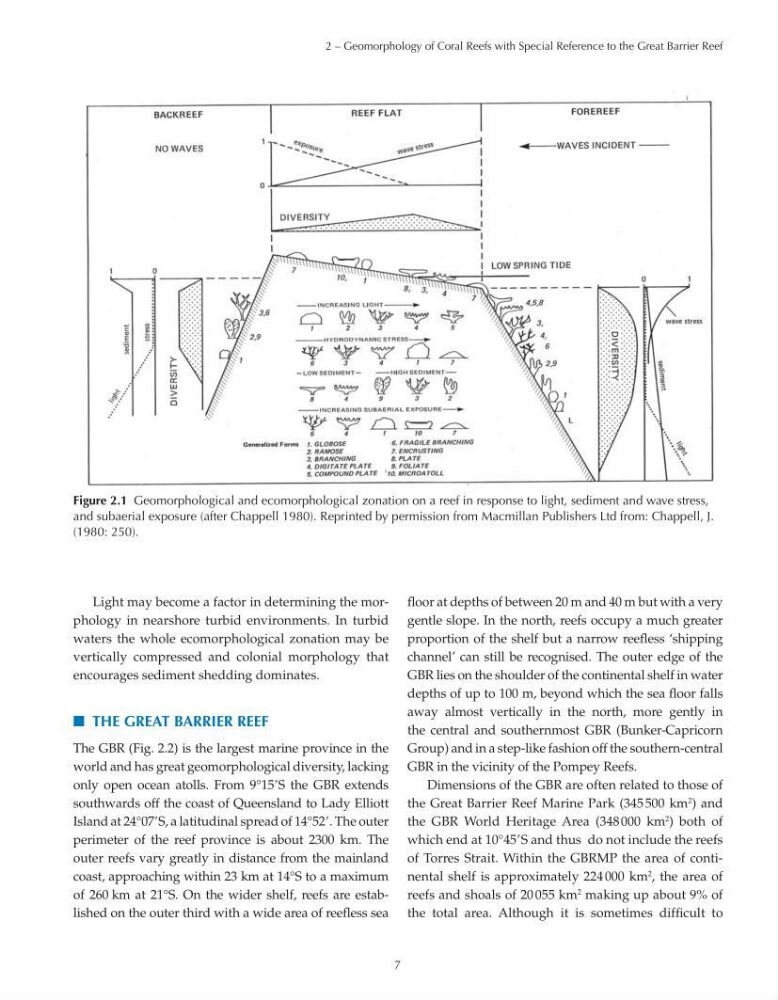
Figure 2.1 Geomorphological and ecomorphological zonation on a reef in response to light, sediment and wave stress,
and subaerial exposure (after Chappell 1980). Reprinted by permission from Macmillan Publishers Ltd from: Chappell, J.
(1980: 250).
7
Light may become a factor in determining the morphology in nearshore turbid environments. In turbid
waters the whole ecomorphological zonation may be
vertically compressed and colonial morphology that
encourages sediment shedding dominates.
N THE GREAT BARRIER REEF
The GBR (Fig. 2.2) is the largest marine province in the
world and has great geomorphological diversity, lacking
only open ocean atolls. From 9°15S the GBR extends
southwards off the coast of Queensland to Lady Elliott
Island at 24°07S, a latitudinal spread of 14°52. The outer
perimeter of the reef province is about 2300 km. The
outer reefs vary greatly in distance from the mainland
coast, approaching within 23 km at 14°S to a maximum
of 260 km at 21°S. On the wider shelf, reefs are established on the outer third with a wide area of reefless sea
floor at depths of between 20 m and 40 m but with a very
gentle slope. In the north, reefs occupy a much greater
proportion of the shelf but a narrow reefless ‘shipping
channel’ can still be recognised. The outer edge of the
GBR lies on the shoulder of the continental shelf in water
depths of up to 100 m, beyond which the sea floor falls
away almost vertically in the north, more gently in
the central and southernmost GBR (Bunker-Capricorn
Group) and in a step-like fashion off the southern-central
GBR in the vicinity of the Pompey Reefs.
Dimensions of the GBR are often related to those of
the Great Barrier Reef Marine Park (345 500 km
2 ) and
the GBR World Heritage Area (348 000 km
2 ) both of
which end at 10°45S and thus do not include the reefs
of Torres Strait. Within the GBRMP the area of continental shelf is approximately 224 000 km
2
, the area of
reefs and shoals of 20 055 km
2 making up about 9% of
the total area. Although it is sometimes difficult to
Figure 2.1 Geomorphological and ecomorphological zonation on a reef in response to light, sediment and wave stress,
and subaerial exposure (after Chappell 1980). Reprinted by permission from Macmillan Publishers Ltd from: Chappell, J.
(1980: 250).