

The Great Barrier Reef
196
change. Water quality conditions that threaten the survival of some organisms may facilitate the development of jellyfish blooms. Numerous examples exist
around the world where jellyfish have essentially
‘flipped’ the local ecosystem, becoming the dominant
predator. In this capacity, jellyfish can have direct and
indirect effects on other species. For example, they may
eat the larvae of other species as well as the food of
these larvae (that, in turn, influences larval survival).
N PREDATION AND DEFENSE
Most medusae and ctenophores will eat a diversity
of plankton and some nekton. They are typically carnivorous, preferring zooplankton prey rather than
phytoplankton. Their own kind can be also be on the
menu. Cyanea spp. (lions mane) eat Aurelia and other
medusae, while the ctenophore Beroe preys on other
ctenophores such as Pleurobrachia. Some species of
‘blubbers’ (Order Rhizostomeae) have symbiotic algae
(zooxanthellae) in their tissues, similar to those of
corals. These symbiotic jellyfishes are typically found
in warm shallow waters, where they ‘farm’ their algal
symbionts; the jellyfish may obtain a significant portion of its nutritional requirements from its algae.
Some jellyfish have definite feeding preferences.
For example, one species of box jellyfish from the GBR
region has been demonstrated to change its dietary
habits as it grows, starting out preferring prawns, and
switching to fish later in life.
While the huge appetites of jellyfish make them
fearsome predators, their soft bodies also make them an
easy meal. Turtles, crabs, many fishes, such as sunfish
and triggerfish, and seabirds actively hunt jellyfishes.
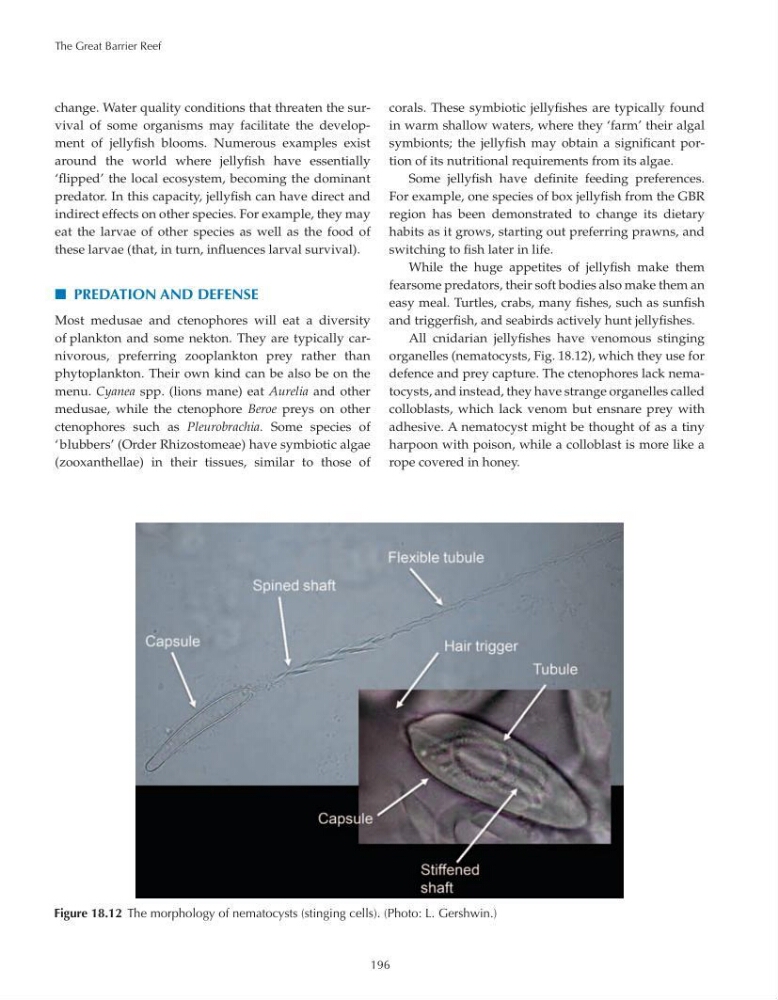
All cnidarian jellyfishes have venomous stinging
organelles (nematocysts, Fig. 18.12), which they use for
defence and prey capture. The ctenophores lack nematocysts, and instead, they have strange organelles called
colloblasts, which lack venom but ensnare prey with
adhesive. A nematocyst might be thought of as a tiny
harpoon with poison, while a colloblast is more like a
rope covered in honey.
Figure 18.12 The morphology of nematocysts (stinging cells). (Photo: L. Gershwin.)
196
change. Water quality conditions that threaten the survival of some organisms may facilitate the development of jellyfish blooms. Numerous examples exist
around the world where jellyfish have essentially
‘flipped’ the local ecosystem, becoming the dominant
predator. In this capacity, jellyfish can have direct and
indirect effects on other species. For example, they may
eat the larvae of other species as well as the food of
these larvae (that, in turn, influences larval survival).
N PREDATION AND DEFENSE
Most medusae and ctenophores will eat a diversity
of plankton and some nekton. They are typically carnivorous, preferring zooplankton prey rather than
phytoplankton. Their own kind can be also be on the
menu. Cyanea spp. (lions mane) eat Aurelia and other
medusae, while the ctenophore Beroe preys on other
ctenophores such as Pleurobrachia. Some species of
‘blubbers’ (Order Rhizostomeae) have symbiotic algae
(zooxanthellae) in their tissues, similar to those of
corals. These symbiotic jellyfishes are typically found
in warm shallow waters, where they ‘farm’ their algal
symbionts; the jellyfish may obtain a significant portion of its nutritional requirements from its algae.
Some jellyfish have definite feeding preferences.
For example, one species of box jellyfish from the GBR
region has been demonstrated to change its dietary
habits as it grows, starting out preferring prawns, and
switching to fish later in life.
While the huge appetites of jellyfish make them
fearsome predators, their soft bodies also make them an
easy meal. Turtles, crabs, many fishes, such as sunfish
and triggerfish, and seabirds actively hunt jellyfishes.
All cnidarian jellyfishes have venomous stinging
organelles (nematocysts, Fig. 18.12), which they use for
defence and prey capture. The ctenophores lack nematocysts, and instead, they have strange organelles called
colloblasts, which lack venom but ensnare prey with
adhesive. A nematocyst might be thought of as a tiny
harpoon with poison, while a colloblast is more like a
rope covered in honey.
Figure 18.12 The morphology of nematocysts (stinging cells). (Photo: L. Gershwin.)