

17 – Sponges
185
BOX 17.2 SPONGE FARMING
Sponges have been used for cosmetic, bath, or industrial applications since early Grecian
times (one early reference is in Homer’s The Iliad). However, modern supply, which is
predominantly from wild harvest fisheries, is unable to meet a well-established global
demand. This shortfall presents an opportunity for sponge production through in-sea
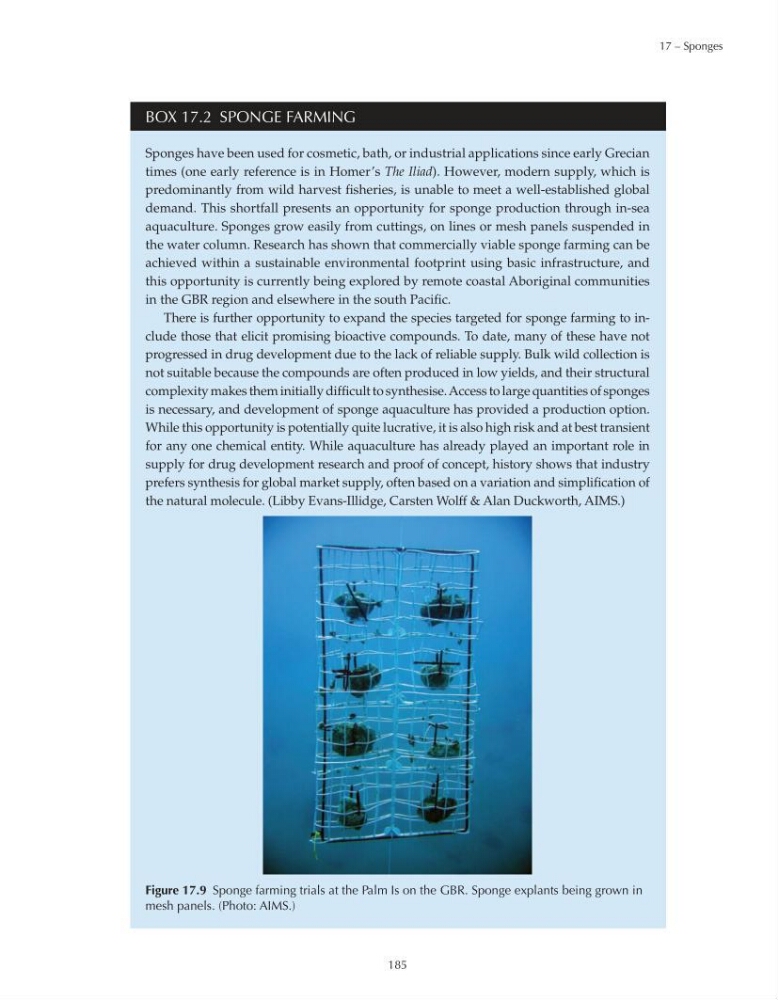
aquaculture. Sponges grow easily from cuttings, on lines or mesh panels suspended in
the water column. Research has shown that commercially viable sponge farming can be
achieved within a sustainable environmental footprint using basic infrastructure, and
this opportunity is currently being explored by remote coastal Aboriginal communities
in the GBR region and elsewhere in the south Pacific.
There is further opportunity to expand the species targeted for sponge farming to include those that elicit promising bioactive compounds. To date, many of these have not
progressed in drug development due to the lack of reliable supply. Bulk wild collection is
not suitable because the compounds are often produced in low yields, and their structural
complexity makes them initially difficult to synthesise. Access to large quantities of sponges
is necessary, and development of sponge aquaculture has provided a production option.
While this opportunity is potentially quite lucrative, it is also high risk and at best transient
for any one chemical entity. While aquaculture has already played an important role in
supply for drug development research and proof of concept, history shows that industry
prefers synthesis for global market supply, often based on a variation and simplification of
the natural molecule. (Libby Evans-Illidge, Carsten Wolff & Alan Duckworth, AIMS.)
Figure 17.9 Sponge farming trials at the Palm Is on the GBR. Sponge explants being grown in
mesh panels. (Photo: AIMS.)
185
BOX 17.2 SPONGE FARMING
Sponges have been used for cosmetic, bath, or industrial applications since early Grecian
times (one early reference is in Homer’s The Iliad). However, modern supply, which is
predominantly from wild harvest fisheries, is unable to meet a well-established global
demand. This shortfall presents an opportunity for sponge production through in-sea
aquaculture. Sponges grow easily from cuttings, on lines or mesh panels suspended in
the water column. Research has shown that commercially viable sponge farming can be
achieved within a sustainable environmental footprint using basic infrastructure, and
this opportunity is currently being explored by remote coastal Aboriginal communities
in the GBR region and elsewhere in the south Pacific.
There is further opportunity to expand the species targeted for sponge farming to include those that elicit promising bioactive compounds. To date, many of these have not
progressed in drug development due to the lack of reliable supply. Bulk wild collection is
not suitable because the compounds are often produced in low yields, and their structural
complexity makes them initially difficult to synthesise. Access to large quantities of sponges
is necessary, and development of sponge aquaculture has provided a production option.
While this opportunity is potentially quite lucrative, it is also high risk and at best transient
for any one chemical entity. While aquaculture has already played an important role in
supply for drug development research and proof of concept, history shows that industry
prefers synthesis for global market supply, often based on a variation and simplification of
the natural molecule. (Libby Evans-Illidge, Carsten Wolff & Alan Duckworth, AIMS.)
Figure 17.9 Sponge farming trials at the Palm Is on the GBR. Sponge explants being grown in
mesh panels. (Photo: AIMS.)