

16 – Mangroves and Seagrasses
159
and reef atolls, never falling below 60% presence
and often above 80% and include: Avicennia marina,
Aegiceras corniculatum, Bruguiera gymnorhiza, Excoecaria
agallocha (Fig. 16.7), Osbornia octodonta (Fig. 16.8) and
Rhizophora stylosa. Only R. stylosa and A. marina are
considered major dominants. All species of this group
are generally described as less climatically sensitive.
Their wide ecological amplitude makes them tolerant
of a wide range of salinities from seaward exposure to
periodic pulses of freshwater. Each species has further
individual traits, for example: R. stylosa are confined to
the leading edge of the mangrove zone, often fronting
the sea and associated with moderate but not extreme
salinities; E. agallocha are mostly associated with dry
margins; while O. octodonta is characteristically common on sandy substrates.
Role of mangroves and the filters of the coast
Mangroves and tidal wetlands are essential to the sustainability of highly productive natural coastal environments. Mangroves have many well-acknowledged
roles in coastal connectivity, supporting enhancements
in biodiversity and biomass not possible otherwise.
At another level, commercial advantages decry the
BOX 16.1 FRUITING MANGROVES AND GRAZING GREEN TURTLES
Green turtles seek out maturing mangrove propagules to include in their diets. Several
observations come as evidence and clues of this previously unknown behaviour. It has
been noted for some time that turtles frequent mangrove-lined waterways at high tide.
They are also known for occasionally, as tides recede, becoming caught up in tree limbs
and stranded on exposed mudflats. Firm evidence of feeding, however, has only recently
been described. In 2000, Limpus and Limpus reported purposeful cropping of mature
propagules of Avicennia marina in Shoalwater Bay. This has been further supported by
observations of A. marina propagules within mature turtle guts interspersed with
seagrass. The feeding behaviour to be interpreted from these observations is that some
turtles feed on seagrass at low tide, and, for a short time at high tide, they take in
the nutritious mangrove propagules. This behaviour is dependant on periods of higher
tides and the distinct seasonality of propagule availability. However, the extent to
which turtles seek out this occasional food bonanza is seemingly shown by more recent
observa tions in Great Sandy Straits of some turtles purposely stranding themselves on
mudflats near mangroves (risking predation and ignoring low tide feeding) to gather
more of this previously unrecognised food source.
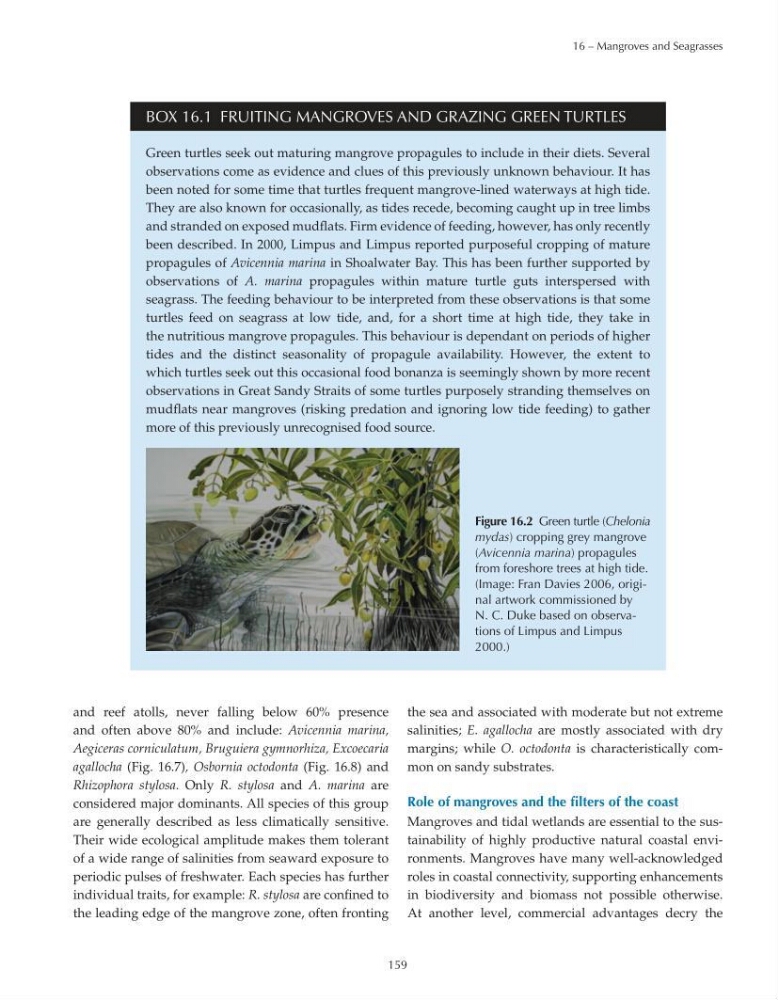
Figure 16.2 Green turtle (Chelonia
mydas) cropping grey mangrove
(Avicennia marina) propagules
from foreshore trees at high tide.
(Image: Fran Davies 2006, original artwork commissioned by
N. C. Duke based on observations of Limpus and Limpus
2000.)
159
and reef atolls, never falling below 60% presence
and often above 80% and include: Avicennia marina,
Aegiceras corniculatum, Bruguiera gymnorhiza, Excoecaria
agallocha (Fig. 16.7), Osbornia octodonta (Fig. 16.8) and
Rhizophora stylosa. Only R. stylosa and A. marina are
considered major dominants. All species of this group
are generally described as less climatically sensitive.
Their wide ecological amplitude makes them tolerant
of a wide range of salinities from seaward exposure to
periodic pulses of freshwater. Each species has further
individual traits, for example: R. stylosa are confined to
the leading edge of the mangrove zone, often fronting
the sea and associated with moderate but not extreme
salinities; E. agallocha are mostly associated with dry
margins; while O. octodonta is characteristically common on sandy substrates.
Role of mangroves and the filters of the coast
Mangroves and tidal wetlands are essential to the sustainability of highly productive natural coastal environments. Mangroves have many well-acknowledged
roles in coastal connectivity, supporting enhancements
in biodiversity and biomass not possible otherwise.
At another level, commercial advantages decry the
BOX 16.1 FRUITING MANGROVES AND GRAZING GREEN TURTLES
Green turtles seek out maturing mangrove propagules to include in their diets. Several
observations come as evidence and clues of this previously unknown behaviour. It has
been noted for some time that turtles frequent mangrove-lined waterways at high tide.
They are also known for occasionally, as tides recede, becoming caught up in tree limbs
and stranded on exposed mudflats. Firm evidence of feeding, however, has only recently
been described. In 2000, Limpus and Limpus reported purposeful cropping of mature
propagules of Avicennia marina in Shoalwater Bay. This has been further supported by
observations of A. marina propagules within mature turtle guts interspersed with
seagrass. The feeding behaviour to be interpreted from these observations is that some
turtles feed on seagrass at low tide, and, for a short time at high tide, they take in
the nutritious mangrove propagules. This behaviour is dependant on periods of higher
tides and the distinct seasonality of propagule availability. However, the extent to
which turtles seek out this occasional food bonanza is seemingly shown by more recent
observa tions in Great Sandy Straits of some turtles purposely stranding themselves on
mudflats near mangroves (risking predation and ignoring low tide feeding) to gather
more of this previously unrecognised food source.
Figure 16.2 Green turtle (Chelonia
mydas) cropping grey mangrove
(Avicennia marina) propagules
from foreshore trees at high tide.
(Image: Fran Davies 2006, original artwork commissioned by
N. C. Duke based on observations of Limpus and Limpus
2000.)