

The Great Barrier Reef
152
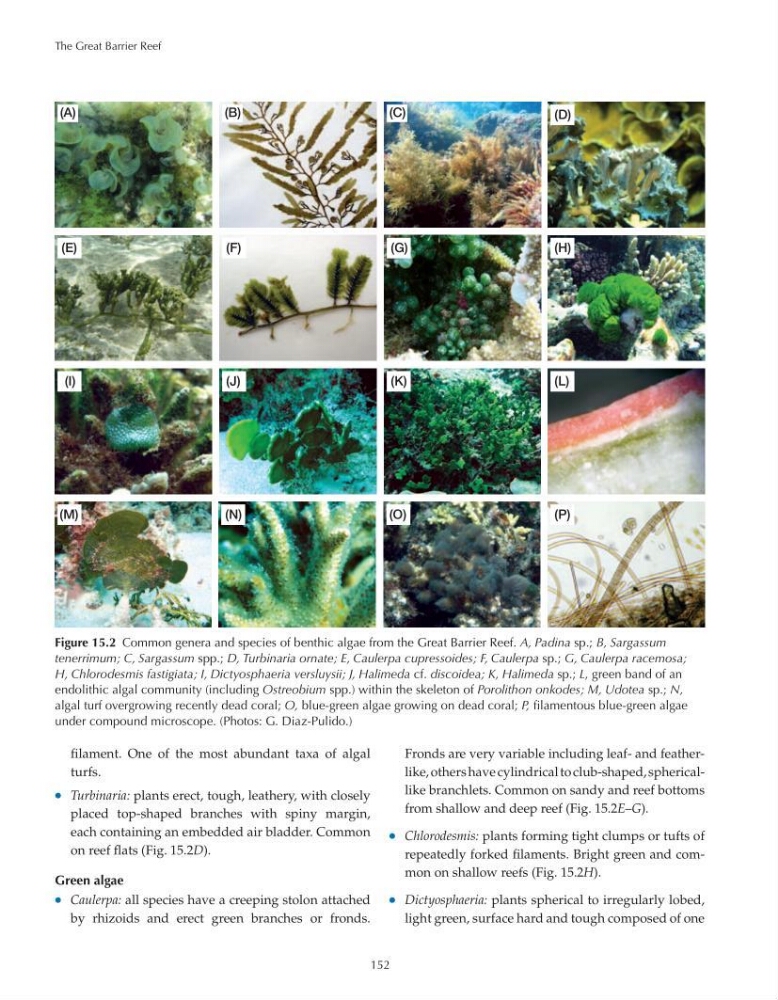
Figure 15.2 Common genera and species of benthic algae from the Great Barrier Reef. A, Padina sp.; B, Sargassum
tenerrimum; C, Sargassum spp.; D, Turbinaria ornate; E, Caulerpa cupressoides; F, Caulerpa sp.; G, Caulerpa racemosa;
H, Chlorodesmis fastigiata; I, Dictyosphaeria versluysii; J, Halimeda cf. discoidea; K, Halimeda sp.; L, green band of an
endolithic algal community (including Ostreobium spp.) within the skeleton of Porolithon onkodes; M, Udotea sp.; N,
algal turf overgrowing recently dead coral; O, blue-green algae growing on dead coral; P, filamentous blue-green algae
under compound microscope. (Photos: G. Diaz-Pulido.)
(M)
(I)
(E)
(A)
(B)
(C)
(D)
(F)
(G)
(H)
(J)
(K)
(L)
(N)
(O)
(P)
filament. One of the most abundant taxa of algal
turfs.
L Turbinaria: plants erect, tough, leathery, with closely
placed top-shaped branches with spiny margin,
each containing an embedded air bladder. Common
on reef flats (Fig. 15.2D).
Green algae
L Caulerpa: all species have a creeping stolon attached
by rhizoids and erect green branches or fronds.
Fronds are very variable including leaf- and featherlike, others have cylindrical to club-shaped, sphericallike branchlets. Common on sandy and reef bottoms
from shallow and deep reef (Fig. 15.2E–G).
L Chlorodesmis: plants forming tight clumps or tufts of
repeatedly forked filaments. Bright green and common on shallow reefs (Fig. 15.2H).
L Dictyosphaeria: plants spherical to irregularly lobed,
light green, surface hard and tough composed of one
152
Figure 15.2 Common genera and species of benthic algae from the Great Barrier Reef. A, Padina sp.; B, Sargassum
tenerrimum; C, Sargassum spp.; D, Turbinaria ornate; E, Caulerpa cupressoides; F, Caulerpa sp.; G, Caulerpa racemosa;
H, Chlorodesmis fastigiata; I, Dictyosphaeria versluysii; J, Halimeda cf. discoidea; K, Halimeda sp.; L, green band of an
endolithic algal community (including Ostreobium spp.) within the skeleton of Porolithon onkodes; M, Udotea sp.; N,
algal turf overgrowing recently dead coral; O, blue-green algae growing on dead coral; P, filamentous blue-green algae
under compound microscope. (Photos: G. Diaz-Pulido.)
(M)
(I)
(E)
(A)
(B)
(C)
(D)
(F)
(G)
(H)
(J)
(K)
(L)
(N)
(O)
(P)
filament. One of the most abundant taxa of algal
turfs.
L Turbinaria: plants erect, tough, leathery, with closely
placed top-shaped branches with spiny margin,
each containing an embedded air bladder. Common
on reef flats (Fig. 15.2D).
Green algae
L Caulerpa: all species have a creeping stolon attached
by rhizoids and erect green branches or fronds.
Fronds are very variable including leaf- and featherlike, others have cylindrical to club-shaped, sphericallike branchlets. Common on sandy and reef bottoms
from shallow and deep reef (Fig. 15.2E–G).
L Chlorodesmis: plants forming tight clumps or tufts of
repeatedly forked filaments. Bright green and common on shallow reefs (Fig. 15.2H).
L Dictyosphaeria: plants spherical to irregularly lobed,
light green, surface hard and tough composed of one