

The Great Barrier Reef
102
having a major problem with the rising concentration of
atmospheric CO 2 and the decrease in the concentration
of carbonate ions. Subsequent studies have shown that
coral calcification is linearly related to the carbonate
ion concentration. These studies have shown consistently that the calcification of coral reef communities
effectively becomes zero at carbonate concentrations of
200 Mmol kg
1 or less. Significantly, carbonate concentrations of 200 Mmol kg
1 occur when atmospheric concentrations of CO 2 rise beyond 450 ppm. Given that
coral reefs represent a balance between calcification and
erosion (Chapter 8), it would appear that atmospheric
CO 2 concentrations would need to remain well below
450–500 ppm if reef calcification (calcification minus
erosion) is to remain positive against the forces of physical and biological erosion. Given that there is growing
evidence that erosion (particularly bioerosion) is likely
to increase under atmospheric CO 2 , these thresholds become even more real (see Chapter 8).
N OTHER GREENHOUSE DRIVEN CHANGES:
SEA LEVEL AND STORM INTENSITY
The increase in the atmospheric concentration of CO 2
and other greenhouse gases impacts other parts of the
environment surrounding corals. The increase in
(A)
m
I
d
(B)
d
(C)
m
p
d
(D)
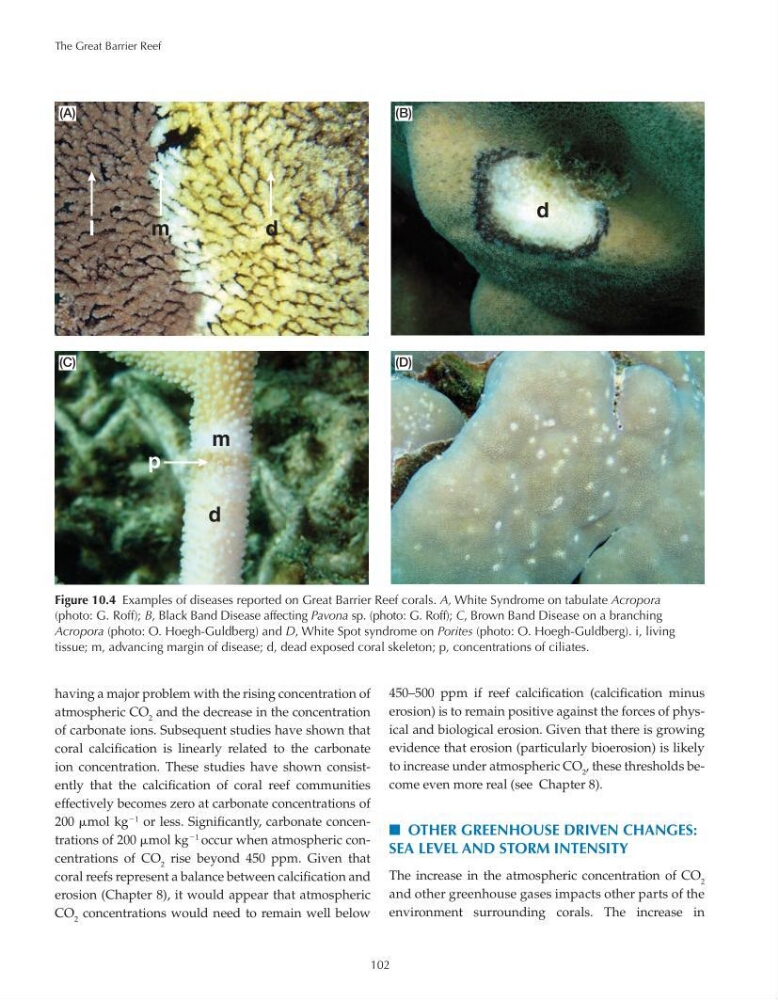
Figure 10.4 Examples of diseases reported on Great Barrier Reef corals. A, White Syndrome on tabulate Acropora
(photo: G. Roff); B, Black Band Disease affecting Pavona sp. (photo: G. Roff); C, Brown Band Disease on a branching
Acropora (photo: O. Hoegh-Guldberg) and D, White Spot syndrome on Porites (photo: O. Hoegh-Guldberg). i, living
tissue; m, advancing margin of disease; d, dead exposed coral skeleton; p, concentrations of ciliates.
102
having a major problem with the rising concentration of
atmospheric CO 2 and the decrease in the concentration
of carbonate ions. Subsequent studies have shown that
coral calcification is linearly related to the carbonate
ion concentration. These studies have shown consistently that the calcification of coral reef communities
effectively becomes zero at carbonate concentrations of
200 Mmol kg
1 or less. Significantly, carbonate concentrations of 200 Mmol kg
1 occur when atmospheric concentrations of CO 2 rise beyond 450 ppm. Given that
coral reefs represent a balance between calcification and
erosion (Chapter 8), it would appear that atmospheric
CO 2 concentrations would need to remain well below
450–500 ppm if reef calcification (calcification minus
erosion) is to remain positive against the forces of physical and biological erosion. Given that there is growing
evidence that erosion (particularly bioerosion) is likely
to increase under atmospheric CO 2 , these thresholds become even more real (see Chapter 8).
N OTHER GREENHOUSE DRIVEN CHANGES:
SEA LEVEL AND STORM INTENSITY
The increase in the atmospheric concentration of CO 2
and other greenhouse gases impacts other parts of the
environment surrounding corals. The increase in
(A)
m
I
d
(B)
d
(C)
m
p
d
(D)
Figure 10.4 Examples of diseases reported on Great Barrier Reef corals. A, White Syndrome on tabulate Acropora
(photo: G. Roff); B, Black Band Disease affecting Pavona sp. (photo: G. Roff); C, Brown Band Disease on a branching
Acropora (photo: O. Hoegh-Guldberg) and D, White Spot syndrome on Porites (photo: O. Hoegh-Guldberg). i, living
tissue; m, advancing margin of disease; d, dead exposed coral skeleton; p, concentrations of ciliates.