

The Great Barrier Reef
100
conditions and can be predicted using sea-surface temperature anomalies measured by satellites. Light is an
important co-factor. Corals that are shaded tend not to
bleach as severely as those under normal irradiances.
Corals also differ in their susceptibility, with some corals such as Porites and Favia being more tolerant of thermal stress than Acropora, Stylophora and Pocillopora.
Differences in sensitivity probably relate to host characteristics such as tissue thickness and pigmentation,
and possibly genotype of the symbiotic dinoflagellates
within coral tissues. Coral bleaching is also affected by
water motion, with corals in still, warm, and sunlit
conditions showing the greatest impact of thermal stress.
The latter is consistent with the first observations of the
association of coral bleaching with the doldrum conditions typical of El Niño years in the eastern Pacific.
Mass coral bleaching has affected almost every coral
reef worldwide since the 1980s and it occurs on the GBR
approximately every 3–5 years at the present time (late
20th and early 21st century). Mass coral bleaching has
occurred most often in El Niño years (e.g. 1987–1988;
1997–1998) and less often in the cooler non-El Niño or La
Nina years (1988–1989; 1999–2000). Bleached corals tend
to recover their dinoflagellate symbiotic populations in
(A)
(B)
t
(C)
(D)
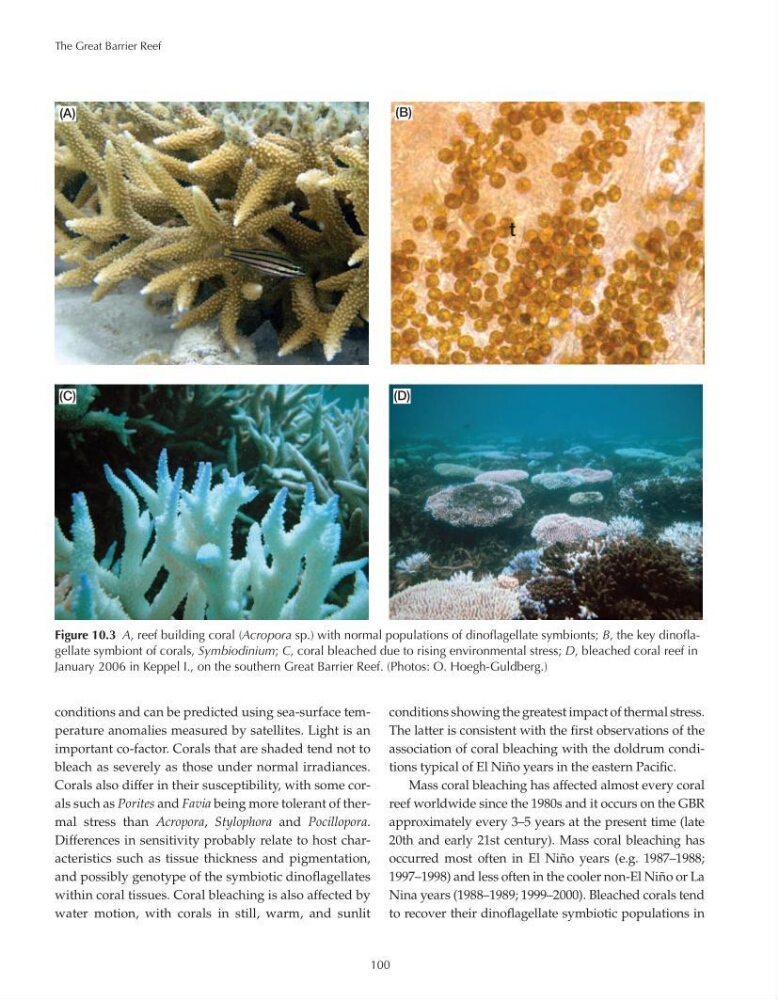
Figure 10.3 A, reef building coral (Acropora sp.) with normal populations of dinoflagellate symbionts; B, the key dinoflagellate symbiont of corals, Symbiodinium; C, coral bleached due to rising environmental stress; D, bleached coral reef in
January 2006 in Keppel I., on the southern Great Barrier Reef. (Photos: O. Hoegh-Guldberg.)
100
conditions and can be predicted using sea-surface temperature anomalies measured by satellites. Light is an
important co-factor. Corals that are shaded tend not to
bleach as severely as those under normal irradiances.
Corals also differ in their susceptibility, with some corals such as Porites and Favia being more tolerant of thermal stress than Acropora, Stylophora and Pocillopora.
Differences in sensitivity probably relate to host characteristics such as tissue thickness and pigmentation,
and possibly genotype of the symbiotic dinoflagellates
within coral tissues. Coral bleaching is also affected by
water motion, with corals in still, warm, and sunlit
conditions showing the greatest impact of thermal stress.
The latter is consistent with the first observations of the
association of coral bleaching with the doldrum conditions typical of El Niño years in the eastern Pacific.
Mass coral bleaching has affected almost every coral
reef worldwide since the 1980s and it occurs on the GBR
approximately every 3–5 years at the present time (late
20th and early 21st century). Mass coral bleaching has
occurred most often in El Niño years (e.g. 1987–1988;
1997–1998) and less often in the cooler non-El Niño or La
Nina years (1988–1989; 1999–2000). Bleached corals tend
to recover their dinoflagellate symbiotic populations in
(A)
(B)
t
(C)
(D)
Figure 10.3 A, reef building coral (Acropora sp.) with normal populations of dinoflagellate symbionts; B, the key dinoflagellate symbiont of corals, Symbiodinium; C, coral bleached due to rising environmental stress; D, bleached coral reef in
January 2006 in Keppel I., on the southern Great Barrier Reef. (Photos: O. Hoegh-Guldberg.)