

The Great Barrier Reef
96
space, with the remaining 70% driving a global average
temperature of the Earth of around 14°C. The trapping
of heat by the atmosphere (referred to as the greenhouse
effect) is largely responsible for life on planet Earth. If
there was no greenhouse effect, the average Earth’s temperature would be 18 °C and carbon-based life forms
would not be able to exist. The term ‘greenhouse effect’
is used because of the similarities between the trapping
of heat in the Earth’s atmosphere to that seen in garden
greenhouses. Visible radiation from the sun passes
through the glass panels of the greenhouse, warming
interior surfaces that in turn reradiate long wavelength
infrared radiation. But infrared wavelengths do not pass
through the glass as efficiently as the incoming radiation, so heat begins to accumulate in the greenhouse.
Likewise, solar energy enters the Earth’s atmosphere
and warms the air, rocks and other components. It too
radiates infrared radiation, which becomes trapped in
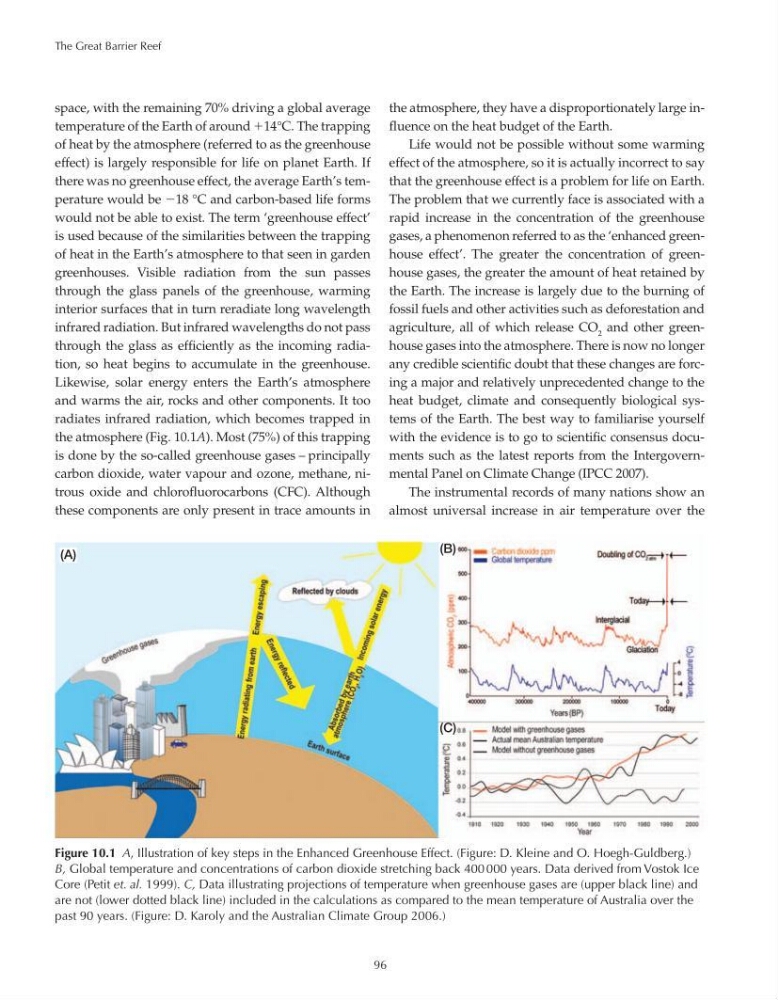
the atmosphere (Fig. 10.1A). Most (75%) of this trapping
is done by the so-called greenhouse gases – principally
carbon dioxide, water vapour and ozone, methane, nitrous oxide and chlorofluorocarbons (CFC). Although
these components are only present in trace amounts in
the atmosphere, they have a disproportionately large influence on the heat budget of the Earth.
Life would not be possible without some warming
effect of the atmosphere, so it is actually incorrect to say
that the greenhouse effect is a problem for life on Earth.
The problem that we currently face is associated with a
rapid increase in the concentration of the greenhouse
gases, a phenomenon referred to as the ‘enhanced greenhouse effect’. The greater the concentration of greenhouse gases, the greater the amount of heat retained by
the Earth. The increase is largely due to the burning of
fossil fuels and other activities such as deforestation and
agriculture, all of which release CO 2 and other greenhouse gases into the atmosphere. There is now no longer
any credible scientific doubt that these changes are forcing a major and relatively unprecedented change to the
heat budget, climate and consequently biological systems of the Earth. The best way to familiarise yourself
with the evidence is to go to scientific consensus documents such as the latest reports from the Intergovernmental Panel on Climate Change (IPCC 2007).
The instrumental records of many nations show an
almost universal increase in air temperature over the
(A)
(B)
(C)
Figure 10.1 A, Illustration of key steps in the Enhanced Greenhouse Effect. (Figure: D. Kleine and O. Hoegh-Guldberg.)
B, Global temperature and concentrations of carbon dioxide stretching back 400 000 years. Data derived from Vostok Ice
Core (Petit et. al. 1999). C, Data illustrating projections of temperature when greenhouse gases are (upper black line) and
are not (lower dotted black line) included in the calculations as compared to the mean temperature of Australia over the
past 90 years. (Figure: D. Karoly and the Australian Climate Group 2006.)
96
space, with the remaining 70% driving a global average
temperature of the Earth of around 14°C. The trapping
of heat by the atmosphere (referred to as the greenhouse
effect) is largely responsible for life on planet Earth. If
there was no greenhouse effect, the average Earth’s temperature would be 18 °C and carbon-based life forms
would not be able to exist. The term ‘greenhouse effect’
is used because of the similarities between the trapping
of heat in the Earth’s atmosphere to that seen in garden
greenhouses. Visible radiation from the sun passes
through the glass panels of the greenhouse, warming
interior surfaces that in turn reradiate long wavelength
infrared radiation. But infrared wavelengths do not pass
through the glass as efficiently as the incoming radiation, so heat begins to accumulate in the greenhouse.
Likewise, solar energy enters the Earth’s atmosphere
and warms the air, rocks and other components. It too
radiates infrared radiation, which becomes trapped in
the atmosphere (Fig. 10.1A). Most (75%) of this trapping
is done by the so-called greenhouse gases – principally
carbon dioxide, water vapour and ozone, methane, nitrous oxide and chlorofluorocarbons (CFC). Although
these components are only present in trace amounts in
the atmosphere, they have a disproportionately large influence on the heat budget of the Earth.
Life would not be possible without some warming
effect of the atmosphere, so it is actually incorrect to say
that the greenhouse effect is a problem for life on Earth.
The problem that we currently face is associated with a
rapid increase in the concentration of the greenhouse
gases, a phenomenon referred to as the ‘enhanced greenhouse effect’. The greater the concentration of greenhouse gases, the greater the amount of heat retained by
the Earth. The increase is largely due to the burning of
fossil fuels and other activities such as deforestation and
agriculture, all of which release CO 2 and other greenhouse gases into the atmosphere. There is now no longer
any credible scientific doubt that these changes are forcing a major and relatively unprecedented change to the
heat budget, climate and consequently biological systems of the Earth. The best way to familiarise yourself
with the evidence is to go to scientific consensus documents such as the latest reports from the Intergovernmental Panel on Climate Change (IPCC 2007).
The instrumental records of many nations show an
almost universal increase in air temperature over the
(A)
(B)
(C)
Figure 10.1 A, Illustration of key steps in the Enhanced Greenhouse Effect. (Figure: D. Kleine and O. Hoegh-Guldberg.)
B, Global temperature and concentrations of carbon dioxide stretching back 400 000 years. Data derived from Vostok Ice
Core (Petit et. al. 1999). C, Data illustrating projections of temperature when greenhouse gases are (upper black line) and
are not (lower dotted black line) included in the calculations as compared to the mean temperature of Australia over the
past 90 years. (Figure: D. Karoly and the Australian Climate Group 2006.)