

68 Organic compounds in soils, sediments & sludges
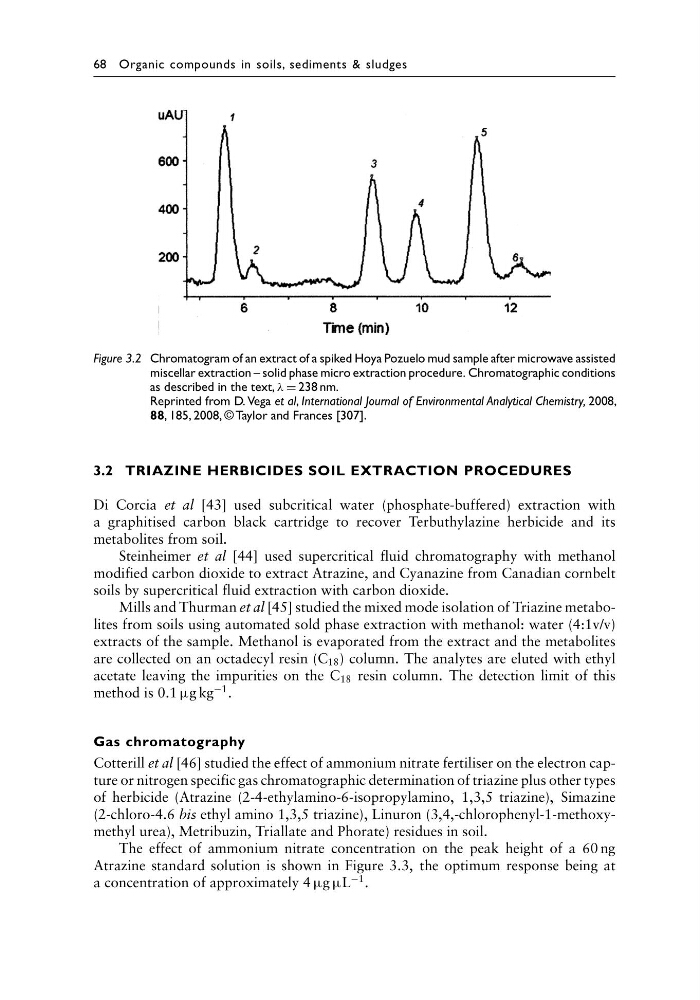
Figure 3.2 Chromatogram of an extract of a spiked Hoya Pozuelo mud sample after microwave assisted
miscellar extraction – solid phase micro extraction procedure. Chromatographic conditions
as described in the text, λ = 238 nm.
Reprinted from D. Vega et al, International Journal of Environmental Analytical Chemistry, 2008,
88, 185, 2008, © Taylor and Frances [307].
3.2 TRIAZINE HERBICIDES SOIL EXTRACTION PROCEDURES
Di Corcia et al [43] used subcritical water (phosphate-buffered) extraction with
a graphitised carbon black cartridge to recover Terbuthylazine herbicide and its
metabolites from soil.
Steinheimer et al [44] used supercritical fluid chromatography with methanol
modified carbon dioxide to extract Atrazine, and Cyanazine from Canadian cornbelt
soils by supercritical fluid extraction with carbon dioxide.
Mills and Thurman et al [45] studied the mixed mode isolation of Triazine metabolites from soils using automated sold phase extraction with methanol: water (4:1v/v)
extracts of the sample. Methanol is evaporated from the extract and the metabolites
are collected on an octadecyl resin (C 18 ) column. The analytes are eluted with ethyl
acetate leaving the impurities on the C 18 resin column. The detection limit of this
method is 0.1 µg kg
−1 .
Gas chromatography
Cotterill et al [46] studied the effect of ammonium nitrate fertiliser on the electron capture or nitrogen specific gas chromatographic determination of triazine plus other types
of herbicide (Atrazine (2-4-ethylamino-6-isopropylamino, 1,3,5 triazine), Simazine
(2-chloro-4.6 bis ethyl amino 1,3,5 triazine), Linuron (3,4,-chlorophenyl-1-methoxymethyl urea), Metribuzin, Triallate and Phorate) residues in soil.
The effect of ammonium nitrate concentration on the peak height of a 60 ng
Atrazine standard solution is shown in Figure 3.3, the optimum response being at
a concentration of approximately 4 µg µL
−1 .
Figure 3.2 Chromatogram of an extract of a spiked Hoya Pozuelo mud sample after microwave assisted
miscellar extraction – solid phase micro extraction procedure. Chromatographic conditions
as described in the text, λ = 238 nm.
Reprinted from D. Vega et al, International Journal of Environmental Analytical Chemistry, 2008,
88, 185, 2008, © Taylor and Frances [307].
3.2 TRIAZINE HERBICIDES SOIL EXTRACTION PROCEDURES
Di Corcia et al [43] used subcritical water (phosphate-buffered) extraction with
a graphitised carbon black cartridge to recover Terbuthylazine herbicide and its
metabolites from soil.
Steinheimer et al [44] used supercritical fluid chromatography with methanol
modified carbon dioxide to extract Atrazine, and Cyanazine from Canadian cornbelt
soils by supercritical fluid extraction with carbon dioxide.
Mills and Thurman et al [45] studied the mixed mode isolation of Triazine metabolites from soils using automated sold phase extraction with methanol: water (4:1v/v)
extracts of the sample. Methanol is evaporated from the extract and the metabolites
are collected on an octadecyl resin (C 18 ) column. The analytes are eluted with ethyl
acetate leaving the impurities on the C 18 resin column. The detection limit of this
method is 0.1 µg kg
−1 .
Gas chromatography
Cotterill et al [46] studied the effect of ammonium nitrate fertiliser on the electron capture or nitrogen specific gas chromatographic determination of triazine plus other types
of herbicide (Atrazine (2-4-ethylamino-6-isopropylamino, 1,3,5 triazine), Simazine
(2-chloro-4.6 bis ethyl amino 1,3,5 triazine), Linuron (3,4,-chlorophenyl-1-methoxymethyl urea), Metribuzin, Triallate and Phorate) residues in soil.
The effect of ammonium nitrate concentration on the peak height of a 60 ng
Atrazine standard solution is shown in Figure 3.3, the optimum response being at
a concentration of approximately 4 µg µL
−1 .