

Organic compounds in soils 31
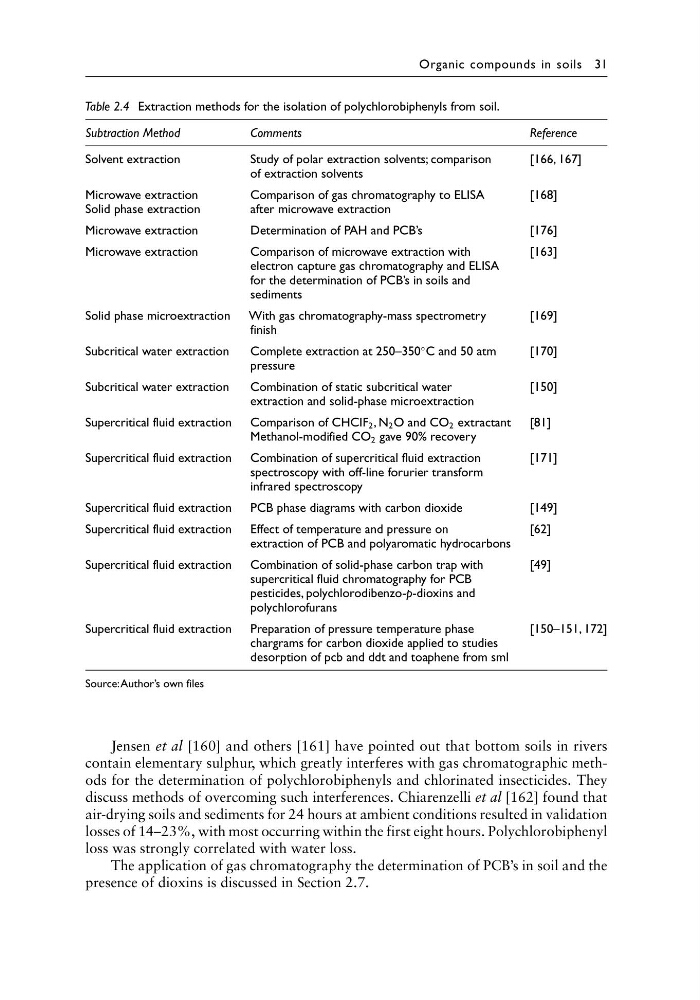
Table 2.4 Extraction methods for the isolation of polychlorobiphenyls from soil.
Subtraction Method
Comments
Reference
Solvent extraction
Study of polar extraction solvents; comparison
[166, 167]
of extraction solvents
Microwave extraction
Comparison of gas chromatography to ELISA
[168]
Solid phase extraction
after microwave extraction
Microwave extraction
Determination of PAH and PCB’s
[176]
Microwave extraction
Comparison of microwave extraction with
[163]
electron capture gas chromatography and ELISA
for the determination of PCB’s in soils and
sediments
Solid phase microextraction With gas chromatography-mass spectrometry
[169]
finish
Subcritical water extraction
Complete extraction at 250–350
◦ C and 50 atm
[170]
pressure
Subcritical water extraction
Combination of static subcritical water
[150]
extraction and solid-phase microextraction
Supercritical fluid extraction Comparison of CHCIF 2 , N 2 O and CO 2 extractant [81]
Methanol-modified CO 2 gave 90% recovery
Supercritical fluid extraction Combination of supercritical fluid extraction
[171]
spectroscopy with off-line forurier transform
infrared spectroscopy
Supercritical fluid extraction PCB phase diagrams with carbon dioxide
[149]
Supercritical fluid extraction Effect of temperature and pressure on
[62]
extraction of PCB and polyaromatic hydrocarbons
Supercritical fluid extraction Combination of solid-phase carbon trap with
[49]
supercritical fluid chromatography for PCB
pesticides, polychlorodibenzo-p-dioxins and
polychlorofurans
Supercritical fluid extraction Preparation of pressure temperature phase
[150–151, 172]
chargrams for carbon dioxide applied to studies
desorption of pcb and ddt and toaphene from sml
Source:Author’s own files
Jensen et al [160] and others [161] have pointed out that bottom soils in rivers
contain elementary sulphur, which greatly interferes with gas chromatographic methods for the determination of polychlorobiphenyls and chlorinated insecticides. They
discuss methods of overcoming such interferences. Chiarenzelli et al [162] found that
air-drying soils and sediments for 24 hours at ambient conditions resulted in validation
losses of 14–23%, with most occurring within the first eight hours. Polychlorobiphenyl
loss was strongly correlated with water loss.
The application of gas chromatography the determination of PCB’s in soil and the
presence of dioxins is discussed in Section 2.7.
Table 2.4 Extraction methods for the isolation of polychlorobiphenyls from soil.
Subtraction Method
Comments
Reference
Solvent extraction
Study of polar extraction solvents; comparison
[166, 167]
of extraction solvents
Microwave extraction
Comparison of gas chromatography to ELISA
[168]
Solid phase extraction
after microwave extraction
Microwave extraction
Determination of PAH and PCB’s
[176]
Microwave extraction
Comparison of microwave extraction with
[163]
electron capture gas chromatography and ELISA
for the determination of PCB’s in soils and
sediments
Solid phase microextraction With gas chromatography-mass spectrometry
[169]
finish
Subcritical water extraction
Complete extraction at 250–350
◦ C and 50 atm
[170]
pressure
Subcritical water extraction
Combination of static subcritical water
[150]
extraction and solid-phase microextraction
Supercritical fluid extraction Comparison of CHCIF 2 , N 2 O and CO 2 extractant [81]
Methanol-modified CO 2 gave 90% recovery
Supercritical fluid extraction Combination of supercritical fluid extraction
[171]
spectroscopy with off-line forurier transform
infrared spectroscopy
Supercritical fluid extraction PCB phase diagrams with carbon dioxide
[149]
Supercritical fluid extraction Effect of temperature and pressure on
[62]
extraction of PCB and polyaromatic hydrocarbons
Supercritical fluid extraction Combination of solid-phase carbon trap with
[49]
supercritical fluid chromatography for PCB
pesticides, polychlorodibenzo-p-dioxins and
polychlorofurans
Supercritical fluid extraction Preparation of pressure temperature phase
[150–151, 172]
chargrams for carbon dioxide applied to studies
desorption of pcb and ddt and toaphene from sml
Source:Author’s own files
Jensen et al [160] and others [161] have pointed out that bottom soils in rivers
contain elementary sulphur, which greatly interferes with gas chromatographic methods for the determination of polychlorobiphenyls and chlorinated insecticides. They
discuss methods of overcoming such interferences. Chiarenzelli et al [162] found that
air-drying soils and sediments for 24 hours at ambient conditions resulted in validation
losses of 14–23%, with most occurring within the first eight hours. Polychlorobiphenyl
loss was strongly correlated with water loss.
The application of gas chromatography the determination of PCB’s in soil and the
presence of dioxins is discussed in Section 2.7.