

26 Organic compounds in soils, sediments & sludges
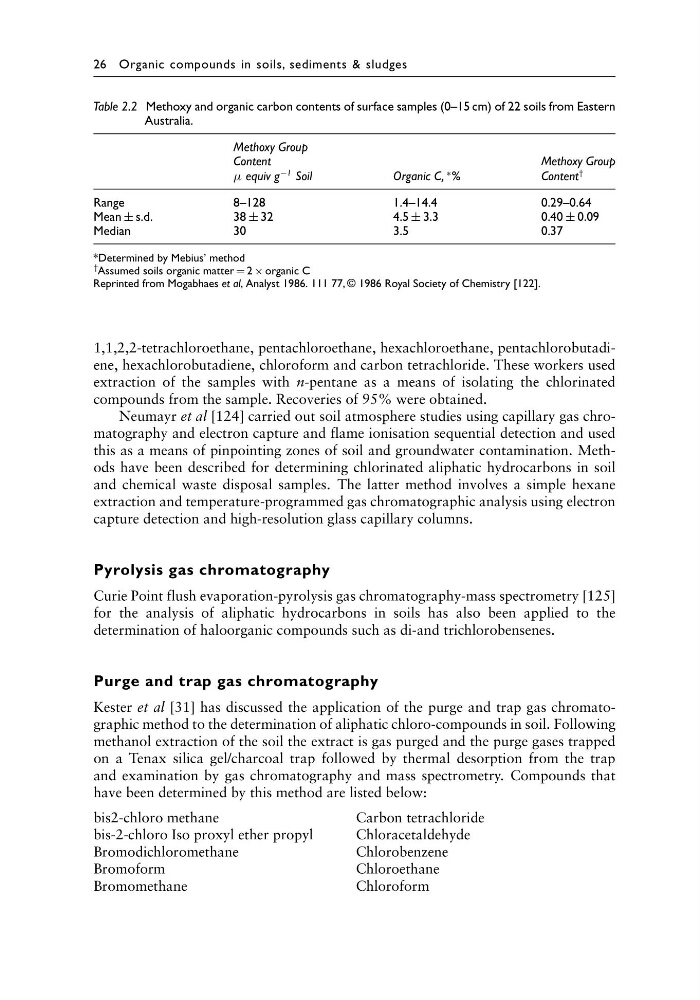
Table 2.2 Methoxy and organic carbon contents of surface samples (0–15 cm) of 22 soils from Eastern
Australia.
Methoxy Group
Content
Methoxy Group
µ equiv g
−1 Soil
Organic C,
∗ %
Content
†
Range
8–128
1.4–14.4
0.29–0.64
Mean ± s.d.
38 ± 32
4.5 ± 3.3
0.40 ± 0.09
Median
30
3.5
0.37
*Determined by Mebius’ method
† Assumed soils organic matter = 2 × organic C
Reprinted from Mogabhaes et al, Analyst 1986. 111 77, © 1986 Royal Society of Chemistry [122].
1,1,2,2-tetrachloroethane, pentachloroethane, hexachloroethane, pentachlorobutadiene, hexachlorobutadiene, chloroform and carbon tetrachloride. These workers used
extraction of the samples with n-pentane as a means of isolating the chlorinated
compounds from the sample. Recoveries of 95% were obtained.
Neumayr et al [124] carried out soil atmosphere studies using capillary gas chromatography and electron capture and flame ionisation sequential detection and used
this as a means of pinpointing zones of soil and groundwater contamination. Methods have been described for determining chlorinated aliphatic hydrocarbons in soil
and chemical waste disposal samples. The latter method involves a simple hexane
extraction and temperature-programmed gas chromatographic analysis using electron
capture detection and high-resolution glass capillary columns.
Pyrolysis gas chromatography
Curie Point flush evaporation-pyrolysis gas chromatography-mass spectrometry [125]
for the analysis of aliphatic hydrocarbons in soils has also been applied to the
determination of haloorganic compounds such as di-and trichlorobensenes.
Purge and trap gas chromatography
Kester et al [31] has discussed the application of the purge and trap gas chromatographic method to the determination of aliphatic chloro-compounds in soil. Following
methanol extraction of the soil the extract is gas purged and the purge gases trapped
on a Tenax silica gel/charcoal trap followed by thermal desorption from the trap
and examination by gas chromatography and mass spectrometry. Compounds that
have been determined by this method are listed below:
bis2-chloro methane
Carbon tetrachloride
bis-2-chloro Iso proxyl ether propyl
Chloracetaldehyde
Bromodichloromethane
Chlorobenzene
Bromoform
Chloroethane
Bromomethane
Chloroform
Table 2.2 Methoxy and organic carbon contents of surface samples (0–15 cm) of 22 soils from Eastern
Australia.
Methoxy Group
Content
Methoxy Group
µ equiv g
−1 Soil
Organic C,
∗ %
Content
†
Range
8–128
1.4–14.4
0.29–0.64
Mean ± s.d.
38 ± 32
4.5 ± 3.3
0.40 ± 0.09
Median
30
3.5
0.37
*Determined by Mebius’ method
† Assumed soils organic matter = 2 × organic C
Reprinted from Mogabhaes et al, Analyst 1986. 111 77, © 1986 Royal Society of Chemistry [122].
1,1,2,2-tetrachloroethane, pentachloroethane, hexachloroethane, pentachlorobutadiene, hexachlorobutadiene, chloroform and carbon tetrachloride. These workers used
extraction of the samples with n-pentane as a means of isolating the chlorinated
compounds from the sample. Recoveries of 95% were obtained.
Neumayr et al [124] carried out soil atmosphere studies using capillary gas chromatography and electron capture and flame ionisation sequential detection and used
this as a means of pinpointing zones of soil and groundwater contamination. Methods have been described for determining chlorinated aliphatic hydrocarbons in soil
and chemical waste disposal samples. The latter method involves a simple hexane
extraction and temperature-programmed gas chromatographic analysis using electron
capture detection and high-resolution glass capillary columns.
Pyrolysis gas chromatography
Curie Point flush evaporation-pyrolysis gas chromatography-mass spectrometry [125]
for the analysis of aliphatic hydrocarbons in soils has also been applied to the
determination of haloorganic compounds such as di-and trichlorobensenes.
Purge and trap gas chromatography
Kester et al [31] has discussed the application of the purge and trap gas chromatographic method to the determination of aliphatic chloro-compounds in soil. Following
methanol extraction of the soil the extract is gas purged and the purge gases trapped
on a Tenax silica gel/charcoal trap followed by thermal desorption from the trap
and examination by gas chromatography and mass spectrometry. Compounds that
have been determined by this method are listed below:
bis2-chloro methane
Carbon tetrachloride
bis-2-chloro Iso proxyl ether propyl
Chloracetaldehyde
Bromodichloromethane
Chlorobenzene
Bromoform
Chloroethane
Bromomethane
Chloroform