

20 Organic compounds in soils, sediments & sludges
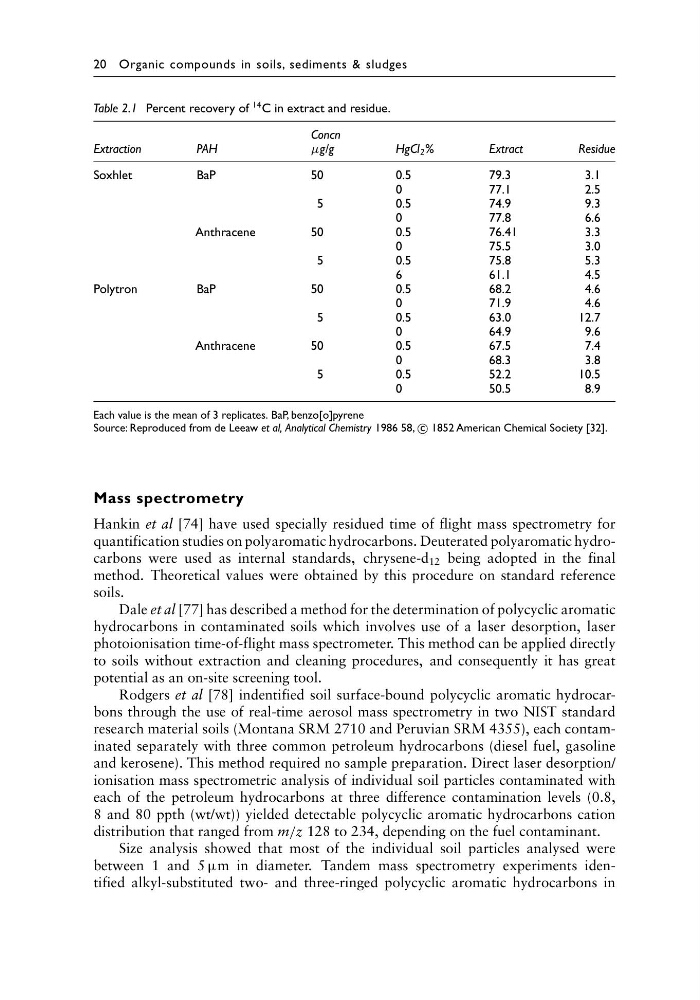
Table 2.1 Percent recovery of
14 C in extract and residue.
Concn
Extraction
PAH
µg/g
HgCl 2 %
Extract
Residue
Soxhlet
BaP
50
0.5
79.3
3.1
0
77.1
2.5
5
0.5
74.9
9.3
0
77.8
6.6
Anthracene
50
0.5
76.41
3.3
0
75.5
3.0
5
0.5
75.8
5.3
6
61.1
4.5
Polytron
BaP
50
0.5
68.2
4.6
0
71.9
4.6
5
0.5
63.0
12.7
0
64.9
9.6
Anthracene
50
0.5
67.5
7.4
0
68.3
3.8
5
0.5
52.2
10.5
0
50.5
8.9
Each value is the mean of 3 replicates. BaP, benzo[o]pyrene
Source: Reproduced from de Leeaw et al, Analytical Chemistry 1986 58, c
1852 American Chemical Society [32].
Mass spectrometry
Hankin et al [74] have used specially residued time of flight mass spectrometry for
quantification studies on polyaromatic hydrocarbons. Deuterated polyaromatic hydrocarbons were used as internal standards, chrysene-d 12 being adopted in the final
method. Theoretical values were obtained by this procedure on standard reference
soils.
Dale et al [77] has described a method for the determination of polycyclic aromatic
hydrocarbons in contaminated soils which involves use of a laser desorption, laser
photoionisation time-of-flight mass spectrometer. This method can be applied directly
to soils without extraction and cleaning procedures, and consequently it has great
potential as an on-site screening tool.
Rodgers et al [78] indentified soil surface-bound polycyclic aromatic hydrocarbons through the use of real-time aerosol mass spectrometry in two NIST standard
research material soils (Montana SRM 2710 and Peruvian SRM 4355), each contaminated separately with three common petroleum hydrocarbons (diesel fuel, gasoline
and kerosene). This method required no sample preparation. Direct laser desorption/
ionisation mass spectrometric analysis of individual soil particles contaminated with
each of the petroleum hydrocarbons at three difference contamination levels (0.8,
8 and 80 ppth (wt/wt)) yielded detectable polycyclic aromatic hydrocarbons cation
distribution that ranged from m/z 128 to 234, depending on the fuel contaminant.
Size analysis showed that most of the individual soil particles analysed were
between 1 and 5 µm in diameter. Tandem mass spectrometry experiments identified alkyl-substituted two- and three-ringed polycyclic aromatic hydrocarbons in
Table 2.1 Percent recovery of
14 C in extract and residue.
Concn
Extraction
PAH
µg/g
HgCl 2 %
Extract
Residue
Soxhlet
BaP
50
0.5
79.3
3.1
0
77.1
2.5
5
0.5
74.9
9.3
0
77.8
6.6
Anthracene
50
0.5
76.41
3.3
0
75.5
3.0
5
0.5
75.8
5.3
6
61.1
4.5
Polytron
BaP
50
0.5
68.2
4.6
0
71.9
4.6
5
0.5
63.0
12.7
0
64.9
9.6
Anthracene
50
0.5
67.5
7.4
0
68.3
3.8
5
0.5
52.2
10.5
0
50.5
8.9
Each value is the mean of 3 replicates. BaP, benzo[o]pyrene
Source: Reproduced from de Leeaw et al, Analytical Chemistry 1986 58, c
1852 American Chemical Society [32].
Mass spectrometry
Hankin et al [74] have used specially residued time of flight mass spectrometry for
quantification studies on polyaromatic hydrocarbons. Deuterated polyaromatic hydrocarbons were used as internal standards, chrysene-d 12 being adopted in the final
method. Theoretical values were obtained by this procedure on standard reference
soils.
Dale et al [77] has described a method for the determination of polycyclic aromatic
hydrocarbons in contaminated soils which involves use of a laser desorption, laser
photoionisation time-of-flight mass spectrometer. This method can be applied directly
to soils without extraction and cleaning procedures, and consequently it has great
potential as an on-site screening tool.
Rodgers et al [78] indentified soil surface-bound polycyclic aromatic hydrocarbons through the use of real-time aerosol mass spectrometry in two NIST standard
research material soils (Montana SRM 2710 and Peruvian SRM 4355), each contaminated separately with three common petroleum hydrocarbons (diesel fuel, gasoline
and kerosene). This method required no sample preparation. Direct laser desorption/
ionisation mass spectrometric analysis of individual soil particles contaminated with
each of the petroleum hydrocarbons at three difference contamination levels (0.8,
8 and 80 ppth (wt/wt)) yielded detectable polycyclic aromatic hydrocarbons cation
distribution that ranged from m/z 128 to 234, depending on the fuel contaminant.
Size analysis showed that most of the individual soil particles analysed were
between 1 and 5 µm in diameter. Tandem mass spectrometry experiments identified alkyl-substituted two- and three-ringed polycyclic aromatic hydrocarbons in