

210 Organic compounds in soils, sediments & sludges
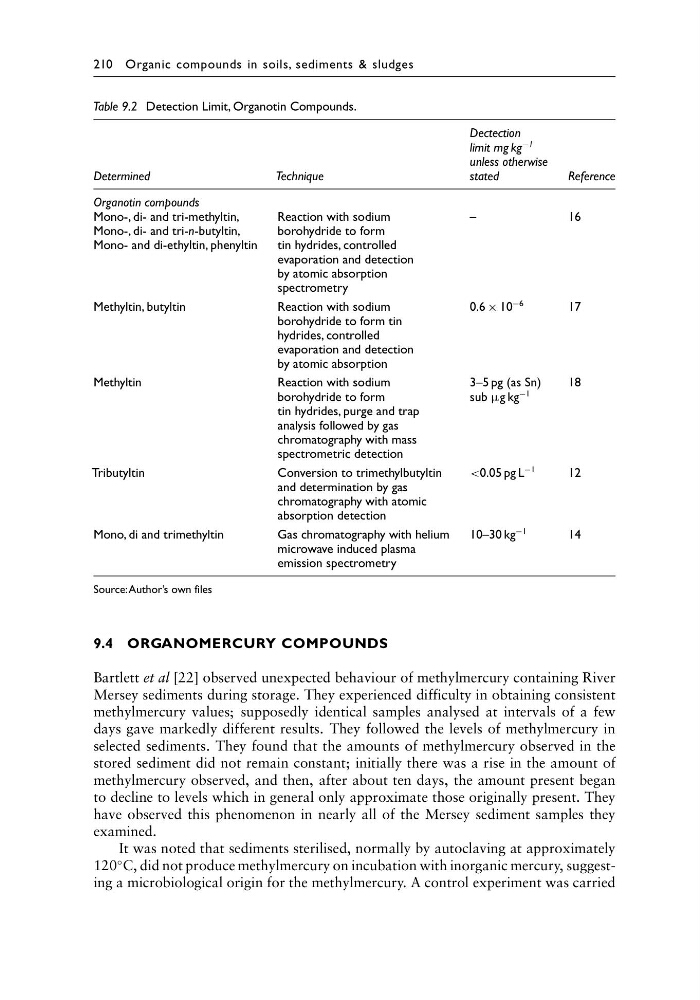
Table 9.2 Detection Limit, Organotin Compounds.
Dectection
limit mg kg
−1
unless otherwise
Determined
Technique
stated
Reference
Organotin compounds
Mono-, di- and tri-methyltin,
Reaction with sodium
–
16
Mono-, di- and tri-n-butyltin,
borohydride to form
Mono- and di-ethyltin, phenyltin
tin hydrides, controlled
evaporation and detection
by atomic absorption
spectrometry
Methyltin, butyltin
Reaction with sodium
0.6 × 10
−6
17
borohydride to form tin
hydrides, controlled
evaporation and detection
by atomic absorption
Methyltin
Reaction with sodium
3–5 pg (as Sn)
18
borohydride to form
sub µg kg
−1
tin hydrides, purge and trap
analysis followed by gas
chromatography with mass
spectrometric detection
Tributyltin
Conversion to trimethylbutyltin
<0.05 pg L
−1
12
and determination by gas
chromatography with atomic
absorption detection
Mono, di and trimethyltin
Gas chromatography with helium
10–30 kg
−1
14
microwave induced plasma
emission spectrometry
Source:Author’s own files
9.4 ORGANOMERCURY COMPOUNDS
Bartlett et al [22] observed unexpected behaviour of methylmercury containing River
Mersey sediments during storage. They experienced difficulty in obtaining consistent
methylmercury values; supposedly identical samples analysed at intervals of a few
days gave markedly different results. They followed the levels of methylmercury in
selected sediments. They found that the amounts of methylmercury observed in the
stored sediment did not remain constant; initially there was a rise in the amount of
methylmercury observed, and then, after about ten days, the amount present began
to decline to levels which in general only approximate those originally present. They
have observed this phenomenon in nearly all of the Mersey sediment samples they
examined.
It was noted that sediments sterilised, normally by autoclaving at approximately
120
◦ C, did not produce methylmercury on incubation with inorganic mercury, suggesting a microbiological origin for the methylmercury. A control experiment was carried
Table 9.2 Detection Limit, Organotin Compounds.
Dectection
limit mg kg
−1
unless otherwise
Determined
Technique
stated
Reference
Organotin compounds
Mono-, di- and tri-methyltin,
Reaction with sodium
–
16
Mono-, di- and tri-n-butyltin,
borohydride to form
Mono- and di-ethyltin, phenyltin
tin hydrides, controlled
evaporation and detection
by atomic absorption
spectrometry
Methyltin, butyltin
Reaction with sodium
0.6 × 10
−6
17
borohydride to form tin
hydrides, controlled
evaporation and detection
by atomic absorption
Methyltin
Reaction with sodium
3–5 pg (as Sn)
18
borohydride to form
sub µg kg
−1
tin hydrides, purge and trap
analysis followed by gas
chromatography with mass
spectrometric detection
Tributyltin
Conversion to trimethylbutyltin
<0.05 pg L
−1
12
and determination by gas
chromatography with atomic
absorption detection
Mono, di and trimethyltin
Gas chromatography with helium
10–30 kg
−1
14
microwave induced plasma
emission spectrometry
Source:Author’s own files
9.4 ORGANOMERCURY COMPOUNDS
Bartlett et al [22] observed unexpected behaviour of methylmercury containing River
Mersey sediments during storage. They experienced difficulty in obtaining consistent
methylmercury values; supposedly identical samples analysed at intervals of a few
days gave markedly different results. They followed the levels of methylmercury in
selected sediments. They found that the amounts of methylmercury observed in the
stored sediment did not remain constant; initially there was a rise in the amount of
methylmercury observed, and then, after about ten days, the amount present began
to decline to levels which in general only approximate those originally present. They
have observed this phenomenon in nearly all of the Mersey sediment samples they
examined.
It was noted that sediments sterilised, normally by autoclaving at approximately
120
◦ C, did not produce methylmercury on incubation with inorganic mercury, suggesting a microbiological origin for the methylmercury. A control experiment was carried