

206 Organic compounds in soils, sediments & sludges
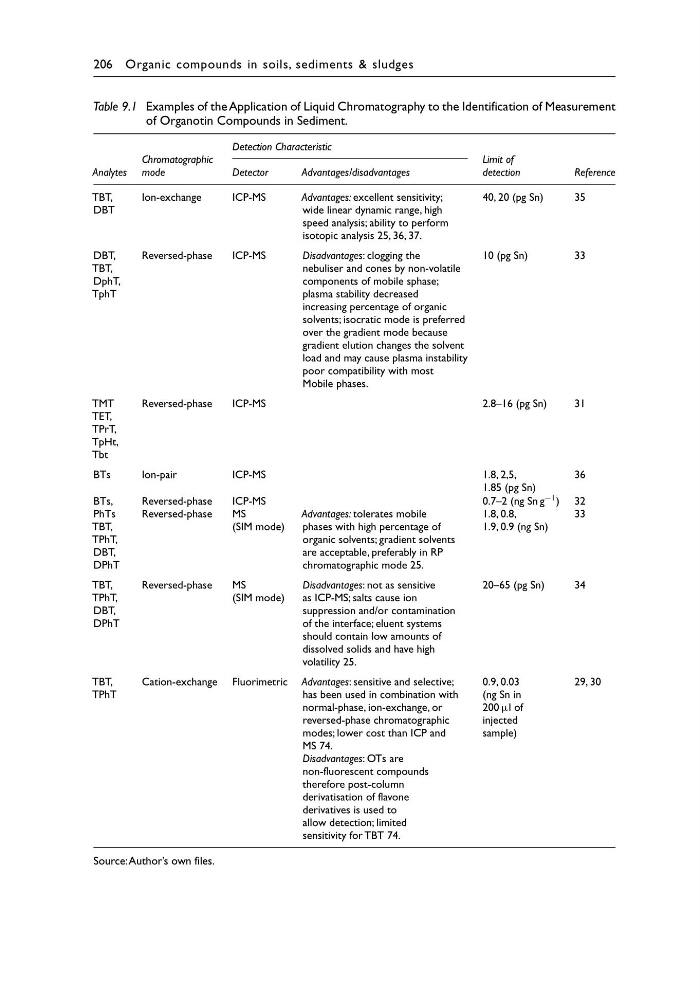
Table 9.1 Examples of the Application of Liquid Chromatography to the Identification of Measurement
of Organotin Compounds in Sediment.
Detection Characteristic
Chromatographic
Limit of
Analytes mode
Detector
Advantages/disadvantages
detection
Reference
TBT,
Ion-exchange
ICP-MS
Advantages: excellent sensitivity;
40, 20 (pg Sn)
35
DBT
wide linear dynamic range, high
speed analysis; ability to perform
isotopic analysis 25, 36, 37.
DBT,
Reversed-phase
ICP-MS
Disadvantages: clogging the
10 (pg Sn)
33
TBT,
nebuliser and cones by non-volatile
DphT,
components of mobile sphase;
TphT
plasma stability decreased
increasing percentage of organic
solvents; isocratic mode is preferred
over the gradient mode because
gradient elution changes the solvent
load and may cause plasma instability
poor compatibility with most
Mobile phases.
TMT
Reversed-phase
ICP-MS
2.8–16 (pg Sn)
31
TET,
TPrT,
TpHt,
Tbt
BTs
Ion-pair
ICP-MS
1.8, 2,5,
36
1.85 (pg Sn)
BTs,
Reversed-phase
ICP-MS
0.7–2 (ng Sn g −1 ) 32
PhTs
Reversed-phase
MS
Advantages: tolerates mobile
1.8, 0.8,
33
TBT,
(SIM mode)
phases with high percentage of
1.9, 0.9 (ng Sn)
TPhT,
organic solvents; gradient solvents
DBT,
are acceptable, preferably in RP
DPhT
chromatographic mode 25.
TBT,
Reversed-phase
MS
Disadvantages: not as sensitive
20–65 (pg Sn)
34
TPhT,
(SIM mode)
as ICP-MS; salts cause ion
DBT,
suppression and/or contamination
DPhT
of the interface; eluent systems
should contain low amounts of
dissolved solids and have high
volatility 25.
TBT,
Cation-exchange Fluorimetric Advantages: sensitive and selective;
0.9, 0.03
29, 30
TPhT
has been used in combination with
(ng Sn in
normal-phase, ion-exchange, or
200 µl of
reversed-phase chromatographic
injected
modes; lower cost than ICP and
sample)
MS 74.
Disadvantages: OTs are
non-fluorescent compounds
therefore post-column
derivatisation of flavone
derivatives is used to
allow detection; limited
sensitivity for TBT 74.
Source:Author’s own files.
Table 9.1 Examples of the Application of Liquid Chromatography to the Identification of Measurement
of Organotin Compounds in Sediment.
Detection Characteristic
Chromatographic
Limit of
Analytes mode
Detector
Advantages/disadvantages
detection
Reference
TBT,
Ion-exchange
ICP-MS
Advantages: excellent sensitivity;
40, 20 (pg Sn)
35
DBT
wide linear dynamic range, high
speed analysis; ability to perform
isotopic analysis 25, 36, 37.
DBT,
Reversed-phase
ICP-MS
Disadvantages: clogging the
10 (pg Sn)
33
TBT,
nebuliser and cones by non-volatile
DphT,
components of mobile sphase;
TphT
plasma stability decreased
increasing percentage of organic
solvents; isocratic mode is preferred
over the gradient mode because
gradient elution changes the solvent
load and may cause plasma instability
poor compatibility with most
Mobile phases.
TMT
Reversed-phase
ICP-MS
2.8–16 (pg Sn)
31
TET,
TPrT,
TpHt,
Tbt
BTs
Ion-pair
ICP-MS
1.8, 2,5,
36
1.85 (pg Sn)
BTs,
Reversed-phase
ICP-MS
0.7–2 (ng Sn g −1 ) 32
PhTs
Reversed-phase
MS
Advantages: tolerates mobile
1.8, 0.8,
33
TBT,
(SIM mode)
phases with high percentage of
1.9, 0.9 (ng Sn)
TPhT,
organic solvents; gradient solvents
DBT,
are acceptable, preferably in RP
DPhT
chromatographic mode 25.
TBT,
Reversed-phase
MS
Disadvantages: not as sensitive
20–65 (pg Sn)
34
TPhT,
(SIM mode)
as ICP-MS; salts cause ion
DBT,
suppression and/or contamination
DPhT
of the interface; eluent systems
should contain low amounts of
dissolved solids and have high
volatility 25.
TBT,
Cation-exchange Fluorimetric Advantages: sensitive and selective;
0.9, 0.03
29, 30
TPhT
has been used in combination with
(ng Sn in
normal-phase, ion-exchange, or
200 µl of
reversed-phase chromatographic
injected
modes; lower cost than ICP and
sample)
MS 74.
Disadvantages: OTs are
non-fluorescent compounds
therefore post-column
derivatisation of flavone
derivatives is used to
allow detection; limited
sensitivity for TBT 74.
Source:Author’s own files.