

Organic compounds in saline marine and estuarine sediments 195
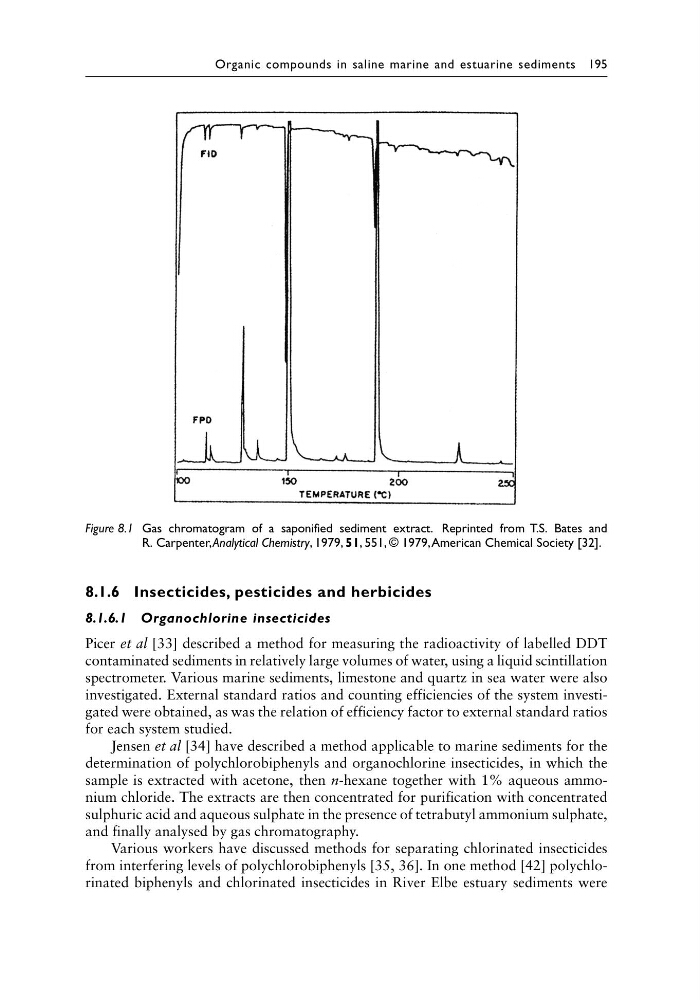
Figure 8.1 Gas chromatogram of a saponified sediment extract. Reprinted from T.S. Bates and
R. Carpenter,Analytical Chemistry, 1979, 51, 551, © 1979,American Chemical Society [32].
8.1.6 Insecticides, pesticides and herbicides
8.1.6.1 Organochlorine insecticides
Picer et al [33] described a method for measuring the radioactivity of labelled DDT
contaminated sediments in relatively large volumes of water, using a liquid scintillation
spectrometer. Various marine sediments, limestone and quartz in sea water were also
investigated. External standard ratios and counting efficiencies of the system investigated were obtained, as was the relation of efficiency factor to external standard ratios
for each system studied.
Jensen et al [34] have described a method applicable to marine sediments for the
determination of polychlorobiphenyls and organochlorine insecticides, in which the
sample is extracted with acetone, then n-hexane together with 1% aqueous ammonium chloride. The extracts are then concentrated for purification with concentrated
sulphuric acid and aqueous sulphate in the presence of tetrabutyl ammonium sulphate,
and finally analysed by gas chromatography.
Various workers have discussed methods for separating chlorinated insecticides
from interfering levels of polychlorobiphenyls [35, 36]. In one method [42] polychlorinated biphenyls and chlorinated insecticides in River Elbe estuary sediments were
Figure 8.1 Gas chromatogram of a saponified sediment extract. Reprinted from T.S. Bates and
R. Carpenter,Analytical Chemistry, 1979, 51, 551, © 1979,American Chemical Society [32].
8.1.6 Insecticides, pesticides and herbicides
8.1.6.1 Organochlorine insecticides
Picer et al [33] described a method for measuring the radioactivity of labelled DDT
contaminated sediments in relatively large volumes of water, using a liquid scintillation
spectrometer. Various marine sediments, limestone and quartz in sea water were also
investigated. External standard ratios and counting efficiencies of the system investigated were obtained, as was the relation of efficiency factor to external standard ratios
for each system studied.
Jensen et al [34] have described a method applicable to marine sediments for the
determination of polychlorobiphenyls and organochlorine insecticides, in which the
sample is extracted with acetone, then n-hexane together with 1% aqueous ammonium chloride. The extracts are then concentrated for purification with concentrated
sulphuric acid and aqueous sulphate in the presence of tetrabutyl ammonium sulphate,
and finally analysed by gas chromatography.
Various workers have discussed methods for separating chlorinated insecticides
from interfering levels of polychlorobiphenyls [35, 36]. In one method [42] polychlorinated biphenyls and chlorinated insecticides in River Elbe estuary sediments were