

Organometallic compounds in non-saline sediments 181
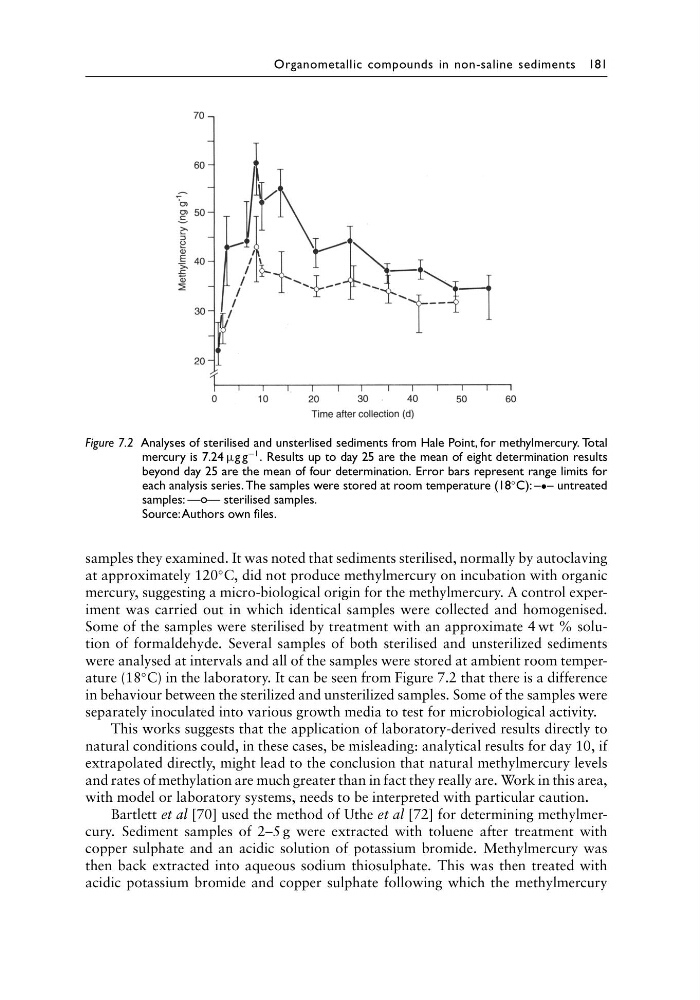
Figure 7.2 Analyses of sterilised and unsterlised sediments from Hale Point, for methylmercury. Total
mercury is 7.24 µg g
−1 . Results up to day 25 are the mean of eight determination results
beyond day 25 are the mean of four determination. Error bars represent range limits for
each analysis series. The samples were stored at room temperature (18
◦ C): –•– untreated
samples: —o— sterilised samples.
Source:Authors own files.
samples they examined. It was noted that sediments sterilised, normally by autoclaving
at approximately 120
◦ C, did not produce methylmercury on incubation with organic
mercury, suggesting a micro-biological origin for the methylmercury. A control experiment was carried out in which identical samples were collected and homogenised.
Some of the samples were sterilised by treatment with an approximate 4 wt % solution of formaldehyde. Several samples of both sterilised and unsterilized sediments
were analysed at intervals and all of the samples were stored at ambient room temperature (18
◦ C) in the laboratory. It can be seen from Figure 7.2 that there is a difference
in behaviour between the sterilized and unsterilized samples. Some of the samples were
separately inoculated into various growth media to test for microbiological activity.
This works suggests that the application of laboratory-derived results directly to
natural conditions could, in these cases, be misleading: analytical results for day 10, if
extrapolated directly, might lead to the conclusion that natural methylmercury levels
and rates of methylation are much greater than in fact they really are. Work in this area,
with model or laboratory systems, needs to be interpreted with particular caution.
Bartlett et al [70] used the method of Uthe et al [72] for determining methylmercury. Sediment samples of 2–5 g were extracted with toluene after treatment with
copper sulphate and an acidic solution of potassium bromide. Methylmercury was
then back extracted into aqueous sodium thiosulphate. This was then treated with
acidic potassium bromide and copper sulphate following which the methylmercury
Figure 7.2 Analyses of sterilised and unsterlised sediments from Hale Point, for methylmercury. Total
mercury is 7.24 µg g
−1 . Results up to day 25 are the mean of eight determination results
beyond day 25 are the mean of four determination. Error bars represent range limits for
each analysis series. The samples were stored at room temperature (18
◦ C): –•– untreated
samples: —o— sterilised samples.
Source:Authors own files.
samples they examined. It was noted that sediments sterilised, normally by autoclaving
at approximately 120
◦ C, did not produce methylmercury on incubation with organic
mercury, suggesting a micro-biological origin for the methylmercury. A control experiment was carried out in which identical samples were collected and homogenised.
Some of the samples were sterilised by treatment with an approximate 4 wt % solution of formaldehyde. Several samples of both sterilised and unsterilized sediments
were analysed at intervals and all of the samples were stored at ambient room temperature (18
◦ C) in the laboratory. It can be seen from Figure 7.2 that there is a difference
in behaviour between the sterilized and unsterilized samples. Some of the samples were
separately inoculated into various growth media to test for microbiological activity.
This works suggests that the application of laboratory-derived results directly to
natural conditions could, in these cases, be misleading: analytical results for day 10, if
extrapolated directly, might lead to the conclusion that natural methylmercury levels
and rates of methylation are much greater than in fact they really are. Work in this area,
with model or laboratory systems, needs to be interpreted with particular caution.
Bartlett et al [70] used the method of Uthe et al [72] for determining methylmercury. Sediment samples of 2–5 g were extracted with toluene after treatment with
copper sulphate and an acidic solution of potassium bromide. Methylmercury was
then back extracted into aqueous sodium thiosulphate. This was then treated with
acidic potassium bromide and copper sulphate following which the methylmercury