

Organometallic compounds in non-saline sediments 179
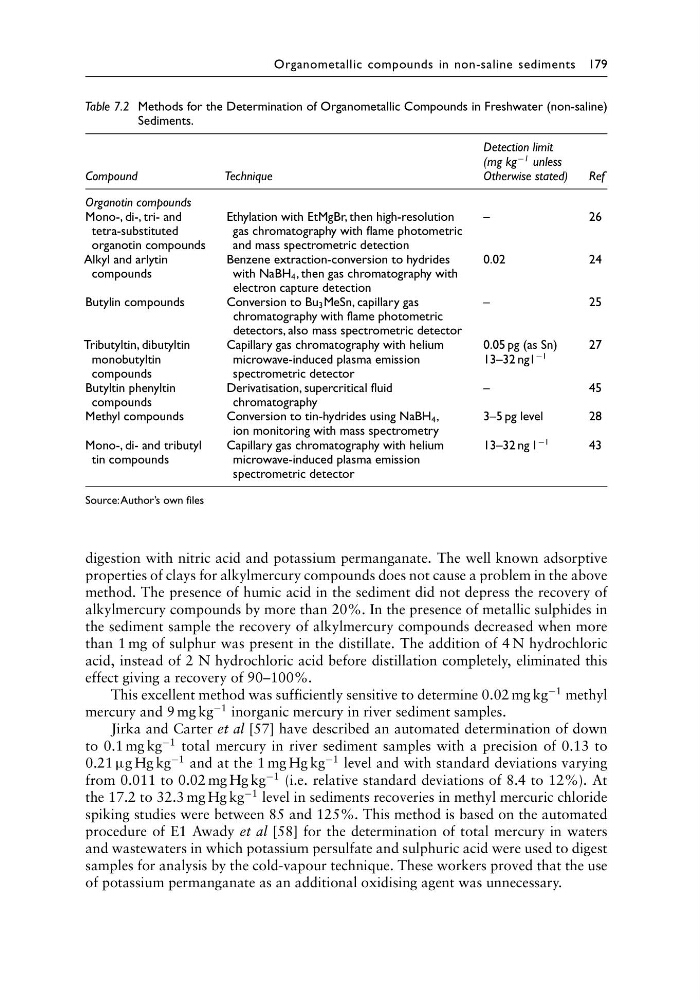
Table 7.2 Methods for the Determination of Organometallic Compounds in Freshwater (non-saline)
Sediments.
Detection limit
(mg kg
−1 unless
Compound
Technique
Otherwise stated)
Ref
Organotin compounds
Mono-, di-, tri- and
Ethylation with EtMgBr, then high-resolution
–
26
tetra-substituted
gas chromatography with flame photometric
organotin compounds
and mass spectrometric detection
Alkyl and arlytin
Benzene extraction-conversion to hydrides
0.02
24
compounds
with NaBH 4 , then gas chromatography with
electron capture detection
Butylin compounds
Conversion to Bu 3 MeSn, capillary gas
–
25
chromatography with flame photometric
detectors, also mass spectrometric detector
Tributyltin, dibutyltin
Capillary gas chromatography with helium
0.05 pg (as Sn)
27
monobutyltin
microwave-induced plasma emission
13–32 ng1
−1
compounds
spectrometric detector
Butyltin phenyltin
Derivatisation, supercritical fluid
–
45
compounds
chromatography
Methyl compounds
Conversion to tin-hydrides using NaBH 4 ,
3–5 pg level
28
ion monitoring with mass spectrometry
Mono-, di- and tributyl
Capillary gas chromatography with helium
13–32 ng 1
−1
43
tin compounds
microwave-induced plasma emission
spectrometric detector
Source:Author’s own files
digestion with nitric acid and potassium permanganate. The well known adsorptive
properties of clays for alkylmercury compounds does not cause a problem in the above
method. The presence of humic acid in the sediment did not depress the recovery of
alkylmercury compounds by more than 20%. In the presence of metallic sulphides in
the sediment sample the recovery of alkylmercury compounds decreased when more
than 1 mg of sulphur was present in the distillate. The addition of 4 N hydrochloric
acid, instead of 2 N hydrochloric acid before distillation completely, eliminated this
effect giving a recovery of 90–100%.
This excellent method was sufficiently sensitive to determine 0.02 mg kg
−1 methyl
mercury and 9 mg kg
−1 inorganic mercury in river sediment samples.
Jirka and Carter et al [57] have described an automated determination of down
to 0.1 mg kg
−1 total mercury in river sediment samples with a precision of 0.13 to
0.21 µg Hg kg
−1 and at the 1 mg Hg kg
−1 level and with standard deviations varying
from 0.011 to 0.02 mg Hg kg
−1 (i.e. relative standard deviations of 8.4 to 12%). At
the 17.2 to 32.3 mg Hg kg
−1 level in sediments recoveries in methyl mercuric chloride
spiking studies were between 85 and 125%. This method is based on the automated
procedure of E1 Awady et al [58] for the determination of total mercury in waters
and wastewaters in which potassium persulfate and sulphuric acid were used to digest
samples for analysis by the cold-vapour technique. These workers proved that the use
of potassium permanganate as an additional oxidising agent was unnecessary.
Table 7.2 Methods for the Determination of Organometallic Compounds in Freshwater (non-saline)
Sediments.
Detection limit
(mg kg
−1 unless
Compound
Technique
Otherwise stated)
Ref
Organotin compounds
Mono-, di-, tri- and
Ethylation with EtMgBr, then high-resolution
–
26
tetra-substituted
gas chromatography with flame photometric
organotin compounds
and mass spectrometric detection
Alkyl and arlytin
Benzene extraction-conversion to hydrides
0.02
24
compounds
with NaBH 4 , then gas chromatography with
electron capture detection
Butylin compounds
Conversion to Bu 3 MeSn, capillary gas
–
25
chromatography with flame photometric
detectors, also mass spectrometric detector
Tributyltin, dibutyltin
Capillary gas chromatography with helium
0.05 pg (as Sn)
27
monobutyltin
microwave-induced plasma emission
13–32 ng1
−1
compounds
spectrometric detector
Butyltin phenyltin
Derivatisation, supercritical fluid
–
45
compounds
chromatography
Methyl compounds
Conversion to tin-hydrides using NaBH 4 ,
3–5 pg level
28
ion monitoring with mass spectrometry
Mono-, di- and tributyl
Capillary gas chromatography with helium
13–32 ng 1
−1
43
tin compounds
microwave-induced plasma emission
spectrometric detector
Source:Author’s own files
digestion with nitric acid and potassium permanganate. The well known adsorptive
properties of clays for alkylmercury compounds does not cause a problem in the above
method. The presence of humic acid in the sediment did not depress the recovery of
alkylmercury compounds by more than 20%. In the presence of metallic sulphides in
the sediment sample the recovery of alkylmercury compounds decreased when more
than 1 mg of sulphur was present in the distillate. The addition of 4 N hydrochloric
acid, instead of 2 N hydrochloric acid before distillation completely, eliminated this
effect giving a recovery of 90–100%.
This excellent method was sufficiently sensitive to determine 0.02 mg kg
−1 methyl
mercury and 9 mg kg
−1 inorganic mercury in river sediment samples.
Jirka and Carter et al [57] have described an automated determination of down
to 0.1 mg kg
−1 total mercury in river sediment samples with a precision of 0.13 to
0.21 µg Hg kg
−1 and at the 1 mg Hg kg
−1 level and with standard deviations varying
from 0.011 to 0.02 mg Hg kg
−1 (i.e. relative standard deviations of 8.4 to 12%). At
the 17.2 to 32.3 mg Hg kg
−1 level in sediments recoveries in methyl mercuric chloride
spiking studies were between 85 and 125%. This method is based on the automated
procedure of E1 Awady et al [58] for the determination of total mercury in waters
and wastewaters in which potassium persulfate and sulphuric acid were used to digest
samples for analysis by the cold-vapour technique. These workers proved that the use
of potassium permanganate as an additional oxidising agent was unnecessary.