

6 Organic compounds in soils, sediments & sludges
Table 1.2 Applications of subcritical water extraction to the determination of organic compounds
in soil.
Subcritical water
Determined
extractant
Sorbent trap
Analytical Finish
Reference
Mixtures of
Water
Miscellaneous
43
herbicides
traps
Terbuthylazine
Phosphate
Graphitised
43
and metabolites
buffed water
carbon block
cartridge
Herbicides and
Water
Miscellaneous
71
breakdown products
traps
Polycyclic aromatic
Static subcritical Styrene-divinyl
72
water
benzene discs
hydrocarbons
Polycyclic aromatic
Water
Solid phase
High performance
73
liquid chromatography,
hydrocarbons
post column fluorimetric
fluorimetric detection
Polychlorobiphenyls
Water
–
74
250–300
◦ C and
50 atmospheres
pressure
Polychlorobiphenyls
Water
Solid phase
5
microextraction
Source:Author’s Own Files
1.5 SUBCRITICAL WATER EXTRACTION
This technique, as discussed above under “Accelerated Solvent Extraction’’, has the
outstanding advantage that extraction with water as opposed to organic solvents does
not cause contamination of the extract with potentially interfering organic components
such as cellulose, lignin and waxes originating in plant cells or interference due to
contamination by the solvent or impurities therein.
Crescenzi et al [69] evaluated the feasibility of selectively extracting phenoxyacetic
acid herbicides with subcritical hot water and collecting the analytes on a Carbograph-4
solid-phase extraction cartridge set on-line with the extraction cell. Final analysis was
by liquid chromatography-mass spectrometry with an electrospray ion source. With
few exceptions, recoveries were in the range 81 to 93% (with the exception of 24 DB
and MCPB which gave 63%) recovery and detection limits of between 1.7 and 10 ng/g.
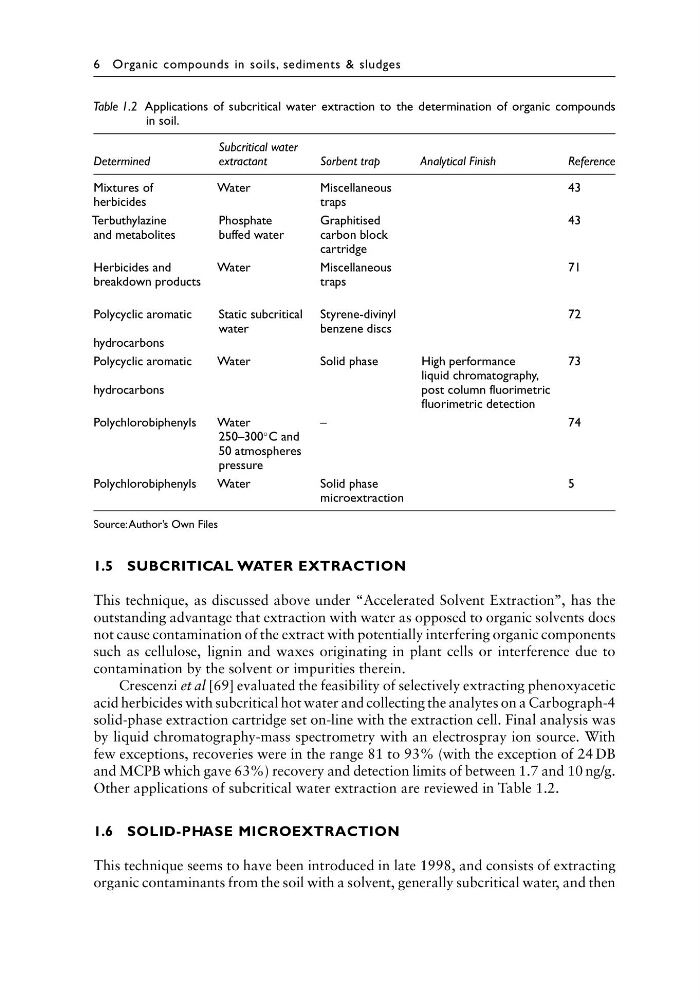
Other applications of subcritical water extraction are reviewed in Table 1.2.
1.6 SOLID-PHASE MICROEXTRACTION
This technique seems to have been introduced in late 1998, and consists of extracting
organic contaminants from the soil with a solvent, generally subcritical water, and then
Table 1.2 Applications of subcritical water extraction to the determination of organic compounds
in soil.
Subcritical water
Determined
extractant
Sorbent trap
Analytical Finish
Reference
Mixtures of
Water
Miscellaneous
43
herbicides
traps
Terbuthylazine
Phosphate
Graphitised
43
and metabolites
buffed water
carbon block
cartridge
Herbicides and
Water
Miscellaneous
71
breakdown products
traps
Polycyclic aromatic
Static subcritical Styrene-divinyl
72
water
benzene discs
hydrocarbons
Polycyclic aromatic
Water
Solid phase
High performance
73
liquid chromatography,
hydrocarbons
post column fluorimetric
fluorimetric detection
Polychlorobiphenyls
Water
–
74
250–300
◦ C and
50 atmospheres
pressure
Polychlorobiphenyls
Water
Solid phase
5
microextraction
Source:Author’s Own Files
1.5 SUBCRITICAL WATER EXTRACTION
This technique, as discussed above under “Accelerated Solvent Extraction’’, has the
outstanding advantage that extraction with water as opposed to organic solvents does
not cause contamination of the extract with potentially interfering organic components
such as cellulose, lignin and waxes originating in plant cells or interference due to
contamination by the solvent or impurities therein.
Crescenzi et al [69] evaluated the feasibility of selectively extracting phenoxyacetic
acid herbicides with subcritical hot water and collecting the analytes on a Carbograph-4
solid-phase extraction cartridge set on-line with the extraction cell. Final analysis was
by liquid chromatography-mass spectrometry with an electrospray ion source. With
few exceptions, recoveries were in the range 81 to 93% (with the exception of 24 DB
and MCPB which gave 63%) recovery and detection limits of between 1.7 and 10 ng/g.
Other applications of subcritical water extraction are reviewed in Table 1.2.
1.6 SOLID-PHASE MICROEXTRACTION
This technique seems to have been introduced in late 1998, and consists of extracting
organic contaminants from the soil with a solvent, generally subcritical water, and then