

Organic compounds in non-saline sediments 155
ion pair rapidly converts the sulphur to thiosulphate in an organic phase. The recovery of added organochlorine insecticides was above 80% and the detection limit in the
range of 1–10 ppb from a 10 g sample. Elemental sulphur present in most sediment and
digested sludge has caused significant problems in residue analysis [168, 169]. If the
sulphur level is high, the electron capture detector will be saturated for a considerable
period of time, and if the level of sulphur is low, it gives three or more distinct peaks
in the chromatogram which can interfere with BHC isomers and Aldrin. Treatment of
the crude extract with potassium hydroxide in ethanol or Raney nickel will quantitatively destroy all sulphur, but will at the same time convert DDT and DDD to DDE
and DDMU (1-chloro-2,2-bis(4-chlorophenyl) ethane), respectively, and most BHC
isomers are lost. Metallic mercury has also been used for removal of sulphur [170].
Jensen et al [168] described an efficient, rapid, non-destructive method to remove the
sulphur according to the reaction:
(TBA
+ ) 2 SO
2−
3 + S(s) → 2TBA
+
+ S 2 O
2−
3
where TBA
+
= tetrabutylammonium ion.
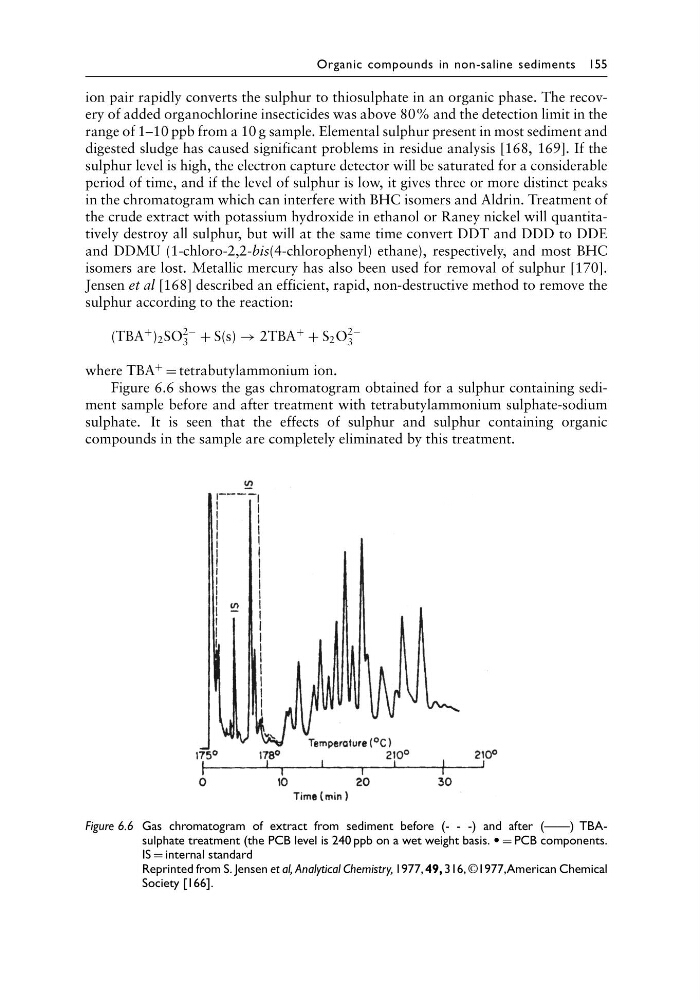
Figure 6.6 shows the gas chromatogram obtained for a sulphur containing sediment sample before and after treatment with tetrabutylammonium sulphate-sodium
sulphate. It is seen that the effects of sulphur and sulphur containing organic
compounds in the sample are completely eliminated by this treatment.
Figure 6.6 Gas chromatogram of extract from sediment before (- - -) and after (——) TBAsulphate treatment (the PCB level is 240 ppb on a wet weight basis. • = PCB components.
IS = internal standard
Reprinted from S. Jensen et al, Analytical Chemistry, 1977, 49, 316, ©1977,American Chemical
Society [166].
ion pair rapidly converts the sulphur to thiosulphate in an organic phase. The recovery of added organochlorine insecticides was above 80% and the detection limit in the
range of 1–10 ppb from a 10 g sample. Elemental sulphur present in most sediment and
digested sludge has caused significant problems in residue analysis [168, 169]. If the
sulphur level is high, the electron capture detector will be saturated for a considerable
period of time, and if the level of sulphur is low, it gives three or more distinct peaks
in the chromatogram which can interfere with BHC isomers and Aldrin. Treatment of
the crude extract with potassium hydroxide in ethanol or Raney nickel will quantitatively destroy all sulphur, but will at the same time convert DDT and DDD to DDE
and DDMU (1-chloro-2,2-bis(4-chlorophenyl) ethane), respectively, and most BHC
isomers are lost. Metallic mercury has also been used for removal of sulphur [170].
Jensen et al [168] described an efficient, rapid, non-destructive method to remove the
sulphur according to the reaction:
(TBA
+ ) 2 SO
2−
3 + S(s) → 2TBA
+
+ S 2 O
2−
3
where TBA
+
= tetrabutylammonium ion.
Figure 6.6 shows the gas chromatogram obtained for a sulphur containing sediment sample before and after treatment with tetrabutylammonium sulphate-sodium
sulphate. It is seen that the effects of sulphur and sulphur containing organic
compounds in the sample are completely eliminated by this treatment.
Figure 6.6 Gas chromatogram of extract from sediment before (- - -) and after (——) TBAsulphate treatment (the PCB level is 240 ppb on a wet weight basis. • = PCB components.
IS = internal standard
Reprinted from S. Jensen et al, Analytical Chemistry, 1977, 49, 316, ©1977,American Chemical
Society [166].