

148 Organic compounds in soils, sediments & sludges
Sediment samples by GC-ECD and GC ϫ GC-ECD
800
700
600
500
400
300
200
100
0
Concentration (ng g
Ϫ1
)
D M D T *
P , P Ј - D D T
P , P Ј - D D E
P , P Ј - D D D
H e p t a c h l o r
H - E p o x i d e *
E n d o s S
E n d o s I
D i e l d r i n
E n d r i n
A l d r i n
γ - B H C
β - B H C
γ - C H L A
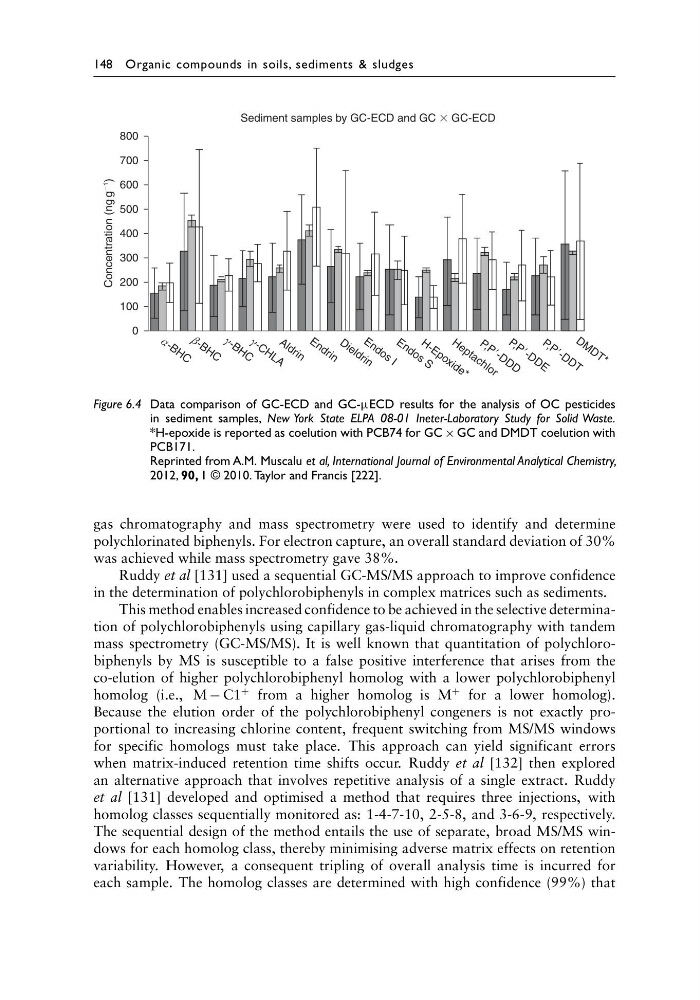
Figure 6.4 Data comparison of GC-ECD and GC-µECD results for the analysis of OC pesticides
in sediment samples, New York State ELPA 08-01 Ineter-Laboratory Study for Solid Waste.
*H-epoxide is reported as coelution with PCB74 for GC × GC and DMDT coelution with
PCB171.
Reprinted from A.M. Muscalu et al, International Journal of Environmental Analytical Chemistry,
2012, 90, 1 © 2010. Taylor and Francis [222].
gas chromatography and mass spectrometry were used to identify and determine
polychlorinated biphenyls. For electron capture, an overall standard deviation of 30%
was achieved while mass spectrometry gave 38%.
Ruddy et al [131] used a sequential GC-MS/MS approach to improve confidence
in the determination of polychlorobiphenyls in complex matrices such as sediments.
This method enables increased confidence to be achieved in the selective determination of polychlorobiphenyls using capillary gas-liquid chromatography with tandem
mass spectrometry (GC-MS/MS). It is well known that quantitation of polychlorobiphenyls by MS is susceptible to a false positive interference that arises from the
co-elution of higher polychlorobiphenyl homolog with a lower polychlorobiphenyl
homolog (i.e., M − C1
+ from a higher homolog is M
+ for a lower homolog).
Because the elution order of the polychlorobiphenyl congeners is not exactly proportional to increasing chlorine content, frequent switching from MS/MS windows
for specific homologs must take place. This approach can yield significant errors
when matrix-induced retention time shifts occur. Ruddy et al [132] then explored
an alternative approach that involves repetitive analysis of a single extract. Ruddy
et al [131] developed and optimised a method that requires three injections, with
homolog classes sequentially monitored as: 1-4-7-10, 2-5-8, and 3-6-9, respectively.
The sequential design of the method entails the use of separate, broad MS/MS windows for each homolog class, thereby minimising adverse matrix effects on retention
variability. However, a consequent tripling of overall analysis time is incurred for
each sample. The homolog classes are determined with high confidence (99%) that
Sediment samples by GC-ECD and GC ϫ GC-ECD
800
700
600
500
400
300
200
100
0
Concentration (ng g
Ϫ1
)
D M D T *
P , P Ј - D D T
P , P Ј - D D E
P , P Ј - D D D
H e p t a c h l o r
H - E p o x i d e *
E n d o s S
E n d o s I
D i e l d r i n
E n d r i n
A l d r i n
γ - B H C
β - B H C
γ - C H L A
Figure 6.4 Data comparison of GC-ECD and GC-µECD results for the analysis of OC pesticides
in sediment samples, New York State ELPA 08-01 Ineter-Laboratory Study for Solid Waste.
*H-epoxide is reported as coelution with PCB74 for GC × GC and DMDT coelution with
PCB171.
Reprinted from A.M. Muscalu et al, International Journal of Environmental Analytical Chemistry,
2012, 90, 1 © 2010. Taylor and Francis [222].
gas chromatography and mass spectrometry were used to identify and determine
polychlorinated biphenyls. For electron capture, an overall standard deviation of 30%
was achieved while mass spectrometry gave 38%.
Ruddy et al [131] used a sequential GC-MS/MS approach to improve confidence
in the determination of polychlorobiphenyls in complex matrices such as sediments.
This method enables increased confidence to be achieved in the selective determination of polychlorobiphenyls using capillary gas-liquid chromatography with tandem
mass spectrometry (GC-MS/MS). It is well known that quantitation of polychlorobiphenyls by MS is susceptible to a false positive interference that arises from the
co-elution of higher polychlorobiphenyl homolog with a lower polychlorobiphenyl
homolog (i.e., M − C1
+ from a higher homolog is M
+ for a lower homolog).
Because the elution order of the polychlorobiphenyl congeners is not exactly proportional to increasing chlorine content, frequent switching from MS/MS windows
for specific homologs must take place. This approach can yield significant errors
when matrix-induced retention time shifts occur. Ruddy et al [132] then explored
an alternative approach that involves repetitive analysis of a single extract. Ruddy
et al [131] developed and optimised a method that requires three injections, with
homolog classes sequentially monitored as: 1-4-7-10, 2-5-8, and 3-6-9, respectively.
The sequential design of the method entails the use of separate, broad MS/MS windows for each homolog class, thereby minimising adverse matrix effects on retention
variability. However, a consequent tripling of overall analysis time is incurred for
each sample. The homolog classes are determined with high confidence (99%) that