

146 Organic compounds in soils, sediments & sludges
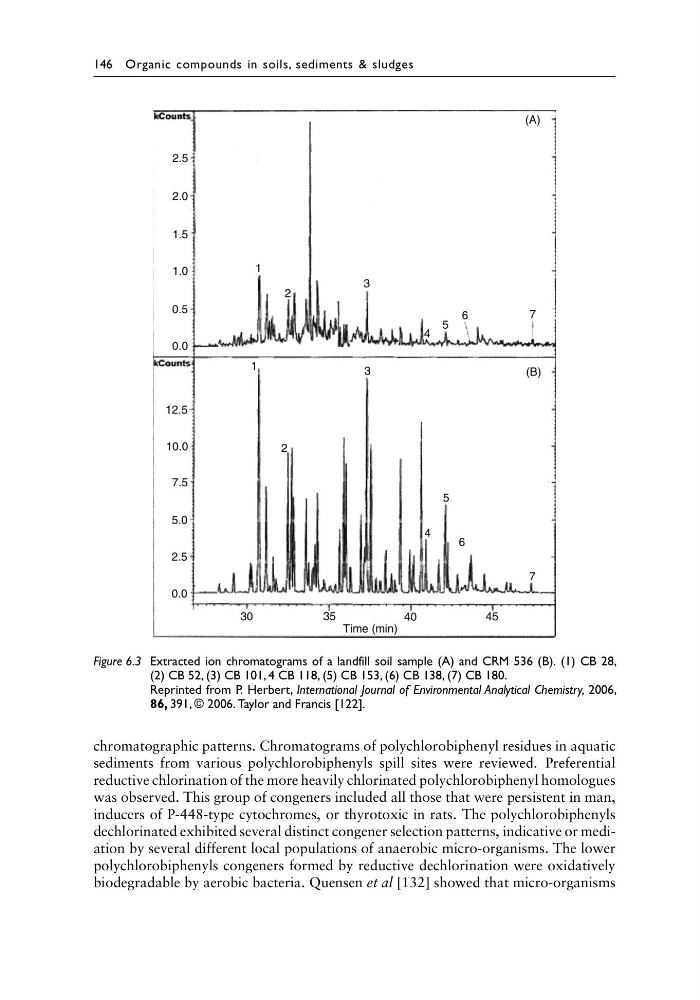
Figure 6.3 Extracted ion chromatograms of a landfill soil sample (A) and CRM 536 (B). (1) CB 28,
(2) CB 52, (3) CB 101, 4 CB 118, (5) CB 153, (6) CB 138, (7) CB 180.
Reprinted from P. Herbert, International Journal of Environmental Analytical Chemistry, 2006,
86, 391, © 2006. Taylor and Francis [122].
chromatographic patterns. Chromatograms of polychlorobiphenyl residues in aquatic
sediments from various polychlorobiphenyls spill sites were reviewed. Preferential
reductive chlorination of the more heavily chlorinated polychlorobiphenyl homologues
was observed. This group of congeners included all those that were persistent in man,
inducers of P-448-type cytochromes, or thyrotoxic in rats. The polychlorobiphenyls
dechlorinated exhibited several distinct congener selection patterns, indicative or mediation by several different local populations of anaerobic micro-organisms. The lower
polychlorobiphenyls congeners formed by reductive dechlorination were oxidatively
biodegradable by aerobic bacteria. Quensen et al [132] showed that micro-organisms
Figure 6.3 Extracted ion chromatograms of a landfill soil sample (A) and CRM 536 (B). (1) CB 28,
(2) CB 52, (3) CB 101, 4 CB 118, (5) CB 153, (6) CB 138, (7) CB 180.
Reprinted from P. Herbert, International Journal of Environmental Analytical Chemistry, 2006,
86, 391, © 2006. Taylor and Francis [122].
chromatographic patterns. Chromatograms of polychlorobiphenyl residues in aquatic
sediments from various polychlorobiphenyls spill sites were reviewed. Preferential
reductive chlorination of the more heavily chlorinated polychlorobiphenyl homologues
was observed. This group of congeners included all those that were persistent in man,
inducers of P-448-type cytochromes, or thyrotoxic in rats. The polychlorobiphenyls
dechlorinated exhibited several distinct congener selection patterns, indicative or mediation by several different local populations of anaerobic micro-organisms. The lower
polychlorobiphenyls congeners formed by reductive dechlorination were oxidatively
biodegradable by aerobic bacteria. Quensen et al [132] showed that micro-organisms