

98 Organic compounds in soils, sediments & sludges
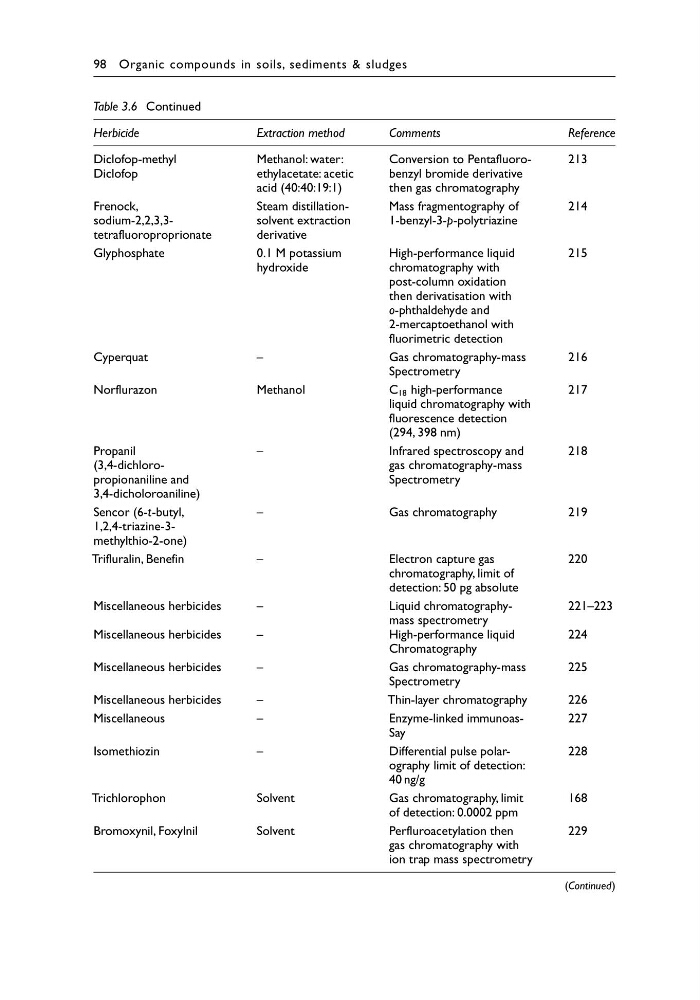
Table 3.6 Continued
Herbicide
Extraction method
Comments
Reference
Diclofop-methyl
Methanol: water:
Conversion to Pentafluoro213
Diclofop
ethylacetate: acetic
benzyl bromide derivative
acid (40:40:19:1)
then gas chromatography
Frenock,
Steam distillationMass fragmentography of
214
sodium-2,2,3,3solvent extraction
1-benzyl-3-p-polytriazine
tetrafluoroproprionate
derivative
Glyphosphate
0.1 M potassium
High-performance liquid
215
hydroxide
chromatography with
post-column oxidation
then derivatisation with
o-phthaldehyde and
2-mercaptoethanol with
fluorimetric detection
Cyperquat
–
Gas chromatography-mass
216
Spectrometry
Norflurazon
Methanol
C 18 high-performance
217
liquid chromatography with
fluorescence detection
(294, 398 nm)
Propanil
–
Infrared spectroscopy and
218
(3,4-dichlorogas chromatography-mass
propionaniline and
Spectrometry
3,4-dicholoroaniline)
Sencor (6-t-butyl,
–
Gas chromatography
219
1,2,4-triazine-3methylthio-2-one)
Trifluralin, Benefin
–
Electron capture gas
220
chromatography, limit of
detection: 50 pg absolute
Miscellaneous herbicides
–
Liquid chromatography221–223
mass spectrometry
Miscellaneous herbicides
–
High-performance liquid
224
Chromatography
Miscellaneous herbicides
–
Gas chromatography-mass
225
Spectrometry
Miscellaneous herbicides
–
Thin-layer chromatography
226
Miscellaneous
–
Enzyme-linked immunoas227
Say
Isomethiozin
–
Differential pulse polar228
ography limit of detection:
40 ng/g
Trichlorophon
Solvent
Gas chromatography, limit
168
of detection: 0.0002 ppm
Bromoxynil, Foxylnil
Solvent
Perfluroacetylation then
229
gas chromatography with
ion trap mass spectrometry
(Continued)
Table 3.6 Continued
Herbicide
Extraction method
Comments
Reference
Diclofop-methyl
Methanol: water:
Conversion to Pentafluoro213
Diclofop
ethylacetate: acetic
benzyl bromide derivative
acid (40:40:19:1)
then gas chromatography
Frenock,
Steam distillationMass fragmentography of
214
sodium-2,2,3,3solvent extraction
1-benzyl-3-p-polytriazine
tetrafluoroproprionate
derivative
Glyphosphate
0.1 M potassium
High-performance liquid
215
hydroxide
chromatography with
post-column oxidation
then derivatisation with
o-phthaldehyde and
2-mercaptoethanol with
fluorimetric detection
Cyperquat
–
Gas chromatography-mass
216
Spectrometry
Norflurazon
Methanol
C 18 high-performance
217
liquid chromatography with
fluorescence detection
(294, 398 nm)
Propanil
–
Infrared spectroscopy and
218
(3,4-dichlorogas chromatography-mass
propionaniline and
Spectrometry
3,4-dicholoroaniline)
Sencor (6-t-butyl,
–
Gas chromatography
219
1,2,4-triazine-3methylthio-2-one)
Trifluralin, Benefin
–
Electron capture gas
220
chromatography, limit of
detection: 50 pg absolute
Miscellaneous herbicides
–
Liquid chromatography221–223
mass spectrometry
Miscellaneous herbicides
–
High-performance liquid
224
Chromatography
Miscellaneous herbicides
–
Gas chromatography-mass
225
Spectrometry
Miscellaneous herbicides
–
Thin-layer chromatography
226
Miscellaneous
–
Enzyme-linked immunoas227
Say
Isomethiozin
–
Differential pulse polar228
ography limit of detection:
40 ng/g
Trichlorophon
Solvent
Gas chromatography, limit
168
of detection: 0.0002 ppm
Bromoxynil, Foxylnil
Solvent
Perfluroacetylation then
229
gas chromatography with
ion trap mass spectrometry
(Continued)