

88 Organic compounds in soils, sediments & sludges
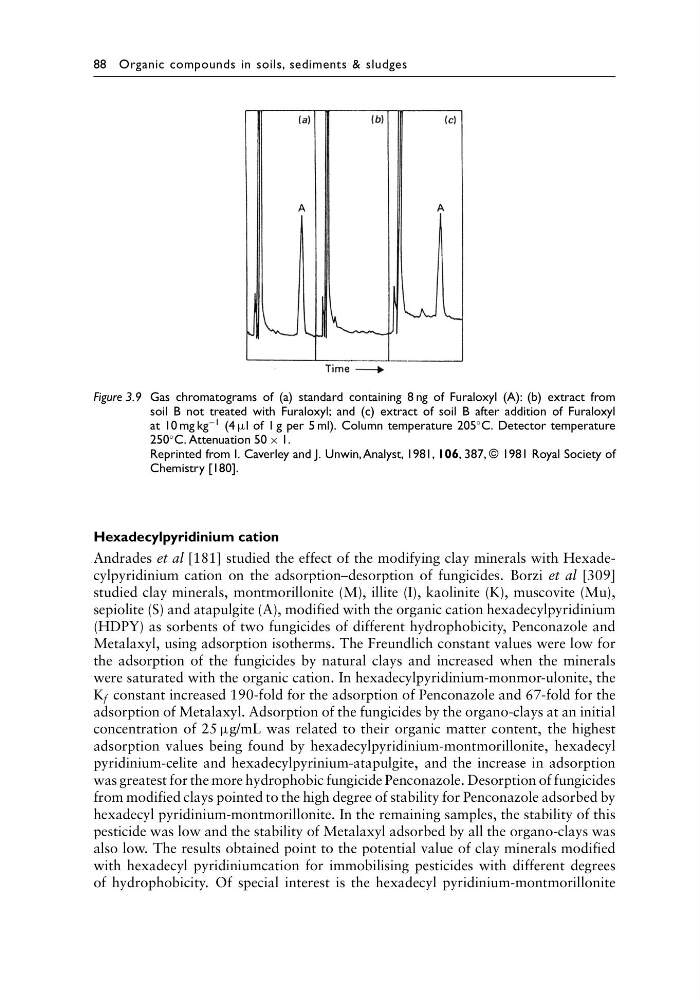
Figure 3.9 Gas chromatograms of (a) standard containing 8 ng of Furaloxyl (A): (b) extract from
soil B not treated with Furaloxyl; and (c) extract of soil B after addition of Furaloxyl
at 10 mg kg
−1 (4 µl of 1 g per 5 ml). Column temperature 205
◦ C. Detector temperature
250
◦ C. Attenuation 50 × 1.
Reprinted from I. Caverley and J. Unwin, Analyst, 1981, 106, 387, © 1981 Royal Society of
Chemistry [180].
Hexadecylpyridinium cation
Andrades et al [181] studied the effect of the modifying clay minerals with Hexadecylpyridinium cation on the adsorption–desorption of fungicides. Borzi et al [309]
studied clay minerals, montmorillonite (M), illite (I), kaolinite (K), muscovite (Mu),
sepiolite (S) and atapulgite (A), modified with the organic cation hexadecylpyridinium
(HDPY) as sorbents of two fungicides of different hydrophobicity, Penconazole and
Metalaxyl, using adsorption isotherms. The Freundlich constant values were low for
the adsorption of the fungicides by natural clays and increased when the minerals
were saturated with the organic cation. In hexadecylpyridinium-monmor-ulonite, the
K f constant increased 190-fold for the adsorption of Penconazole and 67-fold for the
adsorption of Metalaxyl. Adsorption of the fungicides by the organo-clays at an initial
concentration of 25 µg/mL was related to their organic matter content, the highest
adsorption values being found by hexadecylpyridinium-montmorillonite, hexadecyl
pyridinium-celite and hexadecylpyrinium-atapulgite, and the increase in adsorption
was greatest for the more hydrophobic fungicide Penconazole. Desorption of fungicides
from modified clays pointed to the high degree of stability for Penconazole adsorbed by
hexadecyl pyridinium-montmorillonite. In the remaining samples, the stability of this
pesticide was low and the stability of Metalaxyl adsorbed by all the organo-clays was
also low. The results obtained point to the potential value of clay minerals modified
with hexadecyl pyridiniumcation for immobilising pesticides with different degrees
of hydrophobicity. Of special interest is the hexadecyl pyridinium-montmorillonite
Figure 3.9 Gas chromatograms of (a) standard containing 8 ng of Furaloxyl (A): (b) extract from
soil B not treated with Furaloxyl; and (c) extract of soil B after addition of Furaloxyl
at 10 mg kg
−1 (4 µl of 1 g per 5 ml). Column temperature 205
◦ C. Detector temperature
250
◦ C. Attenuation 50 × 1.
Reprinted from I. Caverley and J. Unwin, Analyst, 1981, 106, 387, © 1981 Royal Society of
Chemistry [180].
Hexadecylpyridinium cation
Andrades et al [181] studied the effect of the modifying clay minerals with Hexadecylpyridinium cation on the adsorption–desorption of fungicides. Borzi et al [309]
studied clay minerals, montmorillonite (M), illite (I), kaolinite (K), muscovite (Mu),
sepiolite (S) and atapulgite (A), modified with the organic cation hexadecylpyridinium
(HDPY) as sorbents of two fungicides of different hydrophobicity, Penconazole and
Metalaxyl, using adsorption isotherms. The Freundlich constant values were low for
the adsorption of the fungicides by natural clays and increased when the minerals
were saturated with the organic cation. In hexadecylpyridinium-monmor-ulonite, the
K f constant increased 190-fold for the adsorption of Penconazole and 67-fold for the
adsorption of Metalaxyl. Adsorption of the fungicides by the organo-clays at an initial
concentration of 25 µg/mL was related to their organic matter content, the highest
adsorption values being found by hexadecylpyridinium-montmorillonite, hexadecyl
pyridinium-celite and hexadecylpyrinium-atapulgite, and the increase in adsorption
was greatest for the more hydrophobic fungicide Penconazole. Desorption of fungicides
from modified clays pointed to the high degree of stability for Penconazole adsorbed by
hexadecyl pyridinium-montmorillonite. In the remaining samples, the stability of this
pesticide was low and the stability of Metalaxyl adsorbed by all the organo-clays was
also low. The results obtained point to the potential value of clay minerals modified
with hexadecyl pyridiniumcation for immobilising pesticides with different degrees
of hydrophobicity. Of special interest is the hexadecyl pyridinium-montmorillonite