

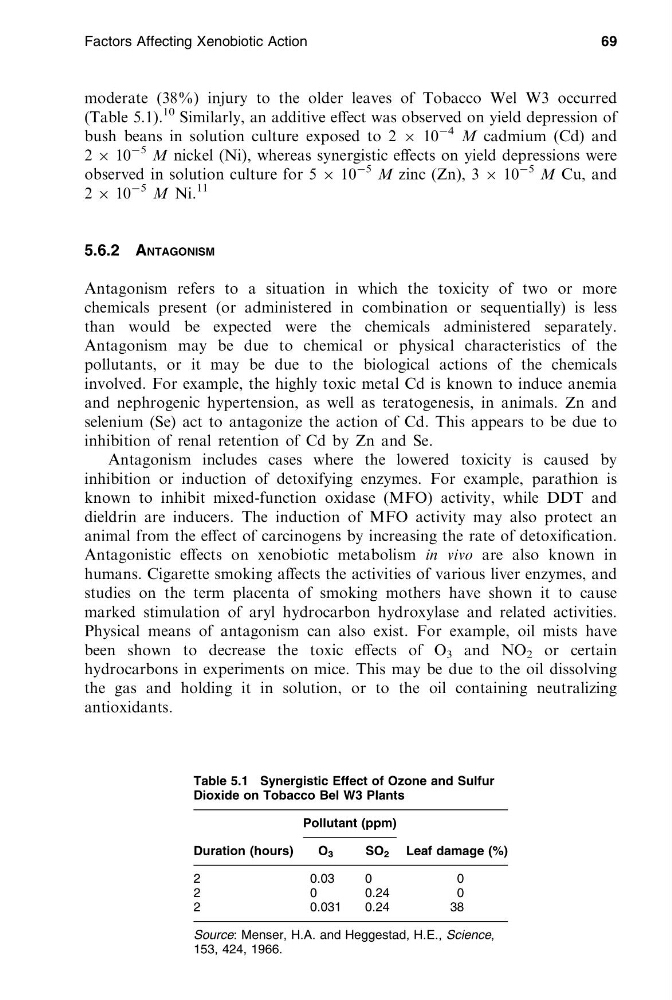
moderate (38%) injury to the older leaves of Tobacco Wel W3 occurred
(Table 5.1).
10 Similarly, an additive effect was observed on yield depression of
bush beans in solution culture exposed to 2 Â 10
À4 M cadmium (Cd) and
2 Â 10
À5 M nickel (Ni), whereas synergistic effects on yield depressions were
observed in solution culture for 5 Â 10
À5 M zinc (Zn), 3 Â 10
À5 M Cu, and
2 Â 10
À5 M Ni.
11
5.6.2 ANTAGONISM
Antagonism refers to a situation in which the toxicity of two or more
chemicals present (or administered in combination or sequentially) is less
than would be expected were the chemicals administered separately.
Antagonism may be due to chemical or physical characteristics of the
pollutants, or it may be due to the biological actions of the chemicals
involved. For example, the highly toxic metal Cd is known to induce anemia
and nephrogenic hypertension, as well as teratogenesis, in animals. Zn and
selenium (Se) act to antagonize the action of Cd. This appears to be due to
inhibition of renal retention of Cd by Zn and Se.
Antagonism includes cases where the lowered toxicity is caused by
inhibition or induction of detoxifying enzymes. For example, parathion is
known to inhibit mixed-function oxidase (MFO) activity, while DDT and
dieldrin are inducers. The induction of MFO activity may also protect an
animal from the effect of carcinogens by increasing the rate of detoxification.
Antagonistic effects on xenobiotic metabolism in vivo are also known in
humans. Cigarette smoking affects the activities of various liver enzymes, and
studies on the term placenta of smoking mothers have shown it to cause
marked stimulation of aryl hydrocarbon hydroxylase and related activities.
Physical means of antagonism can also exist. For example, oil mists have
been shown to decrease the toxic effects of O 3 and NO 2 or certain
hydrocarbons in experiments on mice. This may be due to the oil dissolving
the gas and holding it in solution, or to the oil containing neutralizing
antioxidants.
Factors Affecting Xenobiotic Action
69
[16:54 26/8/04 P:/CRC PRESS/4365 MING-HO.751 (1670)/4365-005.3d]
Ref: 4365 MING-HO YU Chap-005 Page: 69 65-84
Table 5.1 Synergistic Effect of Ozone and Sulfur
Dioxide on Tobacco Bel W3 Plants
Duration (hours)
Pollutant (ppm)
Leaf damage (%)
O 3
SO 2
2
0.03
0
0
2
0
0.24
0
2
0.031
0.24
38
Source: Menser, H.A. and Heggestad, H.E., Science,
153, 424, 1966.
(Table 5.1).
10 Similarly, an additive effect was observed on yield depression of
bush beans in solution culture exposed to 2 Â 10
À4 M cadmium (Cd) and
2 Â 10
À5 M nickel (Ni), whereas synergistic effects on yield depressions were
observed in solution culture for 5 Â 10
À5 M zinc (Zn), 3 Â 10
À5 M Cu, and
2 Â 10
À5 M Ni.
11
5.6.2 ANTAGONISM
Antagonism refers to a situation in which the toxicity of two or more
chemicals present (or administered in combination or sequentially) is less
than would be expected were the chemicals administered separately.
Antagonism may be due to chemical or physical characteristics of the
pollutants, or it may be due to the biological actions of the chemicals
involved. For example, the highly toxic metal Cd is known to induce anemia
and nephrogenic hypertension, as well as teratogenesis, in animals. Zn and
selenium (Se) act to antagonize the action of Cd. This appears to be due to
inhibition of renal retention of Cd by Zn and Se.
Antagonism includes cases where the lowered toxicity is caused by
inhibition or induction of detoxifying enzymes. For example, parathion is
known to inhibit mixed-function oxidase (MFO) activity, while DDT and
dieldrin are inducers. The induction of MFO activity may also protect an
animal from the effect of carcinogens by increasing the rate of detoxification.
Antagonistic effects on xenobiotic metabolism in vivo are also known in
humans. Cigarette smoking affects the activities of various liver enzymes, and
studies on the term placenta of smoking mothers have shown it to cause
marked stimulation of aryl hydrocarbon hydroxylase and related activities.
Physical means of antagonism can also exist. For example, oil mists have
been shown to decrease the toxic effects of O 3 and NO 2 or certain
hydrocarbons in experiments on mice. This may be due to the oil dissolving
the gas and holding it in solution, or to the oil containing neutralizing
antioxidants.
Factors Affecting Xenobiotic Action
69
[16:54 26/8/04 P:/CRC PRESS/4365 MING-HO.751 (1670)/4365-005.3d]
Ref: 4365 MING-HO YU Chap-005 Page: 69 65-84
Table 5.1 Synergistic Effect of Ozone and Sulfur
Dioxide on Tobacco Bel W3 Plants
Duration (hours)
Pollutant (ppm)
Leaf damage (%)
O 3
SO 2
2
0.03
0
0
2
0
0.24
0
2
0.031
0.24
38
Source: Menser, H.A. and Heggestad, H.E., Science,
153, 424, 1966.