

Plants exposed to different kinds of pollutants often show depressed growth
or enzyme activity. For example, mung bean seedlings exposed to varying
concentrations of sodium fluoride (NaF) for 3 days showed significant
decreases in root elongation and the activity of invertase, a key enzyme
responsible for the breakdown of sucrose into glucose and fructose. Invertase
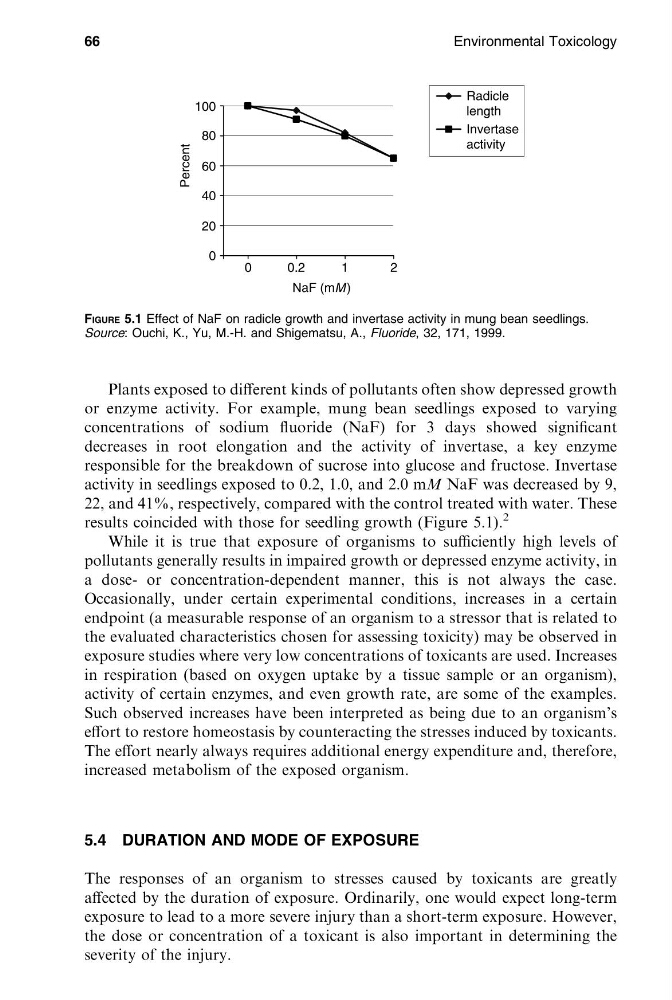
activity in seedlings exposed to 0.2, 1.0, and 2.0 mM NaF was decreased by 9,
22, and 41%, respectively, compared with the control treated with water. These
results coincided with those for seedling growth (Figure 5.1).
2
While it is true that exposure of organisms to sufficiently high levels of
pollutants generally results in impaired growth or depressed enzyme activity, in
a dose- or concentration-dependent manner, this is not always the case.
Occasionally, under certain experimental conditions, increases in a certain
endpoint (a measurable response of an organism to a stressor that is related to
the evaluated characteristics chosen for assessing toxicity) may be observed in
exposure studies where very low concentrations of toxicants are used. Increases
in respiration (based on oxygen uptake by a tissue sample or an organism),
activity of certain enzymes, and even growth rate, are some of the examples.
Such observed increases have been interpreted as being due to an organism’s
effort to restore homeostasis by counteracting the stresses induced by toxicants.
The effort nearly always requires additional energy expenditure and, therefore,
increased metabolism of the exposed organism.
5.4 DURATION AND MODE OF EXPOSURE
The responses of an organism to stresses caused by toxicants are greatly
affected by the duration of exposure. Ordinarily, one would expect long-term
exposure to lead to a more severe injury than a short-term exposure. However,
the dose or concentration of a toxicant is also important in determining the
severity of the injury.
66
Environmental Toxicology
[16:54 26/8/04 P:/CRC PRESS/4365 MING-HO.751 (1670)/4365-005.3d]
Ref: 4365 MING-HO YU Chap-005 Page: 66 65-84
FIGURE 5.1 Effect of NaF on radicle growth and invertase activity in mung bean seedlings.
Source: Ouchi, K., Yu, M.-H. and Shigematsu, A., Fluoride, 32, 171, 1999.
or enzyme activity. For example, mung bean seedlings exposed to varying
concentrations of sodium fluoride (NaF) for 3 days showed significant
decreases in root elongation and the activity of invertase, a key enzyme
responsible for the breakdown of sucrose into glucose and fructose. Invertase
activity in seedlings exposed to 0.2, 1.0, and 2.0 mM NaF was decreased by 9,
22, and 41%, respectively, compared with the control treated with water. These
results coincided with those for seedling growth (Figure 5.1).
2
While it is true that exposure of organisms to sufficiently high levels of
pollutants generally results in impaired growth or depressed enzyme activity, in
a dose- or concentration-dependent manner, this is not always the case.
Occasionally, under certain experimental conditions, increases in a certain
endpoint (a measurable response of an organism to a stressor that is related to
the evaluated characteristics chosen for assessing toxicity) may be observed in
exposure studies where very low concentrations of toxicants are used. Increases
in respiration (based on oxygen uptake by a tissue sample or an organism),
activity of certain enzymes, and even growth rate, are some of the examples.
Such observed increases have been interpreted as being due to an organism’s
effort to restore homeostasis by counteracting the stresses induced by toxicants.
The effort nearly always requires additional energy expenditure and, therefore,
increased metabolism of the exposed organism.
5.4 DURATION AND MODE OF EXPOSURE
The responses of an organism to stresses caused by toxicants are greatly
affected by the duration of exposure. Ordinarily, one would expect long-term
exposure to lead to a more severe injury than a short-term exposure. However,
the dose or concentration of a toxicant is also important in determining the
severity of the injury.
66
Environmental Toxicology
[16:54 26/8/04 P:/CRC PRESS/4365 MING-HO.751 (1670)/4365-005.3d]
Ref: 4365 MING-HO YU Chap-005 Page: 66 65-84
FIGURE 5.1 Effect of NaF on radicle growth and invertase activity in mung bean seedlings.
Source: Ouchi, K., Yu, M.-H. and Shigematsu, A., Fluoride, 32, 171, 1999.