

3.7.2.10 Bhopal, India, 1984
The worst industrial accident in history occurred in the city of Bhopal, India
(Figure 3.4) on the morning of December 3, 1984. Forty tons of the highly
toxic gas methyl isocyanate (MIC) (CH 3 ÀN¼C¼O) leaked from a pesticide
plant located in Bhopal and diffused into densely populated adjacent
neighborhoods. At least 4000 people were killed, and more than 150,000
injured. It was observed that the lung was the main target organ of MIC. A
hospital report released three days after the exposure showed the occurrence of
interstitial edema, alveolar and interstitial edema, and emphysema among the
victims treated.
6 The large number of deaths and injuries (resulting in many
permanently disabled), made the accident the greatest acute chemical disaster
ever.
7
3.7.2.11 Chernobyl, USSR, 1986
By far the gravest disaster in the history of commercial atomic power occurred
on April 26, 1986, at Chernobyl in Ukraine (Figure 3.5), then a state of the
Soviet Union. The No. 4 reactor of the Chernobyl nuclear power station partly
melted down and exploded, killing 32 people in the immediate area and causing
237 cases of acute radiation sickness.
8 The explosion sent a devastating cloud
of radiation across a wide swath of Europe. Radioactive forms of iodine,
cesium, strontium, and plutonium were released into the atmosphere and
deposited throughout the northern hemisphere. The 30 km zone surrounding
the station, from which 115,000 people were evacuated, received especially high
exposure: for the people from this zone the risk of spontaneous leukemia was
Occurrence of Toxicants
39
[16:54 26/8/04 P:/CRC PRESS/4365 MING-HO.751 (1670)/4365-003.3d]
Ref: 4365 MING-HO YU Chap-003 Page: 39 31-44
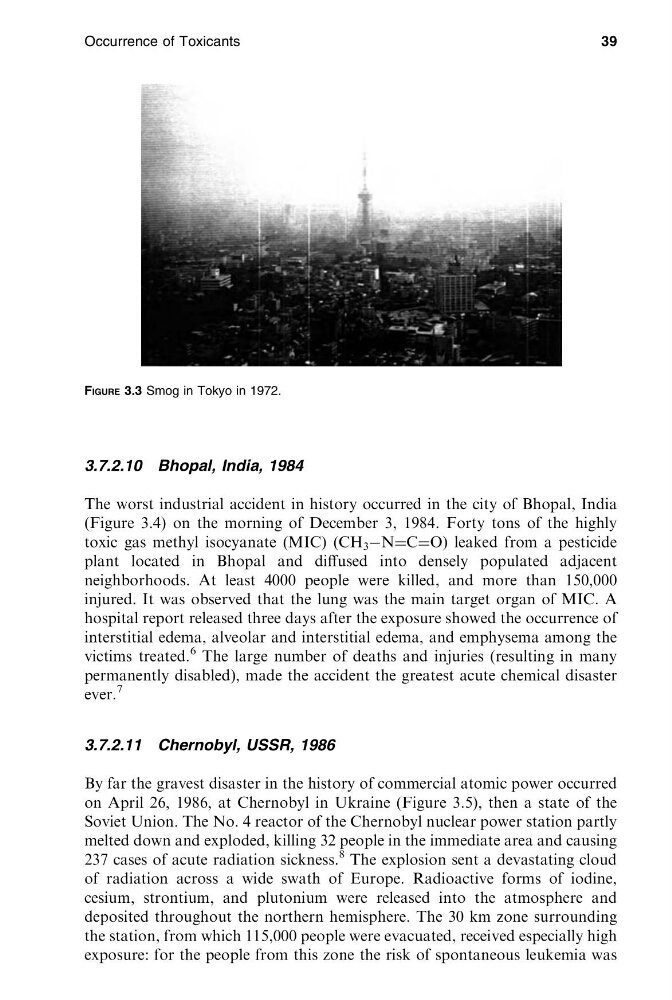
FIGURE 3.3 Smog in Tokyo in 1972.
The worst industrial accident in history occurred in the city of Bhopal, India
(Figure 3.4) on the morning of December 3, 1984. Forty tons of the highly
toxic gas methyl isocyanate (MIC) (CH 3 ÀN¼C¼O) leaked from a pesticide
plant located in Bhopal and diffused into densely populated adjacent
neighborhoods. At least 4000 people were killed, and more than 150,000
injured. It was observed that the lung was the main target organ of MIC. A
hospital report released three days after the exposure showed the occurrence of
interstitial edema, alveolar and interstitial edema, and emphysema among the
victims treated.
6 The large number of deaths and injuries (resulting in many
permanently disabled), made the accident the greatest acute chemical disaster
ever.
7
3.7.2.11 Chernobyl, USSR, 1986
By far the gravest disaster in the history of commercial atomic power occurred
on April 26, 1986, at Chernobyl in Ukraine (Figure 3.5), then a state of the
Soviet Union. The No. 4 reactor of the Chernobyl nuclear power station partly
melted down and exploded, killing 32 people in the immediate area and causing
237 cases of acute radiation sickness.
8 The explosion sent a devastating cloud
of radiation across a wide swath of Europe. Radioactive forms of iodine,
cesium, strontium, and plutonium were released into the atmosphere and
deposited throughout the northern hemisphere. The 30 km zone surrounding
the station, from which 115,000 people were evacuated, received especially high
exposure: for the people from this zone the risk of spontaneous leukemia was
Occurrence of Toxicants
39
[16:54 26/8/04 P:/CRC PRESS/4365 MING-HO.751 (1670)/4365-003.3d]
Ref: 4365 MING-HO YU Chap-003 Page: 39 31-44
FIGURE 3.3 Smog in Tokyo in 1972.