

record high of 77.2 years, based on preliminary data, up from 75.4 years in
1990.
1 During the 20th century, life expectancy at birth increased from 48 to 74
years for males and from 51 to 79 years for females. Similarly, in 2000 the
infant mortality rate declined to a record low of 6.9 infant deaths per 1000 live
births. Between 1950 and 2000, the infant mortality rate declined by about
75%.
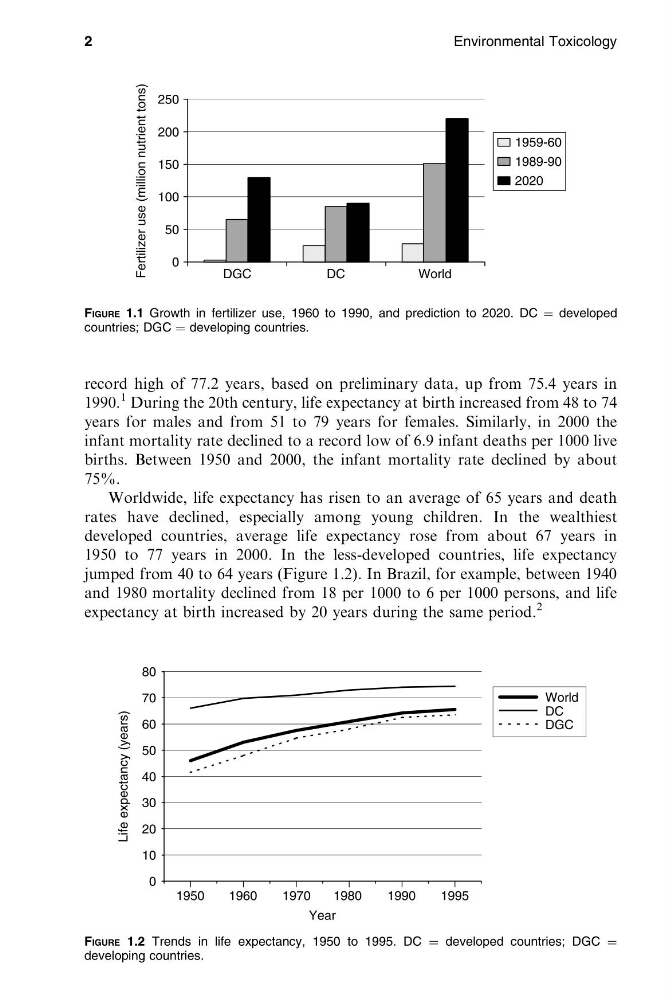
Worldwide, life expectancy has risen to an average of 65 years and death
rates have declined, especially among young children. In the wealthiest
developed countries, average life expectancy rose from about 67 years in
1950 to 77 years in 2000. In the less-developed countries, life expectancy
jumped from 40 to 64 years (Figure 1.2). In Brazil, for example, between 1940
and 1980 mortality declined from 18 per 1000 to 6 per 1000 persons, and life
expectancy at birth increased by 20 years during the same period.
2
2
Environmental Toxicology
[16:55 26/8/04 P:/CRC PRESS/4365 MING-HO.751 (1670)/4365-001.3d]
Ref: 4365 MING-HO YU Chap-001 Page: 2 1-12
FIGURE 1.1 Growth in fertilizer use, 1960 to 1990, and prediction to 2020. DC ¼ developed
countries; DGC ¼ developing countries.
FIGURE 1.2 Trends in life expectancy, 1950 to 1995. DC ¼ developed countries; DGC ¼
developing countries.
1990.
1 During the 20th century, life expectancy at birth increased from 48 to 74
years for males and from 51 to 79 years for females. Similarly, in 2000 the
infant mortality rate declined to a record low of 6.9 infant deaths per 1000 live
births. Between 1950 and 2000, the infant mortality rate declined by about
75%.
Worldwide, life expectancy has risen to an average of 65 years and death
rates have declined, especially among young children. In the wealthiest
developed countries, average life expectancy rose from about 67 years in
1950 to 77 years in 2000. In the less-developed countries, life expectancy
jumped from 40 to 64 years (Figure 1.2). In Brazil, for example, between 1940
and 1980 mortality declined from 18 per 1000 to 6 per 1000 persons, and life
expectancy at birth increased by 20 years during the same period.
2
2
Environmental Toxicology
[16:55 26/8/04 P:/CRC PRESS/4365 MING-HO.751 (1670)/4365-001.3d]
Ref: 4365 MING-HO YU Chap-001 Page: 2 1-12
FIGURE 1.1 Growth in fertilizer use, 1960 to 1990, and prediction to 2020. DC ¼ developed
countries; DGC ¼ developing countries.
FIGURE 1.2 Trends in life expectancy, 1950 to 1995. DC ¼ developed countries; DGC ¼
developing countries.