

foliage of plants. The plants then serve as a vehicle for transfer of F to
herbivores, with the potential for inducing dental and skeletal fluorosis.
F induces both structural and functional changes in plant cells. Changes
occur in cellular and subcellular membranes, causing subsequent injuries.
Although plants differ widely in their susceptibility to F injury, accumulation
of high levels of F in leaves normally leads to chlorosis and necrosis. Chlorosis
is associated with lowered chlorophyll content in the leaf and thus leads to
lowered photosynthesis. Similarly, the destruction of part of the leaf, resulting
from necrosis, will cause a comparable reduction in photosynthesis. Both
chlorosis and necrosis lead to reduced growth and yield. Tree death can result
when the injuries are severe (Figure 10.3a). Contrary to NO 2 or SO 2 , F induces
damage in leaf tips and margins of many plant species (Figure 10.3b and Figure
10.3c).
During the past several decades, numerous field and laboratory studies
have been conducted on the phytotoxicity of F throughout the world.
7–15 In
laboratory experiments, plants exposed to various concentrations of F
generally exhibit concentration-dependent growth impairment. For example,
mung bean seedlings exposed to 0, 0.1, 1.0, and 5.0 mM F (as NaF) for 24, 48,
and 72 hours showed inhibition of germination (Figure 10.4). Similar
observations have frequently been made in field studies. An example is
presented in Case Study 10.1.
CASE STUDY 10.1
In 1979, researchers in the northern part of Taiwan observed a previously
unknown foliage disease of rice plants. Leaves of the plants, grown in an area
adjacent to ceramic and brick-making industrial facilities, manifested acute
Environmental Fluoride
155
[16:52 26/8/04 P:/CRC PRESS/4365 MING-HO.751 (1670)/4365-010.3d]
Ref: 4365 MING-HO YU Chap-010 Page: 155 149-170
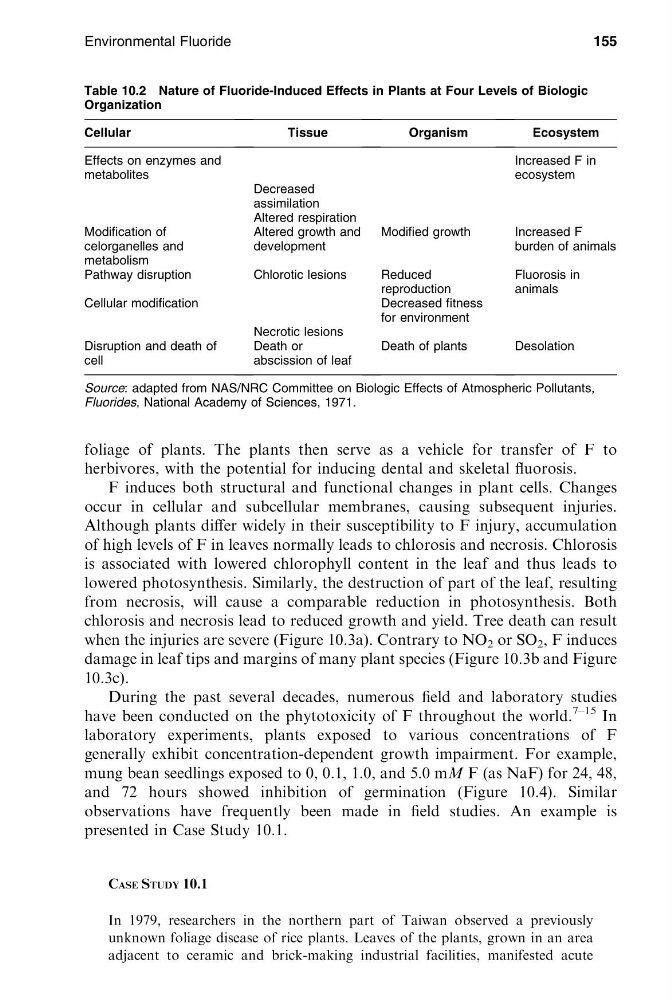
Table 10.2 Nature of Fluoride-Induced Effects in Plants at Four Levels of Biologic
Organization
Cellular
Tissue
Organism
Ecosystem
Effects on enzymes and
metabolites
Increased F in
ecosystem
Decreased
assimilation
Altered respiration
Modification of
celorganelles and
metabolism
Altered growth and
development
Modified growth
Increased F
burden of animals
Pathway disruption
Chlorotic lesions
Reduced
reproduction
Fluorosis in
animals
Cellular modification
Decreased fitness
for environment
Necrotic lesions
Disruption and death of
cell
Death or
abscission of leaf
Death of plants
Desolation
Source: adapted from NAS/NRC Committee on Biologic Effects of Atmospheric Pollutants,
Fluorides, National Academy of Sciences, 1971.
herbivores, with the potential for inducing dental and skeletal fluorosis.
F induces both structural and functional changes in plant cells. Changes
occur in cellular and subcellular membranes, causing subsequent injuries.
Although plants differ widely in their susceptibility to F injury, accumulation
of high levels of F in leaves normally leads to chlorosis and necrosis. Chlorosis
is associated with lowered chlorophyll content in the leaf and thus leads to
lowered photosynthesis. Similarly, the destruction of part of the leaf, resulting
from necrosis, will cause a comparable reduction in photosynthesis. Both
chlorosis and necrosis lead to reduced growth and yield. Tree death can result
when the injuries are severe (Figure 10.3a). Contrary to NO 2 or SO 2 , F induces
damage in leaf tips and margins of many plant species (Figure 10.3b and Figure
10.3c).
During the past several decades, numerous field and laboratory studies
have been conducted on the phytotoxicity of F throughout the world.
7–15 In
laboratory experiments, plants exposed to various concentrations of F
generally exhibit concentration-dependent growth impairment. For example,
mung bean seedlings exposed to 0, 0.1, 1.0, and 5.0 mM F (as NaF) for 24, 48,
and 72 hours showed inhibition of germination (Figure 10.4). Similar
observations have frequently been made in field studies. An example is
presented in Case Study 10.1.
CASE STUDY 10.1
In 1979, researchers in the northern part of Taiwan observed a previously
unknown foliage disease of rice plants. Leaves of the plants, grown in an area
adjacent to ceramic and brick-making industrial facilities, manifested acute
Environmental Fluoride
155
[16:52 26/8/04 P:/CRC PRESS/4365 MING-HO.751 (1670)/4365-010.3d]
Ref: 4365 MING-HO YU Chap-010 Page: 155 149-170
Table 10.2 Nature of Fluoride-Induced Effects in Plants at Four Levels of Biologic
Organization
Cellular
Tissue
Organism
Ecosystem
Effects on enzymes and
metabolites
Increased F in
ecosystem
Decreased
assimilation
Altered respiration
Modification of
celorganelles and
metabolism
Altered growth and
development
Modified growth
Increased F
burden of animals
Pathway disruption
Chlorotic lesions
Reduced
reproduction
Fluorosis in
animals
Cellular modification
Decreased fitness
for environment
Necrotic lesions
Disruption and death of
cell
Death or
abscission of leaf
Death of plants
Desolation
Source: adapted from NAS/NRC Committee on Biologic Effects of Atmospheric Pollutants,
Fluorides, National Academy of Sciences, 1971.