

Half of the animals were injected with a small quantity of ATA and the other
half were left untreated. The results showed that virtually every animal treated
with ATA survived and lived on normally, whereas all the untreated animals
died. The experiments were repeated with hundreds of animals of different
species, with the same high degree of protection. Subsequent studies using
radioactive Be and ATA showed that the chelating agent was found in
practically every cell where Be was present. Previously-damaged cells
recovered, and within a few days they could not be distinguished from the
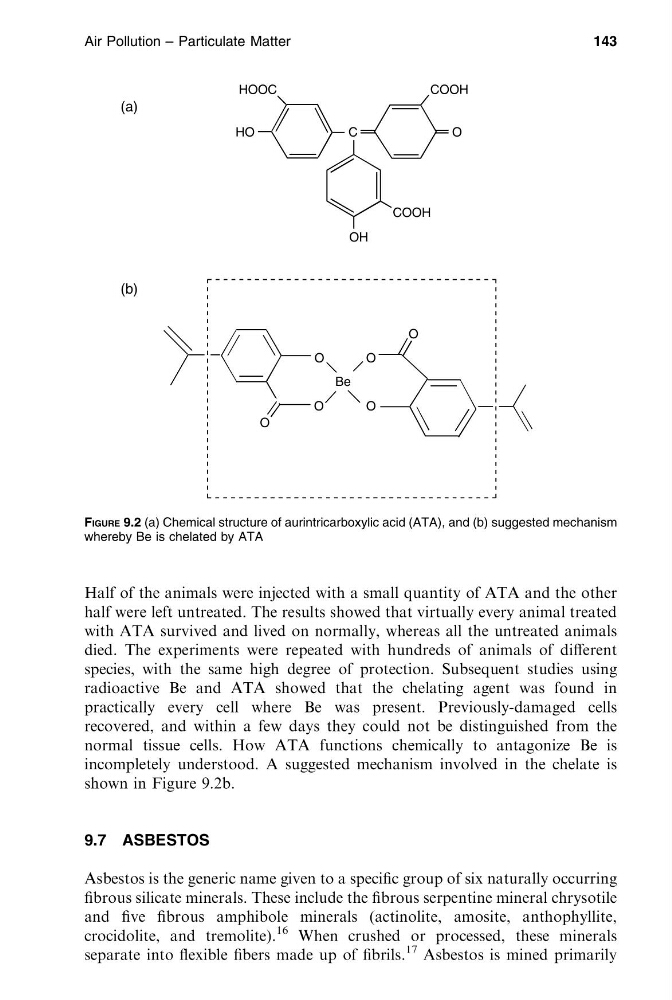
normal tissue cells. How ATA functions chemically to antagonize Be is
incompletely understood. A suggested mechanism involved in the chelate is
shown in Figure 9.2b.
9.7 ASBESTOS
Asbestos is the generic name given to a specific group of six naturally occurring
fibrous silicate minerals. These include the fibrous serpentine mineral chrysotile
and five fibrous amphibole minerals (actinolite, amosite, anthophyllite,
crocidolite, and tremolite).
16 When crushed or processed, these minerals
separate into flexible fibers made up of fibrils.
17 Asbestos is mined primarily
Air Pollution – Particulate Matter
143
[16:52 26/8/04 P:/CRC PRESS/4365 MING-HO.751 (1670)/4365-009.3d]
Ref: 4365 MING-HO YU Chap-009 Page: 143 135-148
FIGURE 9.2 (a) Chemical structure of aurintricarboxylic acid (ATA), and (b) suggested mechanism
whereby Be is chelated by ATA
(a)
(b)
half were left untreated. The results showed that virtually every animal treated
with ATA survived and lived on normally, whereas all the untreated animals
died. The experiments were repeated with hundreds of animals of different
species, with the same high degree of protection. Subsequent studies using
radioactive Be and ATA showed that the chelating agent was found in
practically every cell where Be was present. Previously-damaged cells
recovered, and within a few days they could not be distinguished from the
normal tissue cells. How ATA functions chemically to antagonize Be is
incompletely understood. A suggested mechanism involved in the chelate is
shown in Figure 9.2b.
9.7 ASBESTOS
Asbestos is the generic name given to a specific group of six naturally occurring
fibrous silicate minerals. These include the fibrous serpentine mineral chrysotile
and five fibrous amphibole minerals (actinolite, amosite, anthophyllite,
crocidolite, and tremolite).
16 When crushed or processed, these minerals
separate into flexible fibers made up of fibrils.
17 Asbestos is mined primarily
Air Pollution – Particulate Matter
143
[16:52 26/8/04 P:/CRC PRESS/4365 MING-HO.751 (1670)/4365-009.3d]
Ref: 4365 MING-HO YU Chap-009 Page: 143 135-148
FIGURE 9.2 (a) Chemical structure of aurintricarboxylic acid (ATA), and (b) suggested mechanism
whereby Be is chelated by ATA
(a)
(b)