

based on the tendency of O 3 to react with the ethylene groups of unsaturated
fatty acids, resulting in the formation of free radicals. In the presence of
molecular oxygen, the free radicals can cause peroxidation of unsaturated fatty
acids. It has been observed that lipid material subjected to O 3 exposure showed
a relative decrease in unsaturated fatty acids as compared with saturated fatty
acids, and the more unsaturated the fatty acids were, the greater the decrease
observed. Furthermore, in the rat a deficiency of vitamin E increases the
toxicity of O 3 .
49 Possible mechanisms for O 3 toxicity involving peroxidation of
membrane unsaturated fatty acids include: the ability of O 3 to react with
polyunsaturated fatty acids (PUFA), causing lipid breakdown (breakdown
products can include H 2 O 2 , carbonyl compounds, and various free radicals,
which are detrimental to cells), and the resultant free radicals may react with:
protein –SH groups, leading to enzyme inactivation
mitochondrial PUFA, resulting in swelling and impaired energy metabolism
or loss of energy metabolism
lysosomal PUFA, causing release of lysosomal hydrolases
nuclear PUFA, leading to carcinogenesis
50
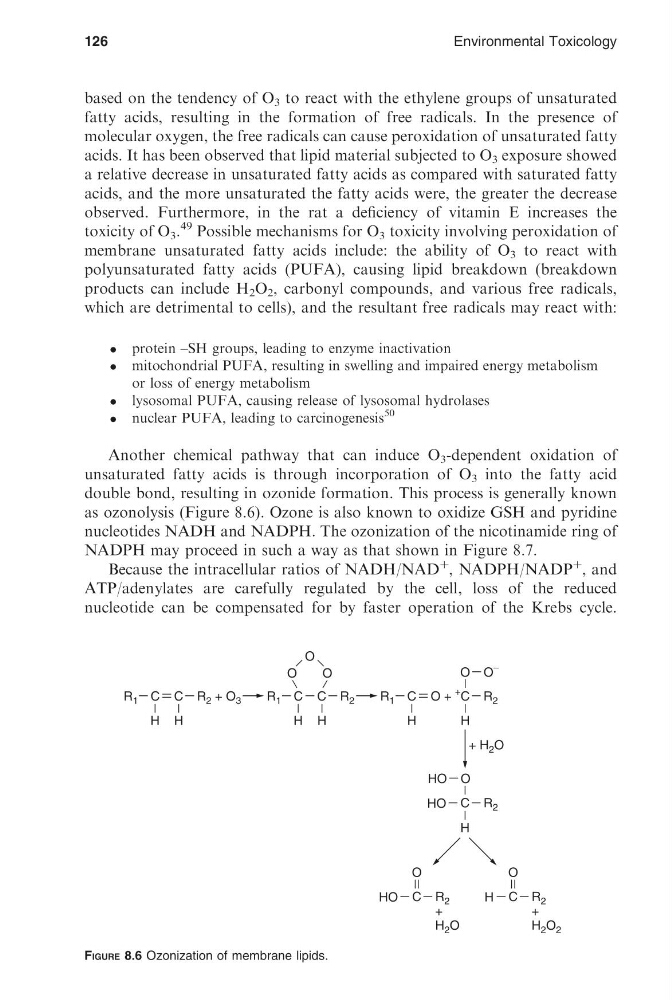
Another chemical pathway that can induce O 3 -dependent oxidation of
unsaturated fatty acids is through incorporation of O 3 into the fatty acid
double bond, resulting in ozonide formation. This process is generally known
as ozonolysis (Figure 8.6). Ozone is also known to oxidize GSH and pyridine
nucleotides NADH and NADPH. The ozonization of the nicotinamide ring of
NADPH may proceed in such a way as that shown in Figure 8.7.
Because the intracellular ratios of NADH/NAD
þ
, NADPH/NADP
þ , and
ATP/adenylates are carefully regulated by the cell, loss of the reduced
nucleotide can be compensated for by faster operation of the Krebs cycle.
126
Environmental Toxicology
[16:53 26/8/04 P:/CRC PRESS/4365 MING-HO.751 (1670)/4365-008.3d]
Ref: 4365 MING-HO YU Chap-008 Page: 126 111-134
FIGURE 8.6 Ozonization of membrane lipids.
fatty acids, resulting in the formation of free radicals. In the presence of
molecular oxygen, the free radicals can cause peroxidation of unsaturated fatty
acids. It has been observed that lipid material subjected to O 3 exposure showed
a relative decrease in unsaturated fatty acids as compared with saturated fatty
acids, and the more unsaturated the fatty acids were, the greater the decrease
observed. Furthermore, in the rat a deficiency of vitamin E increases the
toxicity of O 3 .
49 Possible mechanisms for O 3 toxicity involving peroxidation of
membrane unsaturated fatty acids include: the ability of O 3 to react with
polyunsaturated fatty acids (PUFA), causing lipid breakdown (breakdown
products can include H 2 O 2 , carbonyl compounds, and various free radicals,
which are detrimental to cells), and the resultant free radicals may react with:
protein –SH groups, leading to enzyme inactivation
mitochondrial PUFA, resulting in swelling and impaired energy metabolism
or loss of energy metabolism
lysosomal PUFA, causing release of lysosomal hydrolases
nuclear PUFA, leading to carcinogenesis
50
Another chemical pathway that can induce O 3 -dependent oxidation of
unsaturated fatty acids is through incorporation of O 3 into the fatty acid
double bond, resulting in ozonide formation. This process is generally known
as ozonolysis (Figure 8.6). Ozone is also known to oxidize GSH and pyridine
nucleotides NADH and NADPH. The ozonization of the nicotinamide ring of
NADPH may proceed in such a way as that shown in Figure 8.7.
Because the intracellular ratios of NADH/NAD
þ
, NADPH/NADP
þ , and
ATP/adenylates are carefully regulated by the cell, loss of the reduced
nucleotide can be compensated for by faster operation of the Krebs cycle.
126
Environmental Toxicology
[16:53 26/8/04 P:/CRC PRESS/4365 MING-HO.751 (1670)/4365-008.3d]
Ref: 4365 MING-HO YU Chap-008 Page: 126 111-134
FIGURE 8.6 Ozonization of membrane lipids.