

Both SO 3
2À and HSO 3
À have a lone pair of electrons on the S atom that
strongly favors reactions with electron-deficient sites in other molecules. They
are both phytotoxic, affecting several physiological and biochemical processes
of plants.
5 The phytotoxicity of SO 3
2À and HSO 3
À is diminished when these
species are converted to less toxic forms, such as SO 4
2À
. For instance,
oxidation of HSO 3
À to SO 4
2À can occur both enzymatically and nonenzymatically. Several factors, including cellular enzymes such as peroxidase
and cytochrome oxidase, metals, ultraviolet (UV) light, and superoxide (O 2
Á À ),
114
Environmental Toxicology
[16:53 26/8/04 P:/CRC PRESS/4365 MING-HO.751 (1670)/4365-008.3d]
Ref: 4365 MING-HO YU Chap-008 Page: 114 111-134
FIGURE 8.2 Leaf damage induced by SO 2 .
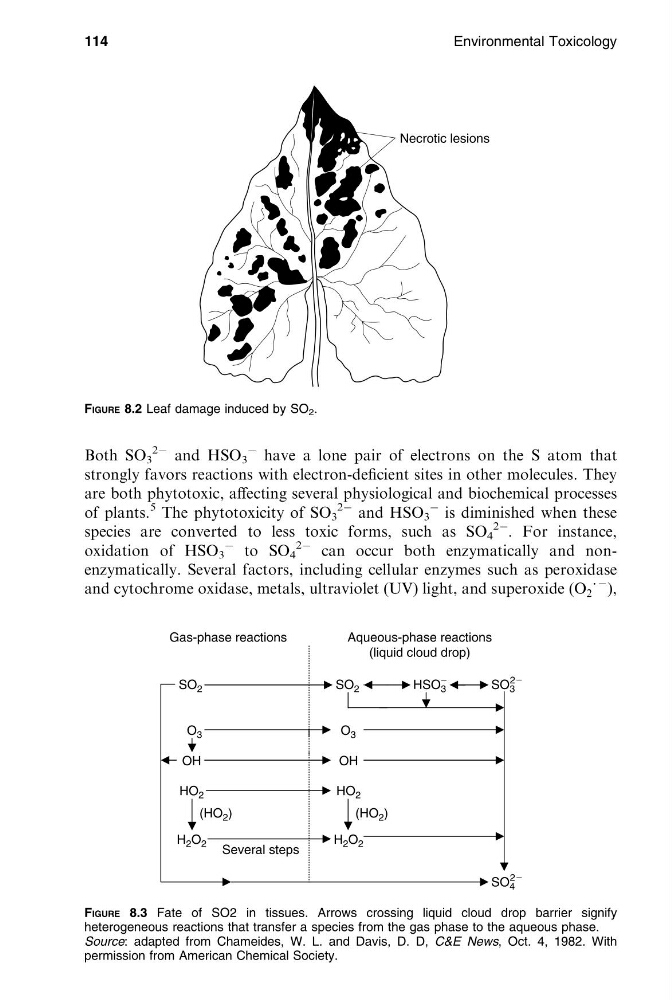
FIGURE 8.3 Fate of SO2 in tissues. Arrows crossing liquid cloud drop barrier signify
heterogeneous reactions that transfer a species from the gas phase to the aqueous phase.
Source: adapted from Chameides, W. L. and Davis, D. D, C&E News, Oct. 4, 1982. With
permission from American Chemical Society.
2À and HSO 3
À have a lone pair of electrons on the S atom that
strongly favors reactions with electron-deficient sites in other molecules. They
are both phytotoxic, affecting several physiological and biochemical processes
of plants.
5 The phytotoxicity of SO 3
2À and HSO 3
À is diminished when these
species are converted to less toxic forms, such as SO 4
2À
. For instance,
oxidation of HSO 3
À to SO 4
2À can occur both enzymatically and nonenzymatically. Several factors, including cellular enzymes such as peroxidase
and cytochrome oxidase, metals, ultraviolet (UV) light, and superoxide (O 2
Á À ),
114
Environmental Toxicology
[16:53 26/8/04 P:/CRC PRESS/4365 MING-HO.751 (1670)/4365-008.3d]
Ref: 4365 MING-HO YU Chap-008 Page: 114 111-134
FIGURE 8.2 Leaf damage induced by SO 2 .
FIGURE 8.3 Fate of SO2 in tissues. Arrows crossing liquid cloud drop barrier signify
heterogeneous reactions that transfer a species from the gas phase to the aqueous phase.
Source: adapted from Chameides, W. L. and Davis, D. D, C&E News, Oct. 4, 1982. With
permission from American Chemical Society.