

nutrients and their metabolites, as well as upon transport of toxins, so reducing
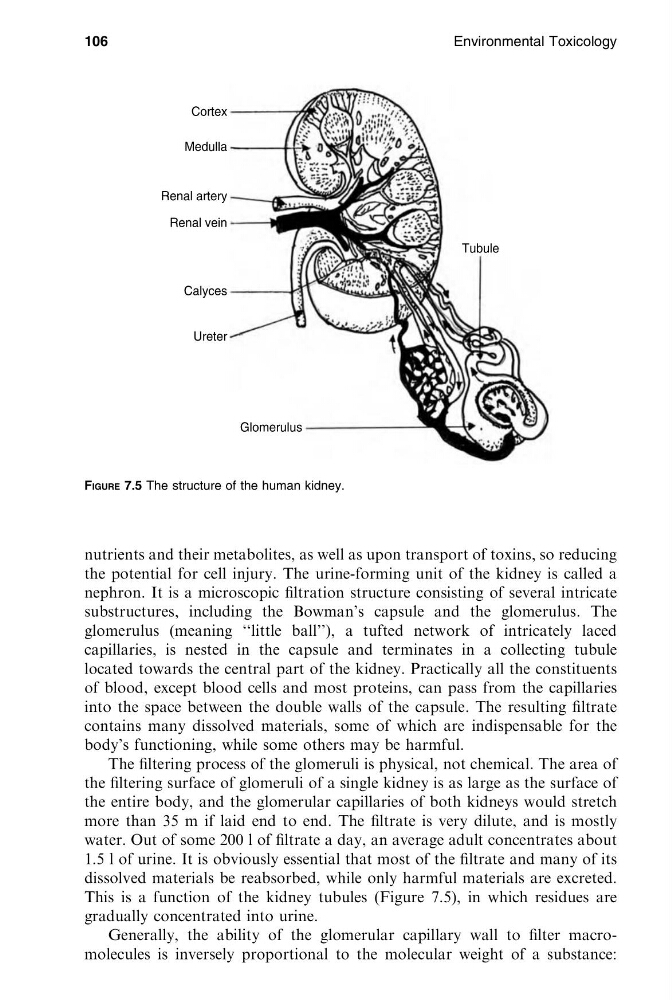
the potential for cell injury. The urine-forming unit of the kidney is called a
nephron. It is a microscopic filtration structure consisting of several intricate
substructures, including the Bowman’s capsule and the glomerulus. The
glomerulus (meaning ‘‘little ball’’), a tufted network of intricately laced
capillaries, is nested in the capsule and terminates in a collecting tubule
located towards the central part of the kidney. Practically all the constituents
of blood, except blood cells and most proteins, can pass from the capillaries
into the space between the double walls of the capsule. The resulting filtrate
contains many dissolved materials, some of which are indispensable for the
body’s functioning, while some others may be harmful.
The filtering process of the glomeruli is physical, not chemical. The area of
the filtering surface of glomeruli of a single kidney is as large as the surface of
the entire body, and the glomerular capillaries of both kidneys would stretch
more than 35 m if laid end to end. The filtrate is very dilute, and is mostly
water. Out of some 200 l of filtrate a day, an average adult concentrates about
1.5 l of urine. It is obviously essential that most of the filtrate and many of its
dissolved materials be reabsorbed, while only harmful materials are excreted.
This is a function of the kidney tubules (Figure 7.5), in which residues are
gradually concentrated into urine.
Generally, the ability of the glomerular capillary wall to filter macromolecules is inversely proportional to the molecular weight of a substance:
106
Environmental Toxicology
[16:53 26/8/04 P:/CRC PRESS/4365 MING-HO.751 (1670)/4365-007.3d]
Ref: 4365 MING-HO YU Chap-007 Page: 106 99-110
FIGURE 7.5 The structure of the human kidney.
the potential for cell injury. The urine-forming unit of the kidney is called a
nephron. It is a microscopic filtration structure consisting of several intricate
substructures, including the Bowman’s capsule and the glomerulus. The
glomerulus (meaning ‘‘little ball’’), a tufted network of intricately laced
capillaries, is nested in the capsule and terminates in a collecting tubule
located towards the central part of the kidney. Practically all the constituents
of blood, except blood cells and most proteins, can pass from the capillaries
into the space between the double walls of the capsule. The resulting filtrate
contains many dissolved materials, some of which are indispensable for the
body’s functioning, while some others may be harmful.
The filtering process of the glomeruli is physical, not chemical. The area of
the filtering surface of glomeruli of a single kidney is as large as the surface of
the entire body, and the glomerular capillaries of both kidneys would stretch
more than 35 m if laid end to end. The filtrate is very dilute, and is mostly
water. Out of some 200 l of filtrate a day, an average adult concentrates about
1.5 l of urine. It is obviously essential that most of the filtrate and many of its
dissolved materials be reabsorbed, while only harmful materials are excreted.
This is a function of the kidney tubules (Figure 7.5), in which residues are
gradually concentrated into urine.
Generally, the ability of the glomerular capillary wall to filter macromolecules is inversely proportional to the molecular weight of a substance:
106
Environmental Toxicology
[16:53 26/8/04 P:/CRC PRESS/4365 MING-HO.751 (1670)/4365-007.3d]
Ref: 4365 MING-HO YU Chap-007 Page: 106 99-110
FIGURE 7.5 The structure of the human kidney.