

The important role that SOD plays in biotransformation is well recognized.
Several factors can either enhance or inhibit the enzyme, fluoride being one
of them. For example, both in vivo and in vitro studies show that the activity
of SOD from the earthworm (Eisenia fetida) is inhibited by NaF in a
concentration-dependent manner.
8 Other studies show that in laboratory
animals exposed to NaF, both SOD and GSHPx activity decrease significantly.
9 However, in aluminum plant workers exposed to fluoride, serum SOD
activity is enhanced.
10 The reason for this discrepancy is not known.
6.7 CHARACTERISTICS OF THE CYTOCHROME P450s
As mentioned earlier, cytochrome P450s consist of a number of isozymes.
Researchers have divided the isozymes into several categories: CYP1, CYP2,
and CYP3. These categories are further divided into subfamilies according to
their properties. The nomenclature and major characteristics of the cytochrome
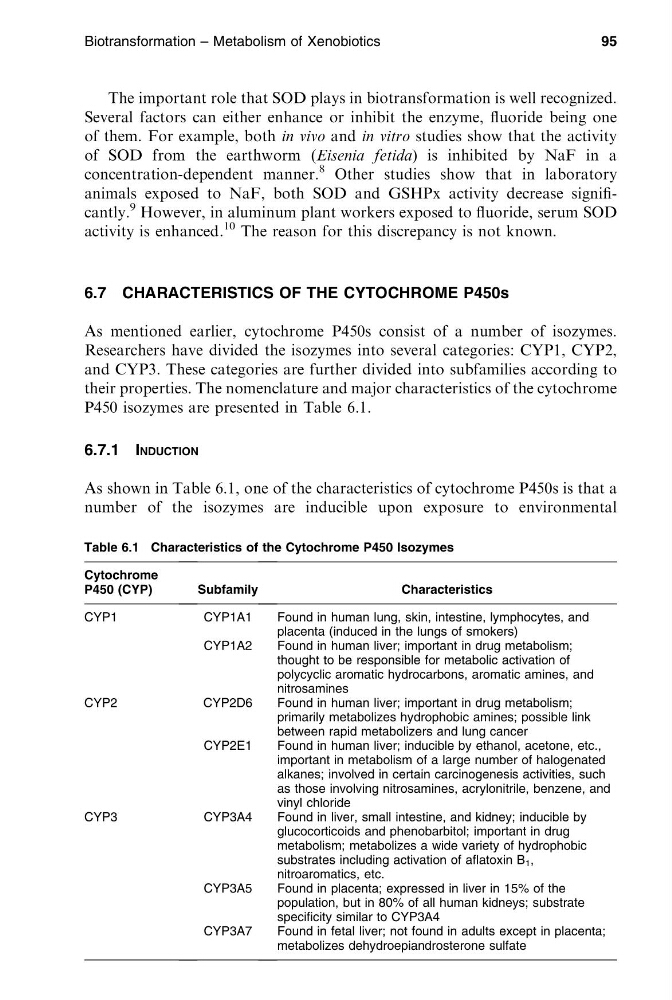
P450 isozymes are presented in Table 6.1.
6.7.1 INDUCTION
As shown in Table 6.1, one of the characteristics of cytochrome P450s is that a
number of the isozymes are inducible upon exposure to environmental
Biotransformation – Metabolism of Xenobiotics
95
[16:54 26/8/04 P:/CRC PRESS/4365 MING-HO.751 (1670)/4365-006.3d]
Ref: 4365 MING-HO YU Chap-006 Page: 95 85-98
Table 6.1 Characteristics of the Cytochrome P450 Isozymes
Cytochrome
P450 (CYP)
Subfamily
Characteristics
CYP1
CYP1A1
Found in human lung, skin, intestine, lymphocytes, and
placenta (induced in the lungs of smokers)
CYP1A2
Found in human liver; important in drug metabolism;
thought to be responsible for metabolic activation of
polycyclic aromatic hydrocarbons, aromatic amines, and
nitrosamines
CYP2
CYP2D6
Found in human liver; important in drug metabolism;
primarily metabolizes hydrophobic amines; possible link
between rapid metabolizers and lung cancer
CYP2E1
Found in human liver; inducible by ethanol, acetone, etc.,
important in metabolism of a large number of halogenated
alkanes; involved in certain carcinogenesis activities, such
as those involving nitrosamines, acrylonitrile, benzene, and
vinyl chloride
CYP3
CYP3A4
Found in liver, small intestine, and kidney; inducible by
glucocorticoids and phenobarbitol; important in drug
metabolism; metabolizes a wide variety of hydrophobic
substrates including activation of aflatoxin B 1 ,
nitroaromatics, etc.
CYP3A5
Found in placenta; expressed in liver in 15% of the
population, but in 80% of all human kidneys; substrate
specificity similar to CYP3A4
CYP3A7
Found in fetal liver; not found in adults except in placenta;
metabolizes dehydroepiandrosterone sulfate
Several factors can either enhance or inhibit the enzyme, fluoride being one
of them. For example, both in vivo and in vitro studies show that the activity
of SOD from the earthworm (Eisenia fetida) is inhibited by NaF in a
concentration-dependent manner.
8 Other studies show that in laboratory
animals exposed to NaF, both SOD and GSHPx activity decrease significantly.
9 However, in aluminum plant workers exposed to fluoride, serum SOD
activity is enhanced.
10 The reason for this discrepancy is not known.
6.7 CHARACTERISTICS OF THE CYTOCHROME P450s
As mentioned earlier, cytochrome P450s consist of a number of isozymes.
Researchers have divided the isozymes into several categories: CYP1, CYP2,
and CYP3. These categories are further divided into subfamilies according to
their properties. The nomenclature and major characteristics of the cytochrome
P450 isozymes are presented in Table 6.1.
6.7.1 INDUCTION
As shown in Table 6.1, one of the characteristics of cytochrome P450s is that a
number of the isozymes are inducible upon exposure to environmental
Biotransformation – Metabolism of Xenobiotics
95
[16:54 26/8/04 P:/CRC PRESS/4365 MING-HO.751 (1670)/4365-006.3d]
Ref: 4365 MING-HO YU Chap-006 Page: 95 85-98
Table 6.1 Characteristics of the Cytochrome P450 Isozymes
Cytochrome
P450 (CYP)
Subfamily
Characteristics
CYP1
CYP1A1
Found in human lung, skin, intestine, lymphocytes, and
placenta (induced in the lungs of smokers)
CYP1A2
Found in human liver; important in drug metabolism;
thought to be responsible for metabolic activation of
polycyclic aromatic hydrocarbons, aromatic amines, and
nitrosamines
CYP2
CYP2D6
Found in human liver; important in drug metabolism;
primarily metabolizes hydrophobic amines; possible link
between rapid metabolizers and lung cancer
CYP2E1
Found in human liver; inducible by ethanol, acetone, etc.,
important in metabolism of a large number of halogenated
alkanes; involved in certain carcinogenesis activities, such
as those involving nitrosamines, acrylonitrile, benzene, and
vinyl chloride
CYP3
CYP3A4
Found in liver, small intestine, and kidney; inducible by
glucocorticoids and phenobarbitol; important in drug
metabolism; metabolizes a wide variety of hydrophobic
substrates including activation of aflatoxin B 1 ,
nitroaromatics, etc.
CYP3A5
Found in placenta; expressed in liver in 15% of the
population, but in 80% of all human kidneys; substrate
specificity similar to CYP3A4
CYP3A7
Found in fetal liver; not found in adults except in placenta;
metabolizes dehydroepiandrosterone sulfate