

2.3 Solutions
69
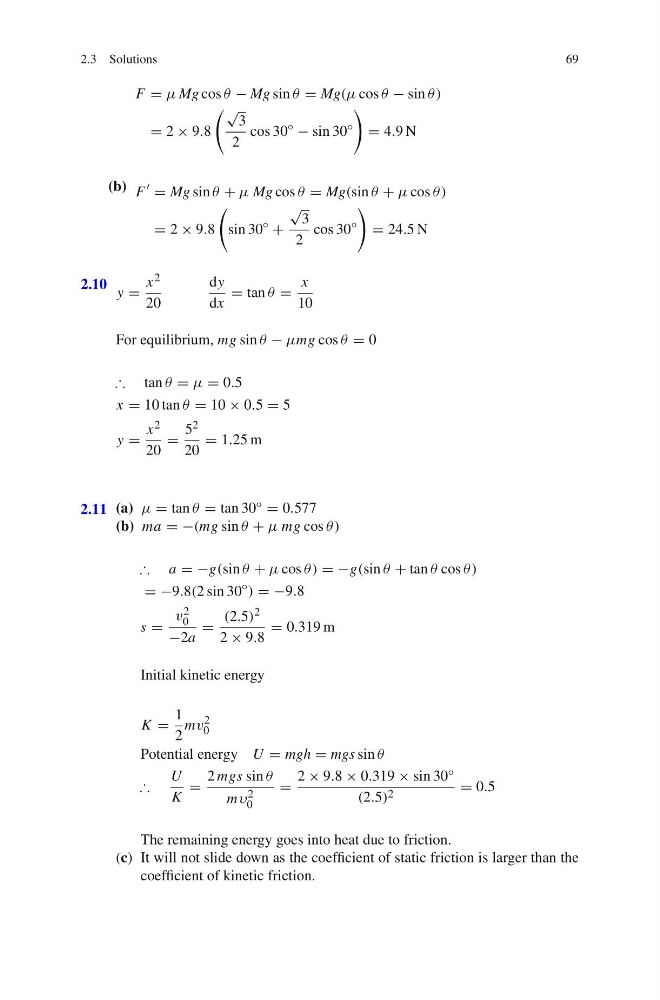
F = μ Mg cos θ − Mg sin θ = Mg(μ cos θ − sin θ)
= 2 × 9.8
√
3
2
cos 30
◦
− sin 30
◦
= 4.9 N
(b) F
= Mg sin θ + μ Mg cos θ = Mg(sin θ + μ cos θ)
= 2 × 9.8
sin 30
◦
+
√
3
2
cos 30
◦
= 24.5 N
2.10 y =
x 2
20
dy
dx
= tan θ =
x
10
For equilibrium, mg sin θ − μmg cos θ = 0
∴ tan θ = μ = 0.5
x = 10 tan θ = 10 × 0.5 = 5
y =
x 2
20
=
5 2
20
= 1.25 m
2.11 (a) μ = tan θ = tan 30 ◦ = 0.577
(b) ma = −(mg sin θ + μ mg cos θ)
∴ a = −g(sin θ + μ cos θ) = −g(sin θ + tan θ cos θ)
= −9.8(2 sin 30
◦
) = −9.8
s =
v 2
0
−2a
=
(2.5) 2
2 × 9.8
= 0.319 m
Initial kinetic energy
K =
1
2
mv
2
0
Potential energy U = mgh = mgs sin θ
∴
U
K
=
2 mgs sin θ
mυ 2
0
=
2 × 9.8 × 0.319 × sin 30 ◦
(2.5) 2
= 0.5
The remaining energy goes into heat due to friction.
(c) It will not slide down as the coefficient of static friction is larger than the
coefficient of kinetic friction.
69
F = μ Mg cos θ − Mg sin θ = Mg(μ cos θ − sin θ)
= 2 × 9.8
√
3
2
cos 30
◦
− sin 30
◦
= 4.9 N
(b) F
= Mg sin θ + μ Mg cos θ = Mg(sin θ + μ cos θ)
= 2 × 9.8
sin 30
◦
+
√
3
2
cos 30
◦
= 24.5 N
2.10 y =
x 2
20
dy
dx
= tan θ =
x
10
For equilibrium, mg sin θ − μmg cos θ = 0
∴ tan θ = μ = 0.5
x = 10 tan θ = 10 × 0.5 = 5
y =
x 2
20
=
5 2
20
= 1.25 m
2.11 (a) μ = tan θ = tan 30 ◦ = 0.577
(b) ma = −(mg sin θ + μ mg cos θ)
∴ a = −g(sin θ + μ cos θ) = −g(sin θ + tan θ cos θ)
= −9.8(2 sin 30
◦
) = −9.8
s =
v 2
0
−2a
=
(2.5) 2
2 × 9.8
= 0.319 m
Initial kinetic energy
K =
1
2
mv
2
0
Potential energy U = mgh = mgs sin θ
∴
U
K
=
2 mgs sin θ
mυ 2
0
=
2 × 9.8 × 0.319 × sin 30 ◦
(2.5) 2
= 0.5
The remaining energy goes into heat due to friction.
(c) It will not slide down as the coefficient of static friction is larger than the
coefficient of kinetic friction.