

2.3 Solutions
67
The equation of motion will be
ma
= F cos θ − μN
= F cos θ − μ(mg + F sin θ)
∴ a
=
F
m
(cos θ − μ sin θ) − μg
(4)
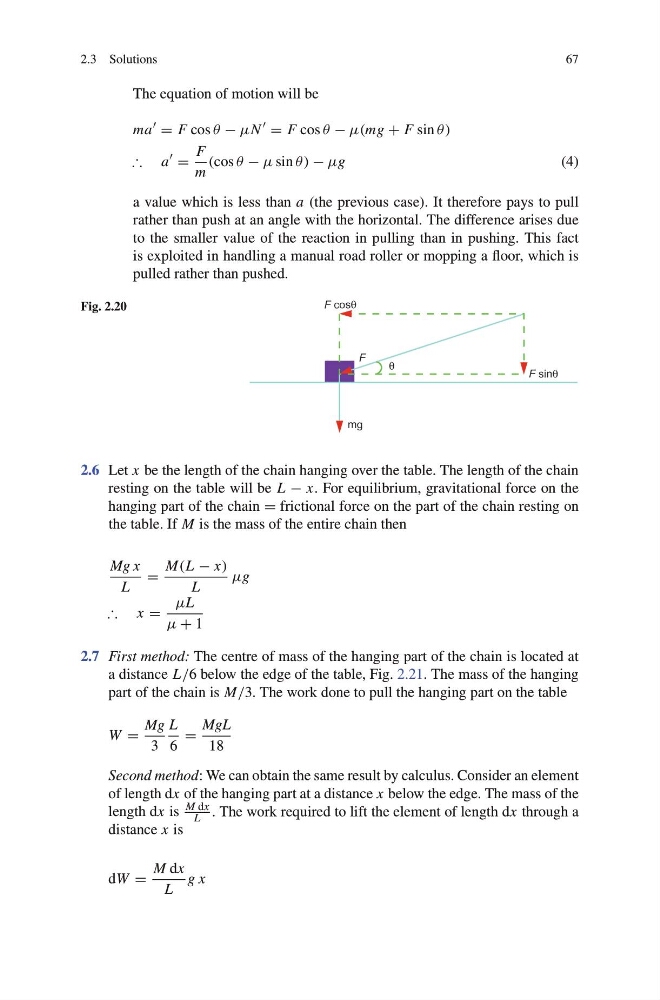
a value which is less than a (the previous case). It therefore pays to pull
rather than push at an angle with the horizontal. The difference arises due
to the smaller value of the reaction in pulling than in pushing. This fact
is exploited in handling a manual road roller or mopping a floor, which is
pulled rather than pushed.
Fig. 2.20
2.6 Let x be the length of the chain hanging over the table. The length of the chain
resting on the table will be L − x. For equilibrium, gravitational force on the
hanging part of the chain = frictional force on the part of the chain resting on
the table. If M is the mass of the entire chain then
Mg x
L
=
M(L − x)
L
μg
∴ x =
μL
μ + 1
2.7 First method: The centre of mass of the hanging part of the chain is located at
a distance L/6 below the edge of the table, Fig. 2.21. The mass of the hanging
part of the chain is M/3. The work done to pull the hanging part on the table
W =
Mg
3
L
6
=
MgL
18
Second method: We can obtain the same result by calculus. Consider an element
of length dx of the hanging part at a distance x below the edge. The mass of the
length dx is
M dx
L . The work required to lift the element of length dx through a
distance x is
dW =
M dx
L
g x
67
The equation of motion will be
ma
= F cos θ − μN
= F cos θ − μ(mg + F sin θ)
∴ a
=
F
m
(cos θ − μ sin θ) − μg
(4)
a value which is less than a (the previous case). It therefore pays to pull
rather than push at an angle with the horizontal. The difference arises due
to the smaller value of the reaction in pulling than in pushing. This fact
is exploited in handling a manual road roller or mopping a floor, which is
pulled rather than pushed.
Fig. 2.20
2.6 Let x be the length of the chain hanging over the table. The length of the chain
resting on the table will be L − x. For equilibrium, gravitational force on the
hanging part of the chain = frictional force on the part of the chain resting on
the table. If M is the mass of the entire chain then
Mg x
L
=
M(L − x)
L
μg
∴ x =
μL
μ + 1
2.7 First method: The centre of mass of the hanging part of the chain is located at
a distance L/6 below the edge of the table, Fig. 2.21. The mass of the hanging
part of the chain is M/3. The work done to pull the hanging part on the table
W =
Mg
3
L
6
=
MgL
18
Second method: We can obtain the same result by calculus. Consider an element
of length dx of the hanging part at a distance x below the edge. The mass of the
length dx is
M dx
L . The work required to lift the element of length dx through a
distance x is
dW =
M dx
L
g x