

62
2 Particle Dynamics
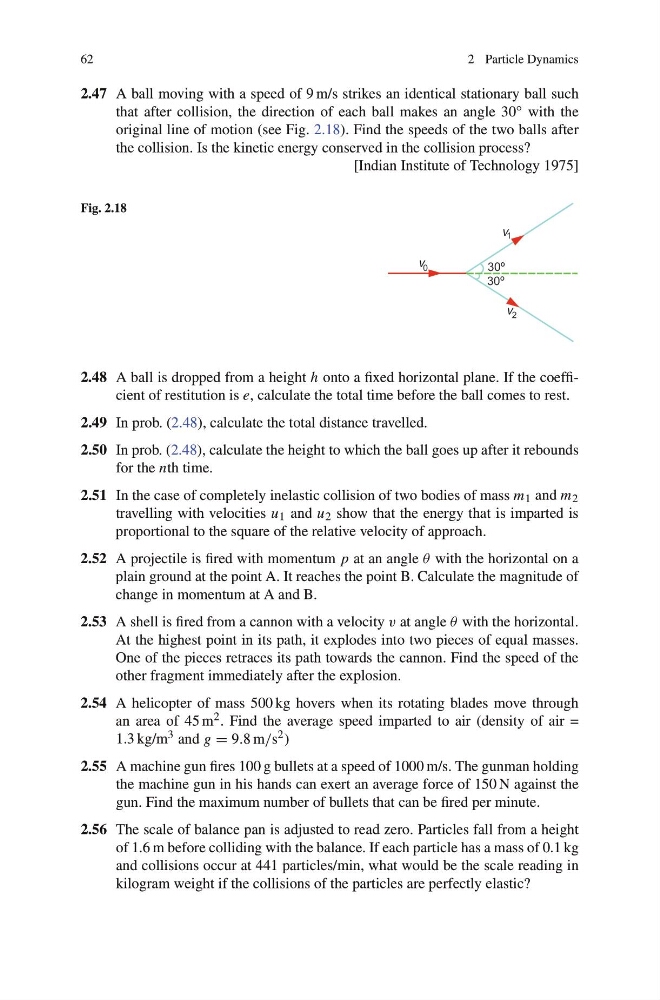
2.47 A ball moving with a speed of 9 m/s strikes an identical stationary ball such
that after collision, the direction of each ball makes an angle 30 ◦ with the
original line of motion (see Fig. 2.18). Find the speeds of the two balls after
the collision. Is the kinetic energy conserved in the collision process?
[Indian Institute of Technology 1975]
Fig. 2.18
2.48 A ball is dropped from a height h onto a fixed horizontal plane. If the coefficient of restitution is e, calculate the total time before the ball comes to rest.
2.49 In prob. (2.48), calculate the total distance travelled.
2.50 In prob. (2.48), calculate the height to which the ball goes up after it rebounds
for the nth time.
2.51 In the case of completely inelastic collision of two bodies of mass m 1 and m 2
travelling with velocities u 1 and u 2 show that the energy that is imparted is
proportional to the square of the relative velocity of approach.
2.52 A projectile is fired with momentum p at an angle θ with the horizontal on a
plain ground at the point A. It reaches the point B. Calculate the magnitude of
change in momentum at A and B.
2.53 A shell is fired from a cannon with a velocity v at angle θ with the horizontal.
At the highest point in its path, it explodes into two pieces of equal masses.
One of the pieces retraces its path towards the cannon. Find the speed of the
other fragment immediately after the explosion.
2.54 A helicopter of mass 500 kg hovers when its rotating blades move through
an area of 45 m 2 . Find the average speed imparted to air (density of air =
1.3 kg/m 3 and g = 9.8 m/s 2 )
2.55 A machine gun fires 100 g bullets at a speed of 1000 m/s. The gunman holding
the machine gun in his hands can exert an average force of 150 N against the
gun. Find the maximum number of bullets that can be fired per minute.
2.56 The scale of balance pan is adjusted to read zero. Particles fall from a height
of 1.6 m before colliding with the balance. If each particle has a mass of 0.1 kg
and collisions occur at 441 particles/min, what would be the scale reading in
kilogram weight if the collisions of the particles are perfectly elastic?
2 Particle Dynamics
2.47 A ball moving with a speed of 9 m/s strikes an identical stationary ball such
that after collision, the direction of each ball makes an angle 30 ◦ with the
original line of motion (see Fig. 2.18). Find the speeds of the two balls after
the collision. Is the kinetic energy conserved in the collision process?
[Indian Institute of Technology 1975]
Fig. 2.18
2.48 A ball is dropped from a height h onto a fixed horizontal plane. If the coefficient of restitution is e, calculate the total time before the ball comes to rest.
2.49 In prob. (2.48), calculate the total distance travelled.
2.50 In prob. (2.48), calculate the height to which the ball goes up after it rebounds
for the nth time.
2.51 In the case of completely inelastic collision of two bodies of mass m 1 and m 2
travelling with velocities u 1 and u 2 show that the energy that is imparted is
proportional to the square of the relative velocity of approach.
2.52 A projectile is fired with momentum p at an angle θ with the horizontal on a
plain ground at the point A. It reaches the point B. Calculate the magnitude of
change in momentum at A and B.
2.53 A shell is fired from a cannon with a velocity v at angle θ with the horizontal.
At the highest point in its path, it explodes into two pieces of equal masses.
One of the pieces retraces its path towards the cannon. Find the speed of the
other fragment immediately after the explosion.
2.54 A helicopter of mass 500 kg hovers when its rotating blades move through
an area of 45 m 2 . Find the average speed imparted to air (density of air =
1.3 kg/m 3 and g = 9.8 m/s 2 )
2.55 A machine gun fires 100 g bullets at a speed of 1000 m/s. The gunman holding
the machine gun in his hands can exert an average force of 150 N against the
gun. Find the maximum number of bullets that can be fired per minute.
2.56 The scale of balance pan is adjusted to read zero. Particles fall from a height
of 1.6 m before colliding with the balance. If each particle has a mass of 0.1 kg
and collisions occur at 441 particles/min, what would be the scale reading in
kilogram weight if the collisions of the particles are perfectly elastic?