

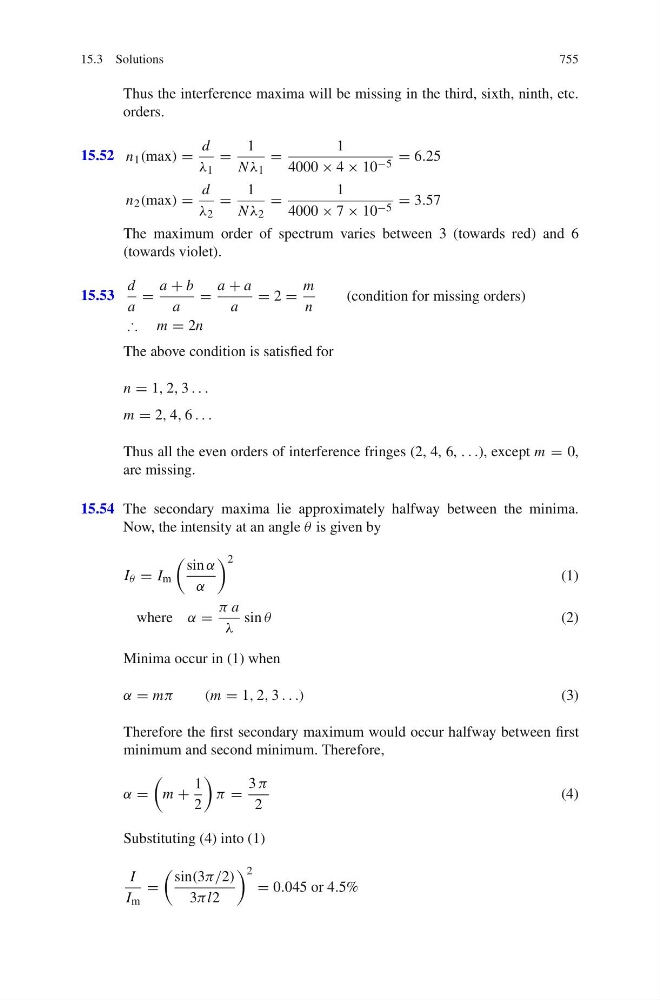
15.3 Solutions
755
Thus the interference maxima will be missing in the third, sixth, ninth, etc.
orders.
15.52 n 1 (max) =
d
λ 1
=
1
N λ 1
=
1
4000 × 4 × 10 −5 = 6.25
n 2 (max) =
d
λ 2
=
1
N λ 2
=
1
4000 × 7 × 10 −5 = 3.57
The maximum order of spectrum varies between 3 (towards red) and 6
(towards violet).
15.53
d
a
=
a + b
a
=
a + a
a
= 2 =
m
n
(condition for missing orders)
∴ m = 2n
The above condition is satisfied for
n = 1, 2, 3 . . .
m = 2, 4, 6 . . .
Thus all the even orders of interference fringes (2, 4, 6, . . .), except m = 0,
are missing.
15.54 The secondary maxima lie approximately halfway between the minima.
Now, the intensity at an angle θ is given by
I θ = I m
sin α
α
2
(1)
where α =
π a
λ
sin θ
(2)
Minima occur in (1) when
α = mπ
(m = 1, 2, 3 . . .)
(3)
Therefore the first secondary maximum would occur halfway between first
minimum and second minimum. Therefore,
α =
m +
1
2
π =
3 π
2
(4)
Substituting (4) into (1)
I
I m
=
sin(3π/2)
3πl2
2
= 0.045 or 4.5%