

750
15 Optics
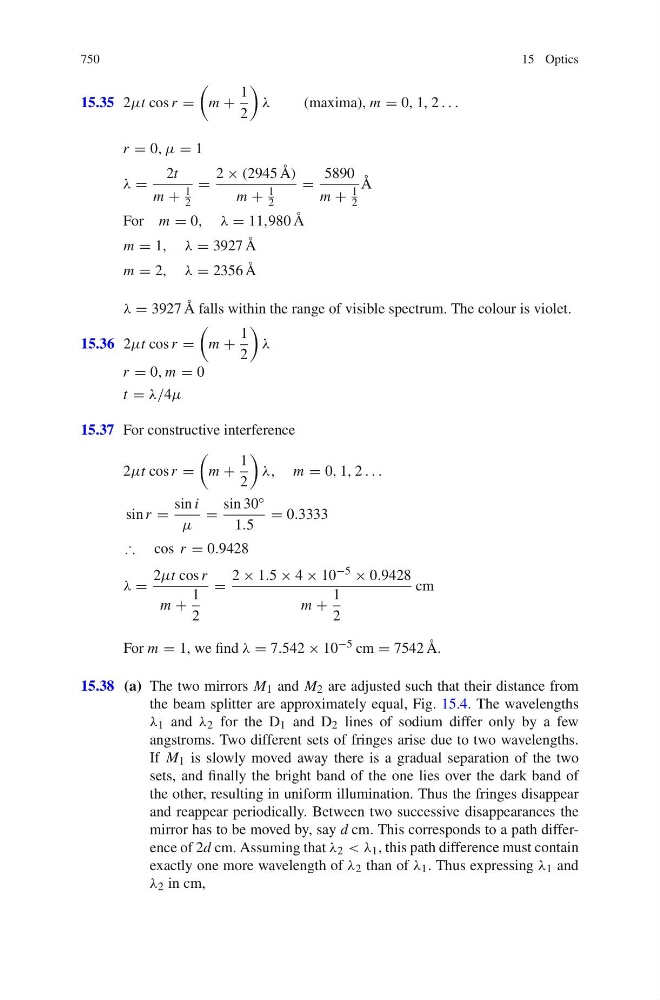
15.35 2μt cos r =
m +
1
2
λ
(maxima), m = 0, 1, 2 . . .
r = 0, μ = 1
λ =
2t
m +
1
2
=
2 × (2945 Å)
m +
1
2
=
5890
m +
1
2
Å
For m = 0, λ = 11,980 Å
m = 1, λ = 3927 Å
m = 2, λ = 2356 Å
λ = 3927 Å falls within the range of visible spectrum. The colour is violet.
15.36 2μt cos r =
m +
1
2
λ
r = 0, m = 0
t = λ/4μ
15.37 For constructive interference
2μt cos r =
m +
1
2
λ, m = 0, 1, 2 . . .
sin r =
sin i
μ
=
sin 30 ◦
1.5
= 0.3333
∴ cos r = 0.9428
λ =
2μt cos r
m +
1
2
=
2 × 1.5 × 4 × 10 −5 × 0.9428
m +
1
2
cm
For m = 1, we find λ = 7.542 × 10 −5 cm = 7542 Å.
15.38 (a) The two mirrors M 1 and M 2 are adjusted such that their distance from
the beam splitter are approximately equal, Fig. 15.4. The wavelengths
λ 1 and λ 2 for the D 1 and D 2 lines of sodium differ only by a few
angstroms. Two different sets of fringes arise due to two wavelengths.
If M 1 is slowly moved away there is a gradual separation of the two
sets, and finally the bright band of the one lies over the dark band of
the other, resulting in uniform illumination. Thus the fringes disappear
and reappear periodically. Between two successive disappearances the
mirror has to be moved by, say d cm. This corresponds to a path difference of 2d cm. Assuming that λ 2 < λ 1 , this path difference must contain
exactly one more wavelength of λ 2 than of λ 1 . Thus expressing λ 1 and
λ 2 in cm,