

746
15 Optics
15.28 The radius of the nth dark ring is given by
r n =
√
nλR
(1)
The radius of the (n + m)th dark ring is given by
r n+m =
(n + m)λR
(2)
Squaring (1) and (2), subtracting and solving for R, the radius of curvature
of lower lens
R =
r 2
n+m − r 2
n
mλ
=
r 2
n+20 − r 2
n
20λ
=
(0.368) 2 − (0.162) 2
20 × 5.46 × 10 −5 = 100 cm
15.29 r n =
√
nλR
(dark ring in air)
r
n =
nλR/μ (dark ring in liquid)
∴ μ =
r 2
n
r
2
n
=
60 2
50 2 = 1.44
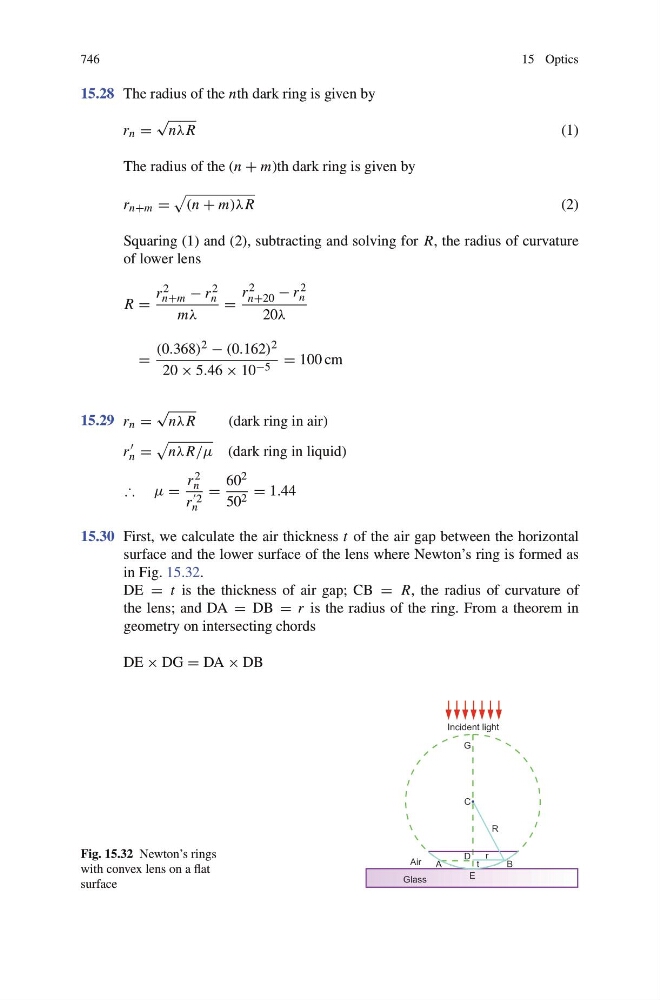
15.30 First, we calculate the air thickness t of the air gap between the horizontal
surface and the lower surface of the lens where Newton’s ring is formed as
in Fig. 15.32.
DE = t is the thickness of air gap; CB = R, the radius of curvature of
the lens; and DA = DB = r is the radius of the ring. From a theorem in
geometry on intersecting chords
DE × DG = DA × DB
Fig. 15.32 Newton’s rings
with convex lens on a flat
surface