

15.3 Solutions
737
15.3.3 Matrix Methods
15.17 Assume that light is always incident from the left, then the refracting surface
is convex if r is positive (from V to C) and concave if r is negative (from V
to C ), Fig. 15.24.
Fig. 15.24 Light is incident
from left. Sign convention for
refraction at a curved optical
surface
The symbols used are object distance x 0 , object size y 0 , image distance x i ,
image size y i and radius of curvature, r . The object–image equation can be
written as
n 1
−x 0
+
n 2
x i
=
n 2 − n 1
r
(1)
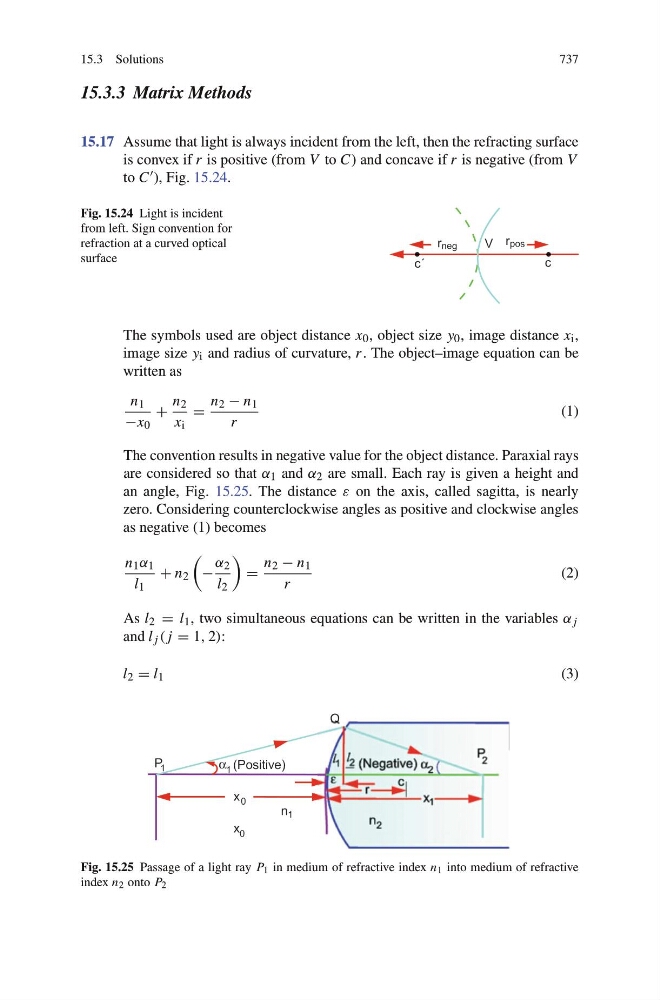
The convention results in negative value for the object distance. Paraxial rays
are considered so that α 1 and α 2 are small. Each ray is given a height and
an angle, Fig. 15.25. The distance ε on the axis, called sagitta, is nearly
zero. Considering counterclockwise angles as positive and clockwise angles
as negative (1) becomes
n 1 α 1
l 1
+ n 2
−
α 2
l 2
=
n 2 − n 1
r
(2)
As l 2 = l 1 , two simultaneous equations can be written in the variables α j
and l j ( j = 1, 2):
l 2 = l 1
(3)
Fig. 15.25 Passage of a light ray P 1 in medium of refractive index n 1 into medium of refractive
index n 2 onto P 2