

15.3 Solutions
731
15.9
1
u
+
1
v
=
1
f
where u, the object distance, and v, the image distance, are measured from the
centre of the lens. For real object and image u and v are positive, for virtual
object or image u and v are negative. f is positive for convex lens and negative
for concave lens.
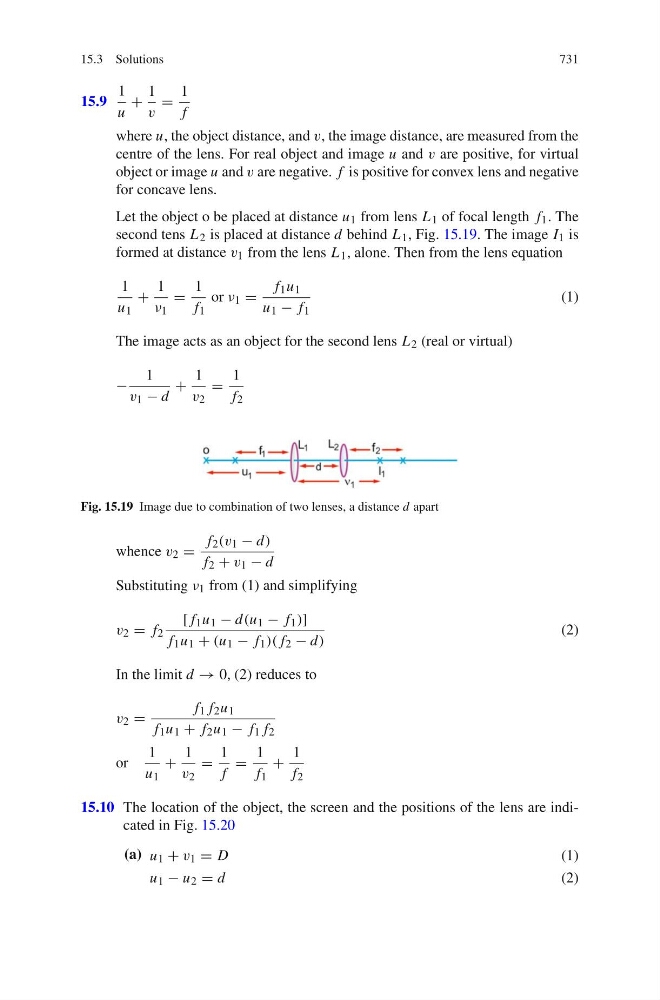
Let the object o be placed at distance u 1 from lens L 1 of focal length f 1 . The
second tens L 2 is placed at distance d behind L 1 , Fig. 15.19. The image I 1 is
formed at distance v 1 from the lens L 1 , alone. Then from the lens equation
1
u 1
+
1
ν 1
=
1
f 1
or ν 1 =
f 1 u 1
u 1 − f 1
(1)
The image acts as an object for the second lens L 2 (real or virtual)
−
1
v 1 − d
+
1
v 2
=
1
f 2
Fig. 15.19 Image due to combination of two lenses, a distance d apart
whence v 2 =
f 2 (v 1 − d)
f 2 + v 1 − d
Substituting ν 1 from (1) and simplifying
v 2 = f 2
[ f 1 u 1 − d(u 1 − f 1 )]
f 1 u 1 + (u 1 − f 1 )( f 2 − d)
(2)
In the limit d → 0, (2) reduces to
v 2 =
f 1 f 2 u 1
f 1 u 1 + f 2 u 1 − f 1 f 2
or
1
u 1
+
1
v 2
=
1
f
=
1
f 1
+
1
f 2
15.10 The location of the object, the screen and the positions of the lens are indicated in Fig. 15.20
(a) u 1 + v 1 = D
(1)
u 1 − u 2 = d
(2)